


Socioeconomic status, white matter, and executive function in children
- PMID: 27781144
- PMCID: PMC5064342
- DOI: 10.1002/brb3.531
Socioeconomic status, white matter, and executive function in children
Abstract
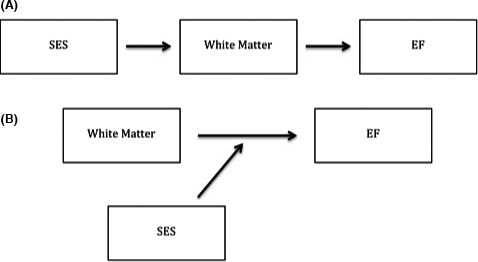
Background: A growing body of evidence links socioeconomic status (SES) to children's brain structure. Few studies, however, have specifically investigated relations of SES to white matter structure. Further, although several studies have demonstrated that family SES is related to development of brain areas that support executive functions (EF), less is known about the role that white matter structure plays in the relation of SES to EF. One possibility is that white matter differences may partially explain SES disparities in EF (i.e., a mediating relationship). Alternatively, SES may differentially shape brain-behavior relations such that the relation of white matter structure to EF may differ as a function of SES (i.e., a moderating relationship).
Method: In a diverse sample of 1082 children and adolescents aged 3-21 years, we examined socioeconomic disparities in white matter macrostructure and microstructure. We further investigated relations between family SES, children's white matter volume and integrity in tracts supporting EF, and performance on EF tasks.
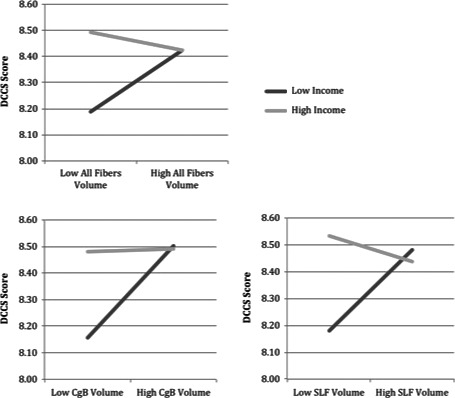
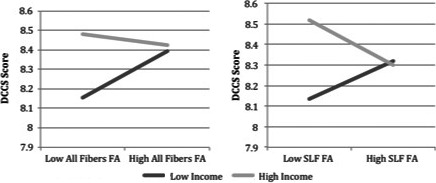
Results: Socioeconomic status was associated with fractional anisotropy (FA) and volume in multiple white matter tracts. Additionally, family income moderated the relation between white matter structure and cognitive flexibility. Specifically, across multiple tracts of interest, lower FA or lower volume was associated with reduced cognitive flexibility among children from lower income families. In contrast, children from higher income families showed preserved cognitive flexibility in the face of low white matter FA or volume. SES factors did not mediate or moderate links between white matter and either working memory or inhibitory control.
Conclusions: This work adds to a growing body of literature suggesting that the socioeconomic contexts in which children develop not only shape cognitive functioning and its underlying neurobiology, but may also shape the relations between brain and behavior.
Keywords: adolescents; children; education; executive function; income; white matter.
Figures
References
-
- Adleman, N. E. , Menon, V. , Blasey, C. M. , White, C. D. , Warsofsky, I. S. , Glover, G. H. , & Reiss, A. L. (2002). A developmental fMRI study of the Stroop color‐word task. NeuroImage, 16, 61–75. - PubMed
-
- Adler, N. E. , & Snibbe, A. C. (2003). The role of psychosocial processes in explaining the gradient between socioeconomic status and health. Current Directions in Psychological Science, 12, 119–123.
-
- Alexander, D. H. , & Lange, K. (2011). Enhancements to the ADMIXTURE algorithm for individual ancestry estimation. BMC Bioinformatics, 12, 246. doi:10.1186/1471‐2105‐12‐246. - DOI - PMC - PubMed
-
- Ashtari, M. , Cottone, J. , Ardekani, B. A. , Cervellione, K. , Szeszko, P. R. , Wu, J. , … Kumra, S. (2007). Disruption of white matter integrity in the inferior longitudinal fasciculus in adolescents with schizophrenia as revealed by fiber tractography. Archives of General Psychiatry, 64, 1270–1280. - PubMed
MeSH terms
Grants and funding
LinkOut - more resources
Full Text Sources
Other Literature Sources
