Lognormal firing rate distribution reveals prominent fluctuation-driven regime in spinal motor networks
- PMID: 27782883
- PMCID: PMC5135395
- DOI: 10.7554/eLife.18805
Lognormal firing rate distribution reveals prominent fluctuation-driven regime in spinal motor networks
Abstract
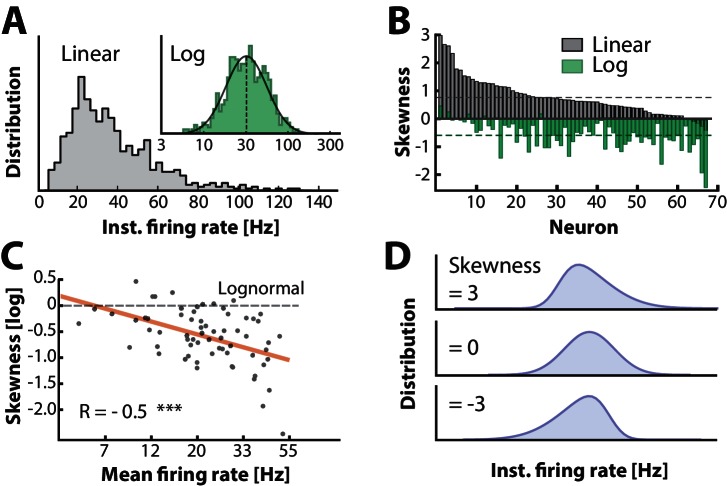
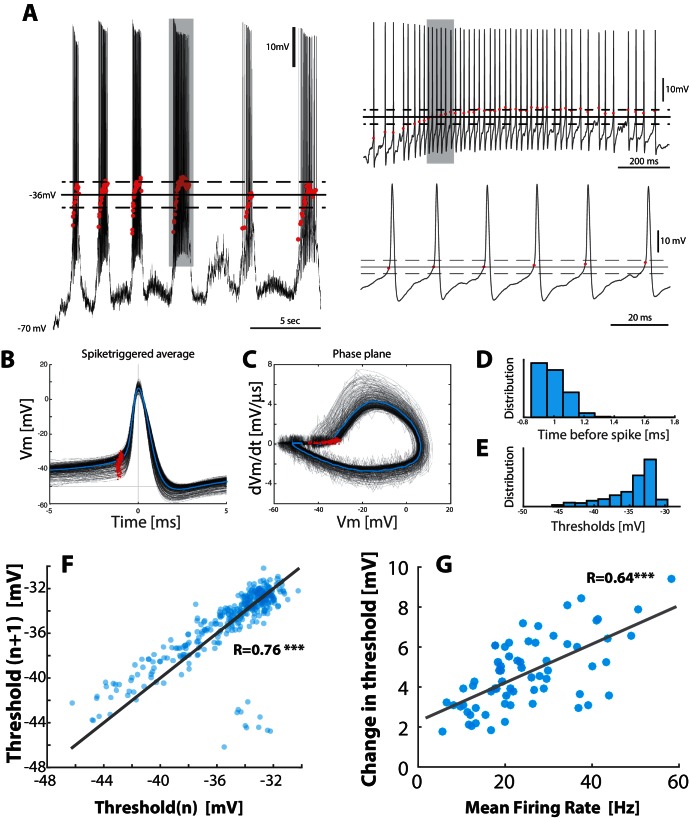
When spinal circuits generate rhythmic movements it is important that the neuronal activity remains within stable bounds to avoid saturation and to preserve responsiveness. Here, we simultaneously record from hundreds of neurons in lumbar spinal circuits of turtles and establish the neuronal fraction that operates within either a 'mean-driven' or a 'fluctuation-driven' regime. Fluctuation-driven neurons have a 'supralinear' input-output curve, which enhances sensitivity, whereas the mean-driven regime reduces sensitivity. We find a rich diversity of firing rates across the neuronal population as reflected in a lognormal distribution and demonstrate that half of the neurons spend at least 50 % of the time in the 'fluctuation-driven' regime regardless of behavior. Because of the disparity in input-output properties for these two regimes, this fraction may reflect a fine trade-off between stability and sensitivity in order to maintain flexibility across behaviors.
Keywords: CPG; lognormal; motor control; network; neuronal ensemble; neuroscience; spinal cord.
Conflict of interest statement
The authors declare that no competing interests exist.
Figures





Comment in
-
The Goldilocks zone in neural circuits.Elife. 2016 Dec 2;5:e22735. doi: 10.7554/eLife.22735. Elife. 2016. PMID: 27911259 Free PMC article.
References
Publication types
MeSH terms
LinkOut - more resources
Full Text Sources
Other Literature Sources