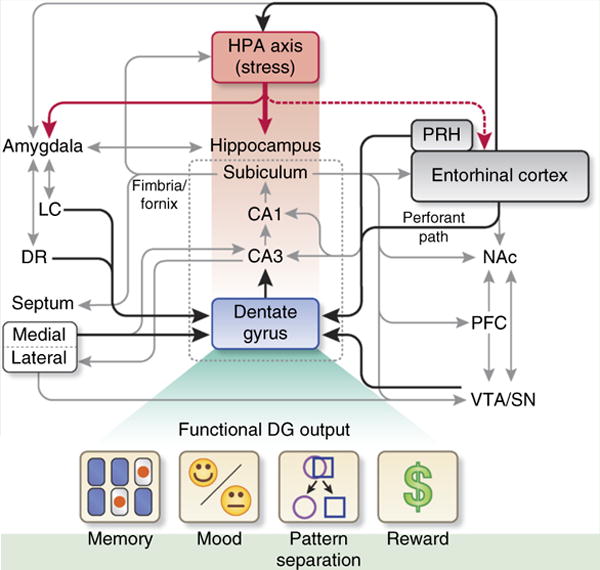
. 2016 Nov;22(11):1239-1247.
doi: 10.1038/nm.4218. Epub 2016 Oct 26.

Re-evaluating the link between neuropsychiatric disorders and dysregulated adult neurogenesis

Affiliations

Re-evaluating the link between neuropsychiatric disorders and dysregulated adult neurogenesis

Sanghee Yun et al. Nat Med. 2016 Nov.

Abstract

People diagnosed with neuropsychiatric disorders such as depression, anxiety, addiction or schizophrenia often have dysregulated memory, mood, pattern separation and/or reward processing. These symptoms are indicative of a disrupted function of the dentate gyrus (DG) subregion of the brain, and they improve with treatment and remission. The dysfunction of the DG is accompanied by structural maladaptations, including dysregulation of adult-generated neurons. An increasing number of studies using modern inducible approaches to manipulate new neurons show that the behavioral symptoms in animal models of neuropsychiatric disorders can be produced or exacerbated by the inhibition of DG neurogenesis. Thus, here we posit that the connection between neuropsychiatric disorders and dysregulated DG neurogenesis is beyond correlation or epiphenomenon, and that the regulation of adult-generated DG neurogenesis merits continued and focused attention in the ongoing effort to develop novel treatments for neuropsychiatric disorders.


Conflict of interest statement

COMPETING FINANCIAL INTERESTS

The authors declare no competing financial interests.

Figures
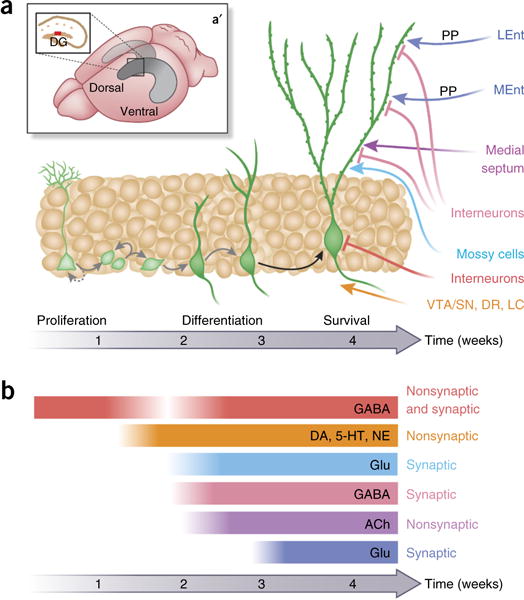
Figure 1
Figure 1
Neurogenesis in the DG and its sensitivity to neurotransmitter systems with relevance to common therapies. (a) In the adult mouse DG (a′ hippocampus in gray, dorsal DG in tan, main schematic in a is expanded view of red bar in the inset), new neurons are generated over time, depicted as green cells maturing through developmental ‘stages’ of proliferation, differentiation and survival, a process that takes ~4 weeks. Mature DG granule neurons (right, green cells) receive diverse input from other DG cells (Mossy Cells, blue; interneurons, red and pink) and other limbic (lateral and medial entorhinal cortex (LEnt, MEnt) in dark blue; medial septum in purple) and midbrain and hindbrain regions (ventral tegmental area/substantia nigra (VTA/SN), dorsal raphe (DR), locus coeruleus (LC) in orange). The main somatic input to new DG granule neurons is from inhibitory interneurons (red flathead lines; for example, DG basket cells). Late-stage differentiation and surviving cells are darker green, whereas proliferating cells are lighter green. (b) As new DG neurons develop, they are regulated by an increasingly diverse set of neurotransmitters. The first input is nonsynaptic (ambient) GABA (red bar) from DG interneurons (red input, a), which eventually transitions to include synaptic GABA as well (white gradient in red bar). The last being synaptic glutamate (bottom dark blue bar, b) from Ent neurons (dark blue arrows (a)). Treatments for neuropsychiatric disorders act on many of the neurotransmitter systems that regulate new neurons (b). Ach, acetylcholine; DA, dopamine; DG, dentate gyrus; DR, dorsal raphe; Ent, entorhinal cortex (LEnt, lateral Ent; MEnt, medial Ent); GABA, gamma-aminobutyric acid; Glu, glutamate; LC, locus coeruleus; NE, norepinephrine/noradrenergic; SN, substantia nigra; VTA, ventral tegmental area.
Figure 2
Figure 2
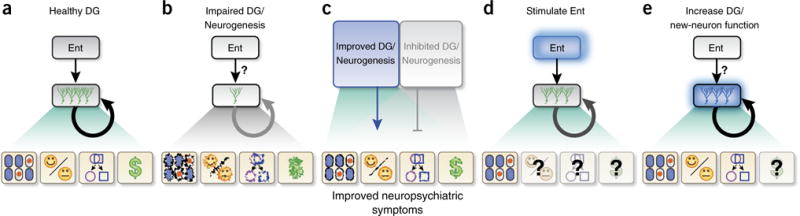
Proven and proposed approaches to targeting new DG neurons to recalibrate DG functional output in neuropsychiatric disorders. (a) In the healthy DG, input from the Ent into the DG drives new neurons and ultimately results in functional DG output, such as memory, mood, pattern separation and reward (green shaded triangle). When DG activity or function is aberrant, as is the case in many neuropsychiatric disorders (b, gray shaded triangle), new neurons are often decreased in number or function, perhaps in part owing to a dysfunctional upstream input from the Ent (indicated by a question mark (?)). (c) We propose that inducible increase in new neuron number, activity or DG activity can improve neuropsychiatric symptoms (blue box, arrow, green shaded triangle), whereas inhibition of new neuron number, activity or DG activity can block such improvement (gray box, flat head line, gray shaded triangle). Thus, targeting new neuron number, activity or DG activity might be a novel treatment for neuropsychiatric disorders. Recalibration of DG functional output is feasible via the stimulation of upstream DG regions (e.g., Ent, d) or increased number of new neurons or increased activity of new neurons or DG (e). For (d), it has already been shown in mice that Ent stimulation (blue box, bold font) enhances neurogenesis and improves learning and memory in both humans and mice (green shaded triangle, d). It remains to be tested whether this upstream stimulation and enhanced new neuron number or activity will affect mood, pattern separation or reward (indicated by question mark (?)). For (e), it has been shown in mice that direct stimulation or induction of adult neurogenesis (blue box) can improve memory, mood and pattern separation, although most of the work in this regard has shown the opposite (e.g., direct inhibition or suppression of adult neurogenesis impairs memory, mood and pattern separation). Although it has not been tested whether direct stimulation or induction of adult neurogenesis can improve reward, the converse has been shown: the suppression of adult neurogenesis enhances vulnerability in animal models of aberrant reward (e.g., addiction). DG, dentate gyrus; Ent, entorhinal cortex.
None

References

    1. Murray CJ, et al. Disability-adjusted life years (DALYs) for 291 diseases and injuries in 21 regions, 1990–2010: a systematic analysis for the Global Burden of Disease Study 2010. Lancet. 2012;380:2197–2223. - PubMed
    1. Bystritsky A. Treatment-resistant anxiety disorders. Mol Psychiatry. 2006;11:805–814. - PubMed
    1. Mouchlianitis E, McCutcheon R, Howes OD. Brain-imaging studies of treatment-resistant schizophrenia: a systematic review. Lancet Psychiatry. 2016;3:451–463. - PMC - PubMed
    1. Culpepper L, et al. Suicidality as a possible side effect of antidepressant treatment. J Clin Psychiatry. 2004;65:742–749. - PubMed
    1. Player MJ, et al. Neuroplasticity in depressed individuals compared with healthy controls. Neuropsychopharmacology. 2013;38:2101–2108. - PMC - PubMed

Publication types