


Microbiological and hydrogeological assessment of groundwater in southern Italy
- PMID: 27783346
- PMCID: PMC5080310
- DOI: 10.1007/s10661-016-5655-y
Microbiological and hydrogeological assessment of groundwater in southern Italy
Abstract
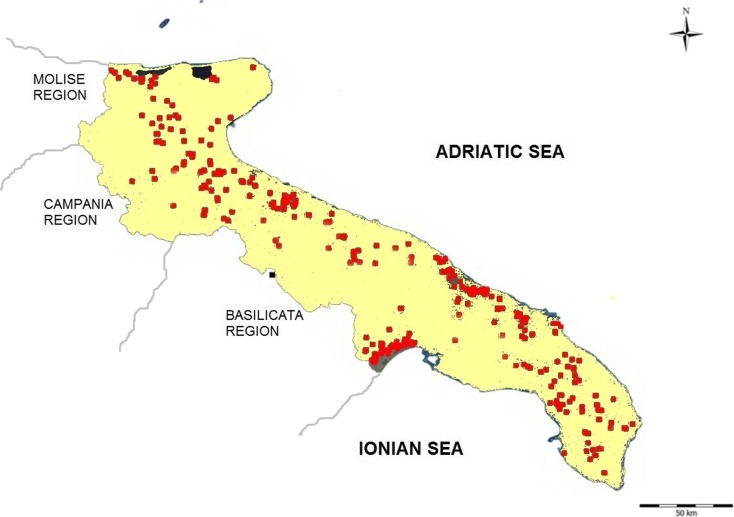
This study represents the first investigation of microbiological groundwater pollution as a function of aquifer type and season for the Apulia region of southern Italy. Two hundred and seven wells were randomly selected from those monitored by the Regional Agency for Environmental Protection for emergency use. Both compulsory (Escherichia coli, Total Coliform, and Enterococci) and optional (Pseudomonas aeruginosa, Salmonella spp., Heterotrophic Plate Count at 37 and 22 °C) microbiological parameters were assessed regularly at these wells. Groundwater from only 18 of the 207 (8.7 %) wells was potable; these all draw from karst-fissured aquifers. The remaining 189 wells draw from karst-fissured (66.1 %) or porous (33.9 %) aquifers. Of these, 82 (43.4 %) tested negative for Salmonella spp. and P. aeruginosa, while 107 (56.6 %) tested positive for P. aeruginosa (75.7 %), Salmonella spp. (10.3 %), or for both Salmonella spp. and P. aeruginosa (14 %). A logistic regression model shows that the probability of potable groundwater depends on both season and aquifer type. Typically, water samples were more likely to be potable in autumn-winter than in spring-summer periods (odds ratio, OR = 2.1; 95 % confidence interval, 95 % CI = 1.6-2.7) and from karst-fissured rather than porous aquifers (OR = 5.8; 95 % CI = 4.4-7.8). Optional parameters only showed a seasonal pattern (OR = 2.6; 95 % CI = 1.7-3.9). Clearly, further investigation of groundwater microbiological aspects should be carried out to identify the risks of fecal contamination and to establish appropriate protection methods, which take into account the hydrogeological and climatic characteristics of this region.
Keywords: Apulia; Drinking water; Fecal contamination; Groundwater; Italy; Microbiological pollution.
Figures

References
-
- Bagordo F, Migoni D, Grassi T, Serio F, Idolo A, Guido M, Zaccarelli N, Fanizzi FP, De Donno A. Using the DPSIR framework to identify factors influencing the quality of groundwater in Grecìa Salentina (Apulia, Italy) Rend Fis Acc Lincei. 2015;8:1–13.
-
- Beer KD, Gargano JW, Roberts VA, Hill VR, Garrison LE, Kutty PK, Hilborn ED, Wade TJ, Fullerton KE, Yoder JS. Surveillance for waterborne disease outbreaks associated with drinking water—United States, 2011–2012. MMWR Morb Mortal Wkly Repn. 2015;64:842–848. doi: 10.15585/mmwr.mm6431a2. - DOI - PMC - PubMed
-
- Berger, P. (2008). Viruses in Ground Water. In Dangerous Pollutants (Xenobiotics) in Urban Water Cycle. Part of the series NATO Science for Peace and Security Series. Hlavinek P et al. (eds), Springer, 131–149
-
- Bitton G, Harvey RW. Transport of pathogens through soil. In: Mitchell R, editor. Environmental microbiology. New York: Wiley-Liss; 1992. pp. 103–124.
MeSH terms
Substances
LinkOut - more resources
Full Text Sources
Other Literature Sources
Medical
Miscellaneous
