


Unconventional oil and gas development and risk of childhood leukemia: Assessing the evidence
- PMID: 27783932
- PMCID: PMC6457992
- DOI: 10.1016/j.scitotenv.2016.10.072
Unconventional oil and gas development and risk of childhood leukemia: Assessing the evidence
Abstract
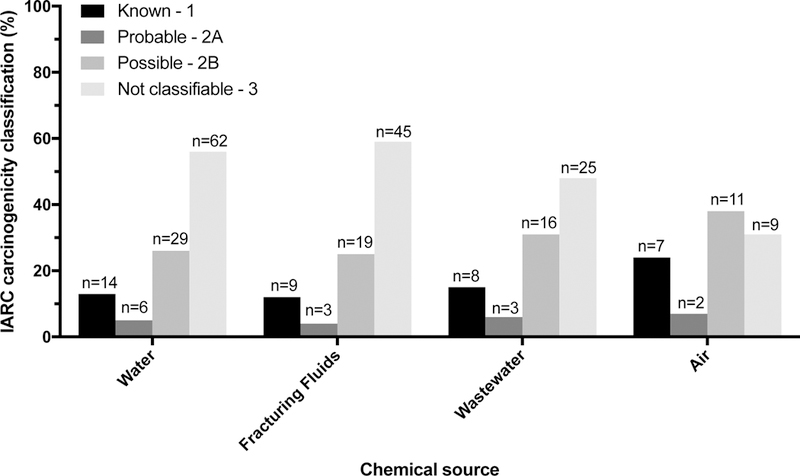
The widespread distribution of unconventional oil and gas (UO&G) wells and other facilities in the United States potentially exposes millions of people to air and water pollutants, including known or suspected carcinogens. Childhood leukemia is a particular concern because of the disease severity, vulnerable population, and short disease latency. A comprehensive review of carcinogens and leukemogens associated with UO&G development is not available and could inform future exposure monitoring studies and human health assessments. The objective of this analysis was to assess the evidence of carcinogenicity of water contaminants and air pollutants related to UO&G development. We obtained a list of 1177 chemicals in hydraulic fracturing fluids and wastewater from the U.S. Environmental Protection Agency and constructed a list of 143 UO&G-related air pollutants through a review of scientific papers published through 2015 using PubMed and ProQuest databases. We assessed carcinogenicity and evidence of increased risk for leukemia/lymphoma of these chemicals using International Agency for Research on Cancer (IARC) monographs. The majority of compounds (>80%) were not evaluated by IARC and therefore could not be reviewed. Of the 111 potential water contaminants and 29 potential air pollutants evaluated by IARC (119 unique compounds), 49 water and 20 air pollutants were known, probable, or possible human carcinogens (55 unique compounds). A total of 17 water and 11 air pollutants (20 unique compounds) had evidence of increased risk for leukemia/lymphoma, including benzene, 1,3-butadiene, cadmium, diesel exhaust, and several polycyclic aromatic hydrocarbons. Though information on the carcinogenicity of compounds associated with UO&G development was limited, our assessment identified 20 known or suspected carcinogens that could be measured in future studies to advance exposure and risk assessments of cancer-causing agents. Our findings support the need for investigation into the relationship between UO&G development and risk of cancer in general and childhood leukemia in particular.
Keywords: Air pollution; Carcinogens; Hydraulic fracturing; Shale; Wastewater; Water contamination.
Copyright © 2016 The Authors. Published by Elsevier B.V. All rights reserved.
Figures
References
-
- Adgate JL, Goldstein BD, McKenzie LM. Potential public health hazards, exposures and health effects from unconventional natural gas development. Environ Sci Technol 2014; 48: 8307–8320. - PubMed
-
- Ahmadi M, John K. Statistical evaluation of the impact of shale gas activities on ozone pollution in North Texas. Sci Total Environ 2015; 536: 457–67. - PubMed
-
- Allen DT. Atmospheric emissions and air quality Impacts from natural gas production and use. Annu Rev Chem Biomol Eng 2014. - PubMed
MeSH terms
Substances
Grants and funding
LinkOut - more resources
Full Text Sources
Other Literature Sources
Medical
