Review
. 2016 Oct 26;8(1):113.
doi: 10.1186/s13073-016-0371-3.

Integrating cancer genomic data into electronic health records

Affiliations
Review

Integrating cancer genomic data into electronic health records

Jeremy L Warner et al. Genome Med. .

Abstract

The rise of genomically targeted therapies and immunotherapy has revolutionized the practice of oncology in the last 10-15 years. At the same time, new technologies and the electronic health record (EHR) in particular have permeated the oncology clinic. Initially designed as billing and clinical documentation systems, EHR systems have not anticipated the complexity and variety of genomic information that needs to be reviewed, interpreted, and acted upon on a daily basis. Improved integration of cancer genomic data with EHR systems will help guide clinician decision making, support secondary uses, and ultimately improve patient care within oncology clinics. Some of the key factors relating to the challenge of integrating cancer genomic data into EHRs include: the bioinformatics pipelines that translate raw genomic data into meaningful, actionable results; the role of human curation in the interpretation of variant calls; and the need for consistent standards with regard to genomic and clinical data. Several emerging paradigms for integration are discussed in this review, including: non-standardized efforts between individual institutions and genomic testing laboratories; "middleware" products that portray genomic information, albeit outside of the clinical workflow; and application programming interfaces that have the potential to work within clinical workflow. The critical need for clinical-genomic knowledge bases, which can be independent or integrated into the aforementioned solutions, is also discussed.


Figures
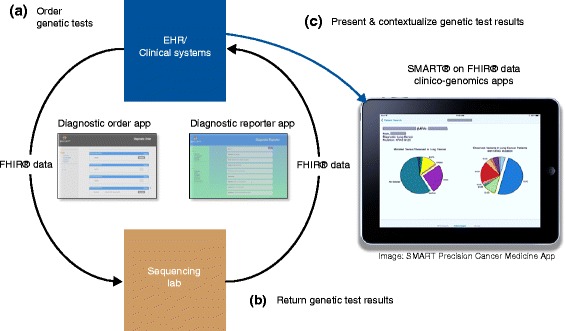
Fig. 1
Fig. 1
FHIR Genomics can be used to enable multiple steps in the genomic testing and interpretation process. The figure shows a hypothetical workflow that a clinician would carry out. a First, any of a number of genetics tests are ordered electronically, and the details are transmitted to an internal or third-party lab, for example a sequencing lab. This step can be accomplished using an app such as the Diagnostic Order App or through native electronic health record (EHR) capabilities. b Second, the lab generates structured test results which are returned to the clinician within their workflow. This step can be accomplished using an app such as the Diagnostic Reporter App or through direct interfaces. c Third, results can be presented and contextualized for the clinician at the point of care through apps that can integrate clinical and genomic data, such as SMART Precision Cancer Medicine. Figure courtesy of David Kreda
Fig. 2
Fig. 2
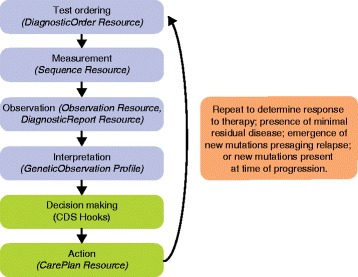
Genomic information in the flow of cancer care. This simplified flow diagram illustrates the process of information gathering and decision making that characterizes the standard model of interventional oncology care. In particular, this model is applicable to the treatment, monitoring, and re-treatment phases of oncology care. In blue are primarily the information gathering steps, and in green are the active decision making and intervention steps. This process is inherently iterative, usually on a pre-planned schedule such as assessment of treatment response after 8 weeks of therapy, or surveillance monitoring on a quarterly basis. Each step of this process can be captured by one or more FHIR Resources/Profiles, which are shown in italics in parentheses. CDS Hooks is a special implementation of FHIR for clinical decision support purposes (see text for details)

References

    1. Stratton MR. Exploring the genomes of cancer cells: progress and promise. Science. 2011;331:1553–8. doi: 10.1126/science.1204040. - DOI - PubMed
    1. Stratton MR, Campbell PJ, Futreal PA. The cancer genome. Nature. 2009;458:719–24. doi: 10.1038/nature07943. - DOI - PMC - PubMed
    1. Garraway LA, Lander ES. Lessons from the cancer genome. Cell. 2013;153:17–37. doi: 10.1016/j.cell.2013.03.002. - DOI - PubMed
    1. Van Allen EM, Wagle N, Levy MA. Clinical analysis and interpretation of cancer genome data. J Clin Oncol. 2013;31:1825–33. doi: 10.1200/JCO.2013.48.7215. - DOI - PMC - PubMed
    1. Weed LL. Medical records that guide and teach. N Engl J Med. 1968;278:593–600. doi: 10.1056/NEJM196803142781105. - DOI - PubMed

Publication types

MeSH terms