Trivalent inactivated influenza vaccine effective against influenza A(H3N2) variant viruses in children during the 2014/15 season, Japan
- PMID: 27784529
- PMCID: PMC5291153
- DOI: 10.2807/1560-7917.ES.2016.21.42.30377
Trivalent inactivated influenza vaccine effective against influenza A(H3N2) variant viruses in children during the 2014/15 season, Japan
Abstract
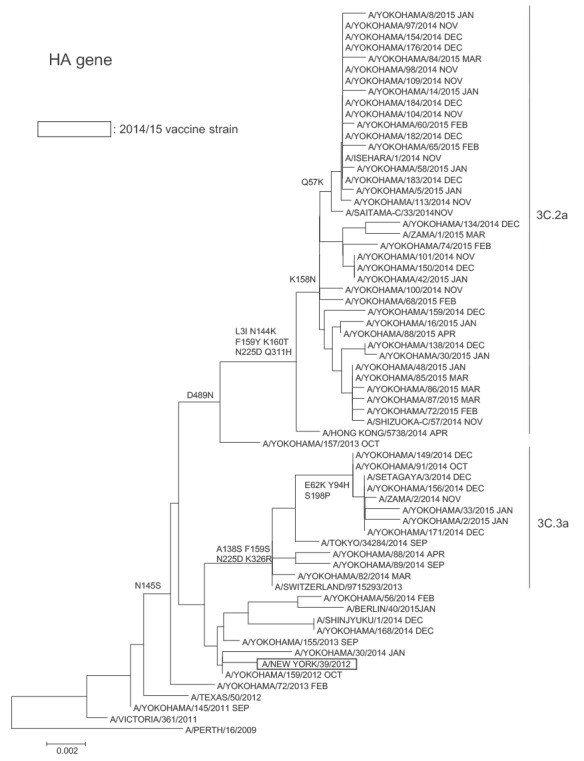
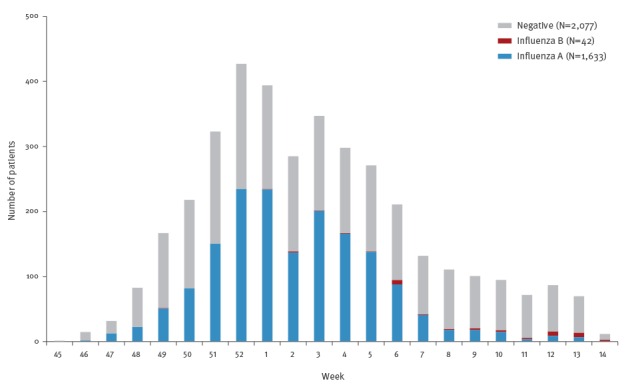
The 2014/15 influenza season in Japan was characterised by predominant influenza A(H3N2) activity; 99% of influenza A viruses detected were A(H3N2). Subclade 3C.2a viruses were the major epidemic A(H3N2) viruses, and were genetically distinct from A/New York/39/2012(H3N2) of 2014/15 vaccine strain in Japan, which was classified as clade 3C.1. We assessed vaccine effectiveness (VE) of inactivated influenza vaccine (IIV) in children aged 6 months to 15 years by test-negative case-control design based on influenza rapid diagnostic test. Between November 2014 and March 2015, a total of 3,752 children were enrolled: 1,633 tested positive for influenza A and 42 for influenza B, and 2,077 tested negative. Adjusted VE was 38% (95% confidence intervals (CI): 28 to 46) against influenza virus infection overall, 37% (95% CI: 27 to 45) against influenza A, and 47% (95% CI: -2 to 73) against influenza B. However, IIV was not statistically significantly effective against influenza A in infants aged 6 to 11 months or adolescents aged 13 to 15 years. VE in preventing hospitalisation for influenza A infection was 55% (95% CI: 42 to 64). Trivalent IIV that included A/New York/39/2012(H3N2) was effective against drifted influenza A(H3N2) virus, although vaccine mismatch resulted in low VE.
Keywords: Influenza; Influenza Virus; Laboratory surveillance; vaccine and immunization; vaccine effectiveness.
This article is copyright of The Authors, 2016.
Conflict of interest statement
NS has received speakers' honoraria from Astellas, Daiichi Sankyo, Denka Seiken and Takeda, none of which was in connection with the work presented here. MS has received speakers’ honoraria from Astellas, Daiichi Sankyo, Japan Vaccine and MSD; and grant support from Japan Vaccine, none of which was in connection with the work presented here. KM has received speakers’ honoraria from Japan Vaccine and MSD, none of which was in connection with the work presented here. For other authors, none declared.
Figures
References
-
- Eisenberg KW, Szilagyi PG, Fairbrother G, Griffin MR, Staat M, Shone LP, et al. New Vaccine Surveillance Network . Vaccine effectiveness against laboratory-confirmed influenza in children 6 to 59 months of age during the 2003-2004 and 2004-2005 influenza seasons. Pediatrics. 2008;122(5):911-9. 10.1542/peds.2007-3304 - DOI - PMC - PubMed
-
- Skowronski DM, Chambers C, Sabaiduc S, De Serres G, Dickinson JA, Winter AL, et al. Interim estimates of 2014/15 vaccine effectiveness against influenza A(H3N2) from Canada’s Sentinel Physician Surveillance Network, January 2015. Euro Surveill. 2015;20(4):21022. 10.2807/1560-7917.ES2015.20.4.21022 - DOI - PubMed
MeSH terms
Substances
LinkOut - more resources
Full Text Sources
Other Literature Sources
Medical