. 2016 Dec 1;311(6):R1013-R1021.
doi: 10.1152/ajpregu.00360.2016. Epub 2016 Oct 26.

Central vs. peripheral determinants of sympathetic neural recruitment: insights from static handgrip exercise and postexercise circulatory occlusion

Affiliations

Central vs. peripheral determinants of sympathetic neural recruitment: insights from static handgrip exercise and postexercise circulatory occlusion

Mark B Badrov et al. Am J Physiol Regul Integr Comp Physiol. .

Abstract

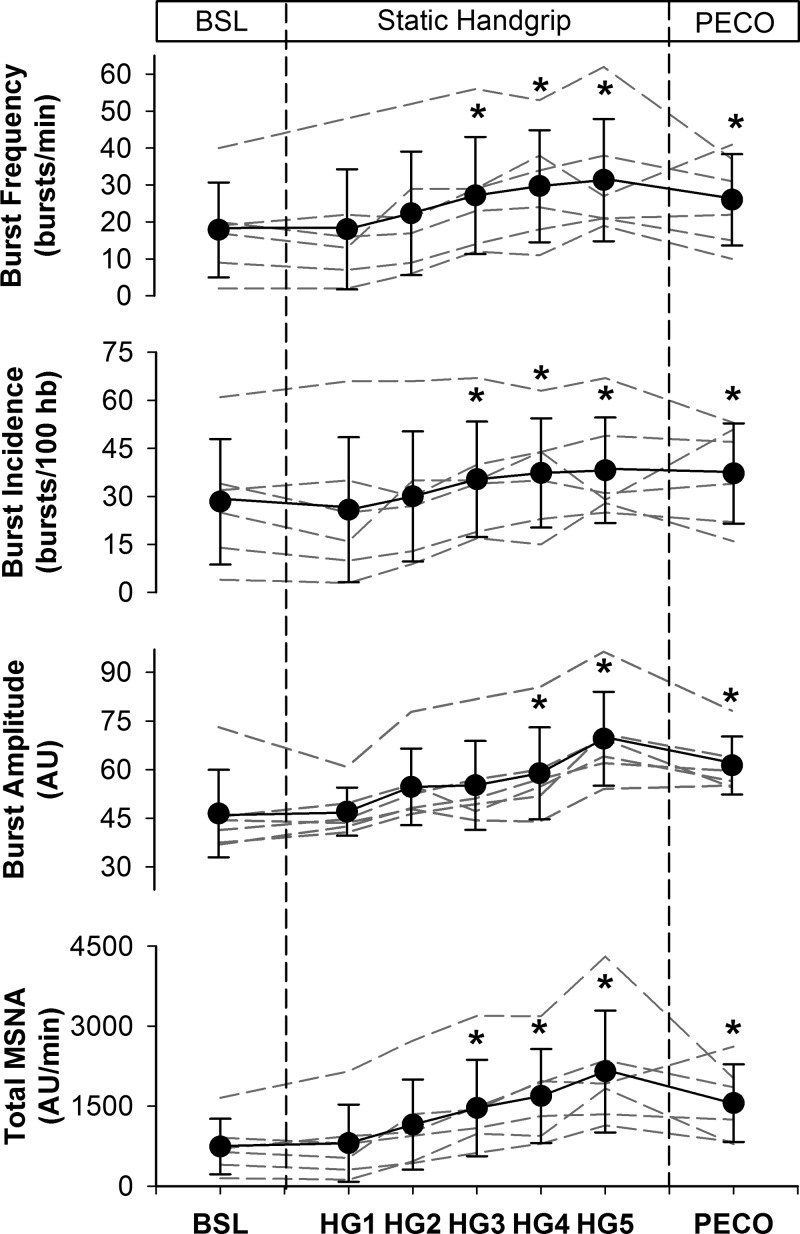
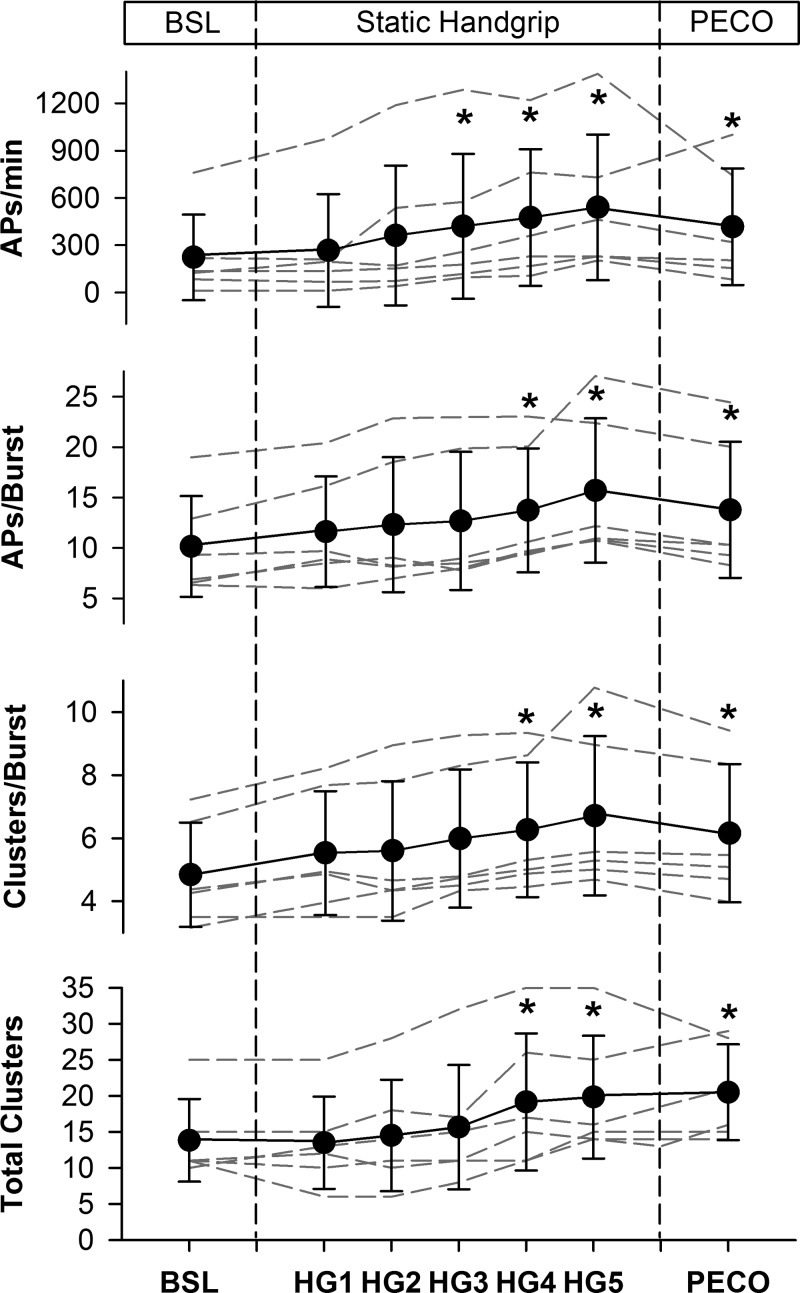
Sympathetic outflow is modified during acute homeostatic stress through increased firing of low-threshold axons, recruitment of latent axons, and synaptic delay modifications. However, the role of central mechanisms versus peripheral reflex control over sympathetic recruitment remains unknown. Here, we examined sympathetic discharge patterns during fatiguing static handgrip (SHG) exercise and postexercise circulatory occlusion (PECO) to study the central vs. peripheral reflex elements of sympathetic neural coding. Muscle sympathetic nerve activity (MSNA; microneurography) was measured in six males (25 ± 3 yr) at baseline (3 min) and during 5 min of SHG exercise completed at 20% maximal voluntary contraction. Isolation of the peripheral metaboreflex component was achieved by PECO for 3 min. Action potential (AP) patterns were studied using wavelet-based methodology. Compared with baseline, total MSNA increased by minute 3 of SHG, remaining elevated throughout the duration of exercise and PECO (all P < 0.05). The AP content per burst increased above baseline by minute 4 of SHG (Δ4 ± 2), remaining elevated at minute 5 (Δ6 ± 4) and PECO (Δ4 ± 4; all P < 0.05). Similarly, total AP clusters increased by minute 4 of SHG (Δ5 ± 5) and remained elevated at minute 5 (Δ6 ± 3) and PECO (Δ7 ± 5; all P < 0.01), indicating recruitment of latent subpopulations. Finally, the AP cluster size-latency profile was shifted downward during minutes 4 (-32 ± 22 ms) and 5 (-49 ± 17 ms; both P < 0.05) of SHG but was not different than baseline during PECO (P > 0.05). Our findings suggest that central perceptual factors play a specific role in the synaptic delay aspect of sympathetic discharge timing, whereas peripheral reflex mechanisms affect recruitment of latent axons.

Keywords: action potential; exercise pressor reflex; metaboreflex; microneurography; sympathetic nerve activity.


Figures

Fig. 1.
Fig. 1.
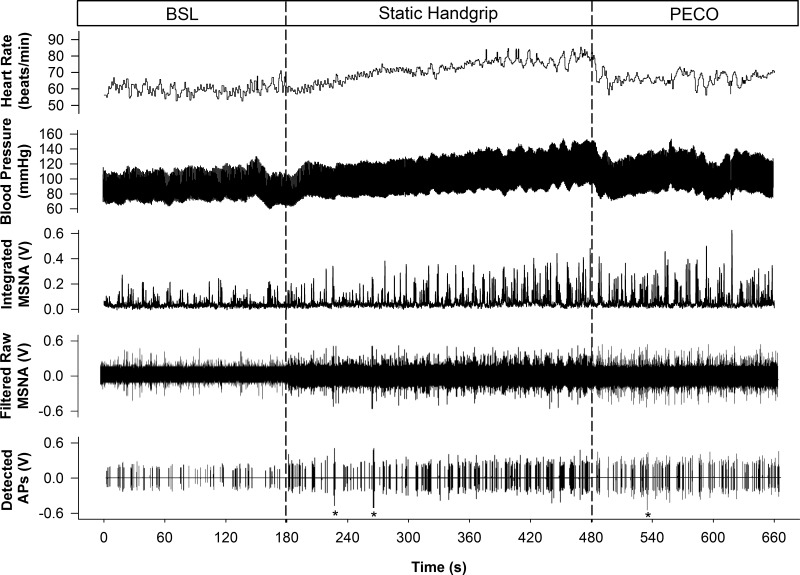
Representative sample of data collected from 1 subject at baseline (BSL) and during static handgrip exercise and postexercise circulatory occlusion (PECO). HR, heart rate; BP, blood pressure; MSNA, muscle sympathetic nerve activity; AP, action potential. *Denotes noise spikes not included in analysis.
Fig. 2.
Fig. 2.
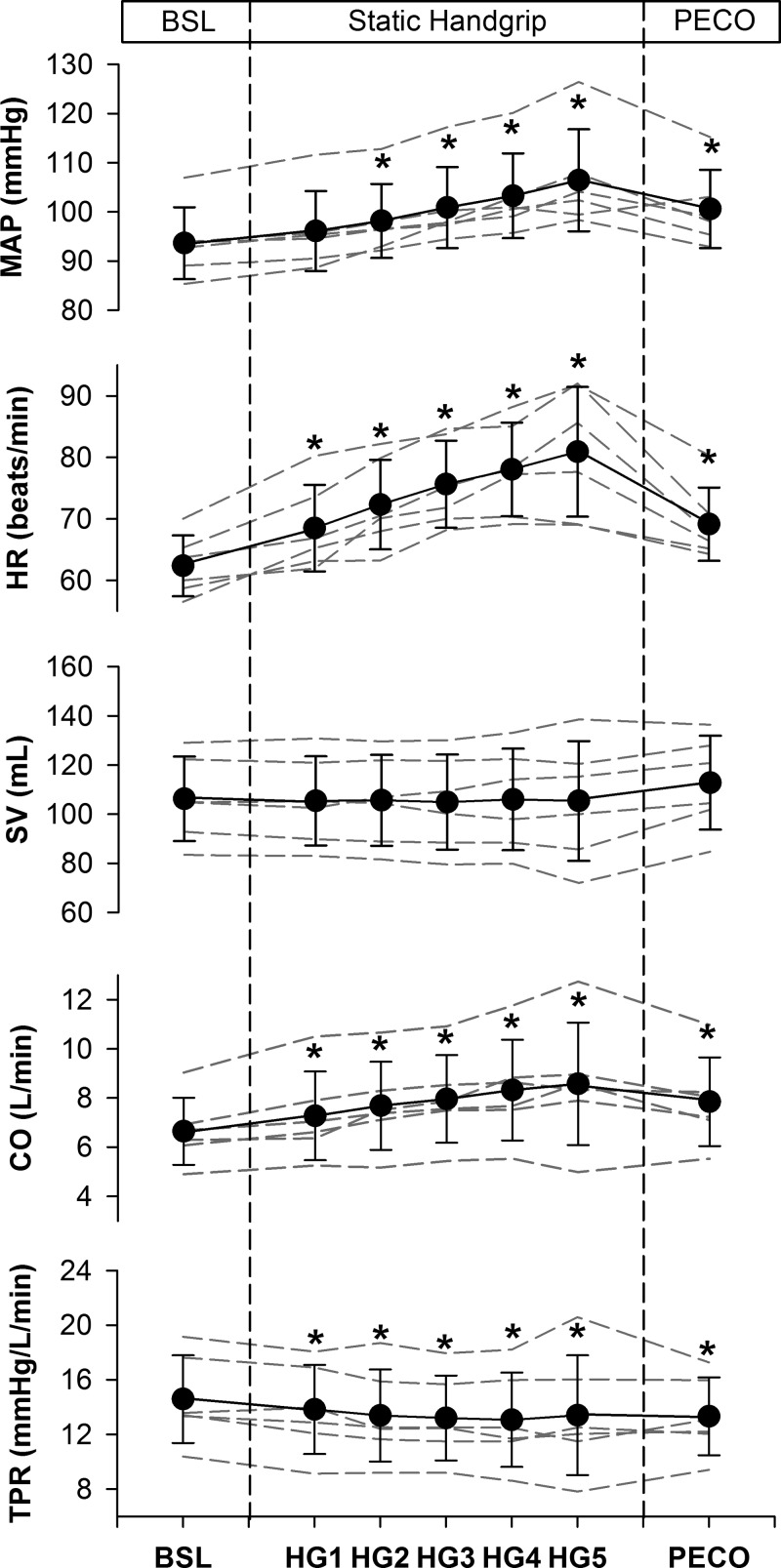
Hemodynamic responses to static handgrip (HG) exercise and postexercise circulatory occlusion (PECO). Dashed lines represent individual data. Values are means ± SD. MAP, mean arterial pressure; HR, heart rate; SV, stroke volume; CO, cardiac output; TPR, total peripheral resistance. *P < 0.05, significantly different from baseline (BSL).
Fig. 3.
Fig. 3.
Integrated muscle sympathetic nerve activity (MSNA) responses to static handgrip (HG) exercise and postexercise circulatory occlusion (PECO). Dashed lines represent individual data. Values are means ± SD. AU, arbitrary units; hb, heartbeats. *P < 0.05, significantly different from baseline (BSL).
Fig. 4.
Fig. 4.
Sympathetic action potential (AP) responses to static handgrip (HG) exercise and postexercise circulatory occlusion (PECO). Dashed lines represent individual data. Values are means ± SD. *P < 0.05, significantly different from baseline (BSL).
Fig. 5.
Fig. 5.
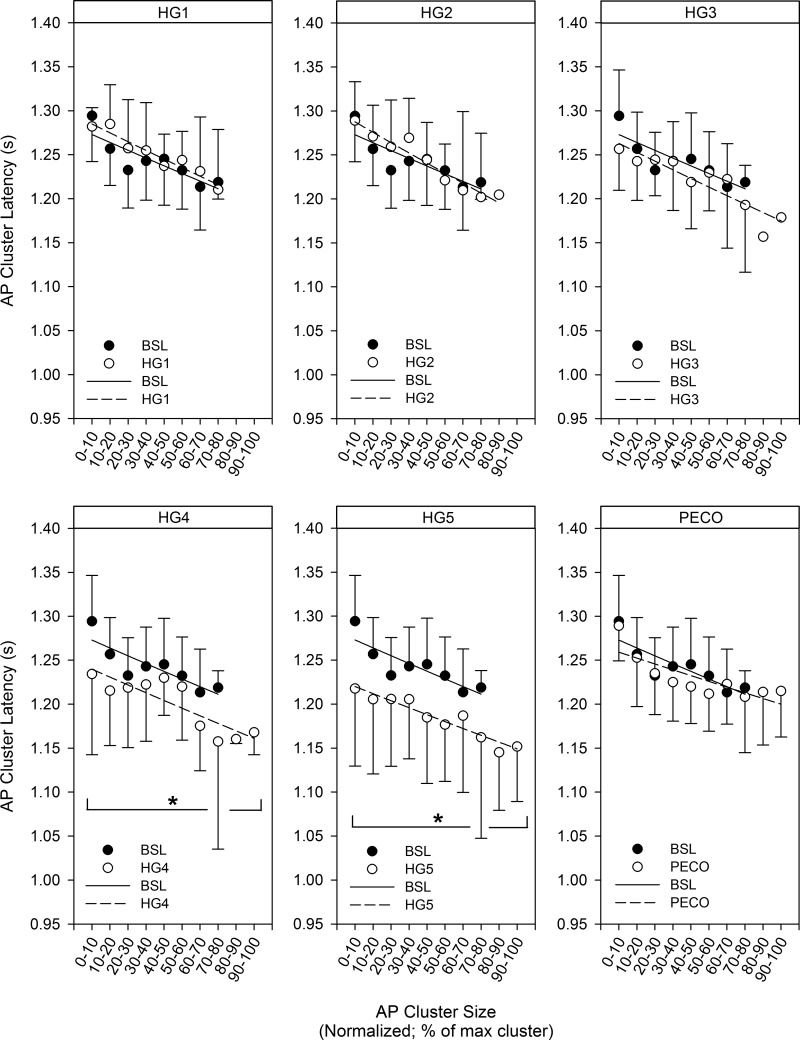
Action potential (AP) cluster latency as a function of AP cluster size at baseline (BSL), minutes 1-5 of static handgrip (HG), and postexercise circulatory occlusion (PECO). No significant upward or downward shift was seen in the AP cluster size-latency profile during HG1 (range −14 to 36 ms; range represents individual data), HG2 (range −18 to 35 ms), or HG3 (range −53 to 10 ms), whereas a significant downward shift in the profile was observed during HG4 (range 4 to −136 ms) and HG5 (range −9 to −198 ms). Finally, no significant upward or downward shift was seen during PECO (range −28 to 22 ms). *P < 0.05, significantly different from BSL.

References

    1. Alam M, Smirk FH. Observations in man upon a blood pressure raising reflex arising from the voluntary muscles. J Physiol 89: 372–383, 1937. doi: 10.1113/jphysiol.1937.sp003485. - DOI - PMC - PubMed
    1. Badrov MB, Lalande S, Olver TD, Suskin N, Shoemaker JK. Effects of aging and coronary artery disease on sympathetic neural recruitment strategies during end-inspiratory and end-expiratory apnea. Am J Physiol Heart Circ Physiol 311: H1040–H1050, 2016. doi: 10.1152/ajpheart.00334.2016. - DOI - PubMed
    1. Badrov MB, Usselman CW, Shoemaker JK. Sympathetic neural recruitment strategies: responses to severe chemoreflex and baroreflex stress. Am J Physiol Regul Integr Comp Physiol 309: R160–R168, 2015. doi: 10.1152/ajpregu.00077.2015. - DOI - PMC - PubMed
    1. Basnayake SD, Green AL, Paterson DJ. Mapping the central neurocircuitry that integrates the cardiovascular response to exercise in humans. Exp Physiol 97: 29–38, 2012. doi: 10.1113/expphysiol.2011.060848. - DOI - PubMed
    1. Borg G. Perceived exertion as an indicator of somatic stress. Scand J Rehabil Med 2: 92–98, 1970. - PubMed

Publication types