


Socioeconomic status and COPD among low- and middle-income countries
- PMID: 27785006
- PMCID: PMC5065097
- DOI: 10.2147/COPD.S111145
Socioeconomic status and COPD among low- and middle-income countries
Abstract
Background: Socioeconomic status (SES) is a strong social determinant of health. There remains a limited understanding of the association between SES and COPD prevalence among low- and middle-income countries where the majority of COPD-related morbidity and mortality occurs. We examined the association between SES and COPD prevalence using data collected in Argentina, Bangladesh, Chile, Peru, and Uruguay.
Methods: We compiled lung function, demographic, and SES data from three population-based studies for 11,042 participants aged 35-95 years. We used multivariable alternating logistic regressions to study the association between COPD prevalence and SES indicators adjusted for age, sex, self-reported daily smoking, and biomass fuel smoke exposure. Principal component analysis was performed on monthly household income, household size, and education to create a composite SES index.
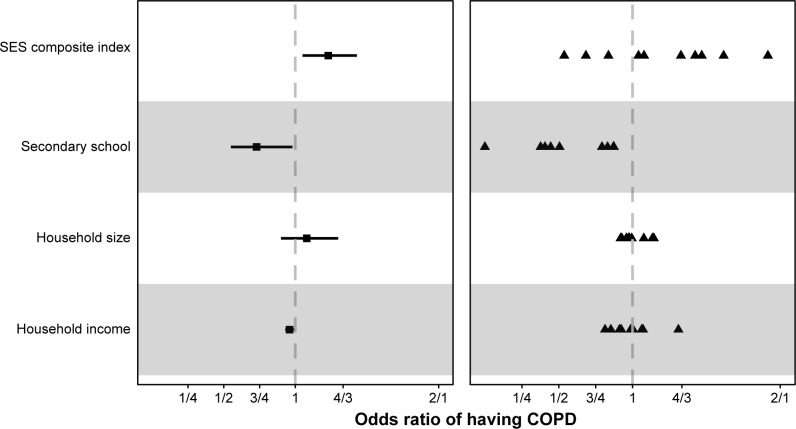
Results: Overall COPD prevalence was 9.2%, ranging from 1.7% to 15.4% across sites. The adjusted odds ratio of having COPD was lower for people who completed secondary school (odds ratio [OR] =0.73, 95% CI 0.55-0.98) and lower with higher monthly household income (OR =0.96 per category, 95% CI 0.93-0.99). When combining SES factors into a composite index, we found that the odds of having COPD was greater with lower SES (interquartile OR =1.23, 95% CI 1.05-1.43) even after controlling for subject-specific factors and environmental exposures.
Conclusion: In this analysis of multiple population-based studies, lower education, lower household income, and lower composite SES index were associated with COPD. Since household income may be underestimated in population studies, adding household size and education into a composite index may provide a better surrogate for SES.
Keywords: COPD; low- and middle-income country; socioeconomic status.
Conflict of interest statement
The authors report no conflicts of interest in this work.
Figures

References
-
- Buist AS, McBurnie MA, Vollmer WM, et al. International variation in the prevalence of COPD (the BOLD Study): a population-based prevalence study. Lancet. 2007;370(9589):741–750. - PubMed
-
- Pauwels RA, Buist AS, Calverley PM, Jenkins CR, Hurd SS, GOLD Scientific Committee Global strategy for the diagnosis, management, and prevention of chronic obstructive pulmonary disease. NHLBI/WHO global initiative for chronic obstructive lung disease (GOLD) workshop summary. Am J Respir Crit Care Med. 2001;163(5):1256–1276. - PubMed
-
- Mannino DM, Buist AS. Global burden of COPD: risk factors, prevalence, and future trends. Lancet. 2007;370(9589):765–773. - PubMed
-
- Menezes AM, Perez-Padilla R, Jardim JR, et al. Chronic obstructive pulmonary disease in five Latin American cities (the PLATINO study): a prevalence study. Lancet. 2005;366(9500):1875–1881. - PubMed
Publication types
MeSH terms
Grants and funding
LinkOut - more resources
Full Text Sources
Other Literature Sources
Medical
