


Assessment of fungal diversity in a water-damaged office building
- PMID: 27786737
- PMCID: PMC6314010
- DOI: 10.1080/15459624.2016.1252044
Assessment of fungal diversity in a water-damaged office building
Abstract
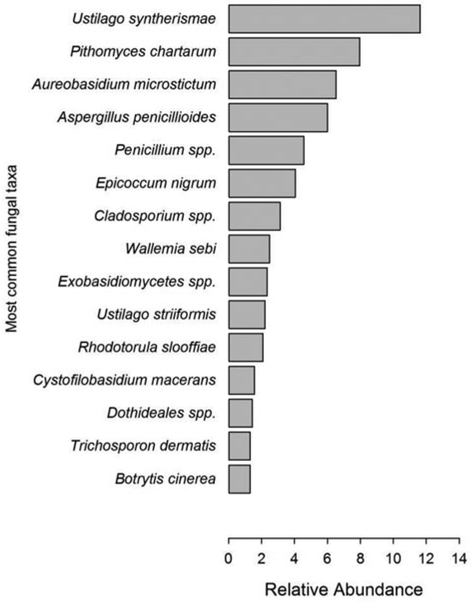
Recent studies have described fungal communities in indoor environments using gene sequencing-based approaches. In this study, dust-borne fungal communities were elucidated from a water-damaged office building located in the northeastern region of the United States using internal transcribed spacer (ITS) rRNA gene sequencing. Genomic DNA was extracted from 5 mg of floor dust derived from 22 samples collected from either the lower floors (n = 8) or a top floor (n = 14) of the office building. ITS gene sequencing resolved a total of 933 ITS sequences and was clustered into 216 fungal operational taxonomic units (OTUs). Analysis of fungal OTUs at the 97% similarity threshold showed a difference between the lower and top floors that was marginally significant (p = 0.049). Species richness and diversity indices were reduced in the lower floor samples compared to the top floor samples and there was a high degree of compositional dissimilarity within and between the two different areas within the building. Fungal OTUs were placed in the phyla Ascomycota (55%), Basidiomycota (41%), Zygomycota (3%), Glomeromycota (0.4%), Chytridiomycota (0.3%), and unassigned fungi (0.5%). The Ascomycota classes with the highest relative abundances included the Dothideomycetes (30%) and Eurotiomycetes (16%). The Basidiomycota consisted of the classes Ustilaginomycetes (14%), Tremellomycetes (11%), and Agaricomycetes (8%). Sequence reads derived from the plant pathogen Ustilago syntherismae were the most abundant in the analysis as were obligate Basidiomycota yeast species that accounted for 12% and 11% of fungal ITS sequences, respectively. ITS gene sequencing provides additional insight into the diversity of fungal OTUs. These data further highlight the contribution of fungi placed in the phylum Basidiomycota, obligate yeasts, as well as xerophilic species that are typically not resolved using traditional culture methods.
Keywords: Exposure assessment; fungus; gene sequencing; occupational; office building.
Conflict of interest statement
The authors declare no conflict of interest.
Figures


References
-
- WHO: WHO Guidelines for Indoor Air Quality: Dampness and Mould. Geneva: WHO Regional Office for Europe, 2009. - PubMed
-
- Institute of Medicine of the National Academies: Damp indoor spaces and health. Washington, DC: The National Academies Press, 2004. - PubMed
-
- Petti CA: Detection and identification of microorganisms by gene amplification and sequencing. Clin. Infect. Dis 44(8):1108–1114 (2007). - PubMed
-
- Scott JA, Summerbell RC, and Green BJ: Detection of indoor fungi bioaerosols In Fundamentals of Mold Growth in Indoor Environments and Strategies for Healthy Living, Adnan O and Samson RA (eds.), pp. 353–373. Amsterdam, The Netherlands: Wageningen Academic Publishers, 2011.
Publication types
MeSH terms
Substances
Grants and funding
LinkOut - more resources
Full Text Sources
Other Literature Sources
Medical