


Review
doi: 10.1016/j.coviro.2016.09.007.
Epub 2016 Oct 24.
Dynamics of West Nile virus evolution in mosquito vectors
Affiliations
- PMID: 27788400
- PMCID: PMC5384794
- DOI: 10.1016/j.coviro.2016.09.007
Item in Clipboard
Review
Dynamics of West Nile virus evolution in mosquito vectors
Curr Opin Virol.
2016 Dec.
Abstract
West Nile virus remains the most common cause of arboviral encephalitis in North America. Since it was introduced, it has undergone adaptive genetic change as it spread throughout the continent. The WNV transmission cycle is relatively tractable in the laboratory. Thus the virus serves as a convenient model system for studying the population biology of mosquito-borne flaviviruses as they undergo transmission to and from mosquitoes and vertebrates. This review summarizes the current knowledge regarding the population dynamics of this virus within mosquito vectors.
Copyright © 2016 Elsevier B.V. All rights reserved.
Figures
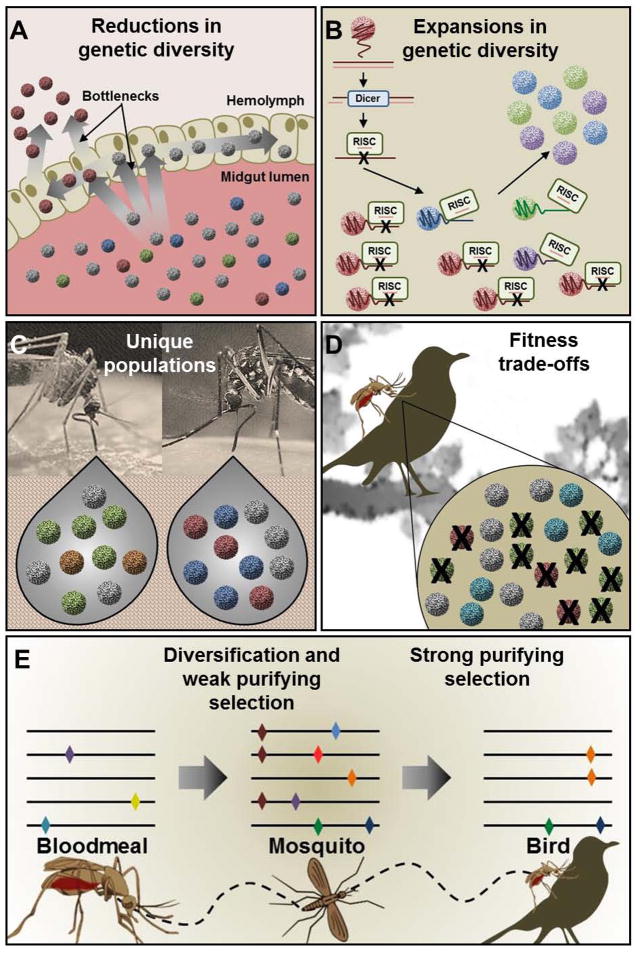
Dynamics of WNV evolution during mosquito transmission. (a) WNV population genetic diversity can be immediately reduced upon midgut infection through bottlenecks, introducing random genetic drift and founder’s effects. These stochastic events occur during each major anatomical barrier to infection: midgut and salivary gland infection and escape. (b) WNV population genetic diversity can be rapidly restored through negative frequency-dependent selection introduced by RNAi. Essentially, common variants are more likely targeted by RNAi-mediated degradation while rare variants with mismatches between the template RNA loaded into RISC are allowed to replicate, increasing population complexity. (c) The influence of repeated random bottlenecks and RNAi-mediated diversification leads to the formation of unique subpopulations in different mosquito tissues and compartments, including what is expectorated in saliva. Furthermore, these processes influenced by the mosquito species, leading to very different WNV populations transmitted between different vectors. (d) The combined effects of bottlenecks, diversifying selection, and weak purifying selection lead to the accumulation many deleterious mutations into a population. In addition, mosquito-adapted variants are often not as fit in birds. Thus, there are fitness trade-offs in birds, which is predicted to remove many of the WNV produced within mosquitoes. (e) Together, the input WNV population taken up by mosquitoes during bloodfeeding drastically diverges and diversifies during mosquito infection, and weak purifying selection allows for many deleterious mutations to persist. During transmission to birds, strong purifying selection removes many of the variants, decreasing WNV population genetic diversity and maintaining fitness.
References
-
- Leparc-Goffart I, Nougairede A, Cassadou S, Prat C, de Lamballerie X. Chikungunya in the Americas. Lancet. 2014;383:514. - PubMed
-
- Ebel GD, Carricaburu J, Young D, Bernard KA, Kramer LD. Genetic and phenotypic variation of West Nile virus in New York, 2000–2003. Am J Trop Med Hyg. 2004;71:493–500. - PubMed
-
- Davis CT, Ebel GD, Lanciotti RS, Brault AC, Guzman H, et al. Phylogenetic analysis of North American West Nile virus isolates, 2001–2004: evidence for the emergence of a dominant genotype. Virology. 2005;342:252–265. - PubMed
Publication types
MeSH terms
Grants and funding
LinkOut - more resources
Full Text Sources
Other Literature Sources
