Editorial
. 2016 Oct 28;14(1):173.
doi: 10.1186/s12916-016-0712-5.

Immuno-psychiatry: an agenda for clinical practice and innovative research

Affiliations
Editorial

Immuno-psychiatry: an agenda for clinical practice and innovative research

Marion Leboyer et al. BMC Med. .

Abstract

Background: The diagnostic scheme for psychiatric disorders is currently based purely on descriptive nomenclature given that biomarkers subtypes and clearly defined causal mechanisms are lacking for the vast majority of disorders. The emerging field of "immuno-psychiatry" has the potential to widen the exploration of a mechanism-based nosology, possibly leading to the discovery of more effective personalised treatment strategies.

Discussion: Disturbances in immuno-inflammatory and related systems have been implicated in the aetiology, pathophysiology, phenomenology and comorbidity of several psychiatric disorders, including major mood disorders and schizophrenia. A fundamental challenge in their clinical management is to identify bio-signatures that might indicate risk, state, trait, prognosis or theragnosis. Here, we provide the rationale for a clinical and research agenda to refine future clinical practice and conceptual views, and to delineate pathways toward innovative treatment discovery.

Conclusion: The development of bio-signatures will allow clinicians to tailor interventions to the abovementioned biomarker subtypes - a major translational goal for research in this field.

Keywords: Biological pathways; Biomarkers; Immune inflammation; Personalised psychiatry; Translational research.


Figures
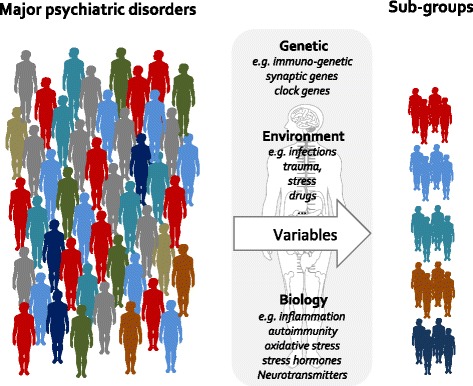
Fig. 1
Fig. 1
Schematic illustration of the putative diversity within a psychiatric patient cohort (e.g. schizophrenic ones) diagnosed with a descriptive, and not mechanistic, nomenclature. The emerging field of immuno-psychiatry has the potential to open up the exploration of mechanism-based nosology and personalised treatment strategies once multiple variables (e.g. genetic, environmental, biological) are integrated to identify patient subgroups
Fig. 2
Fig. 2
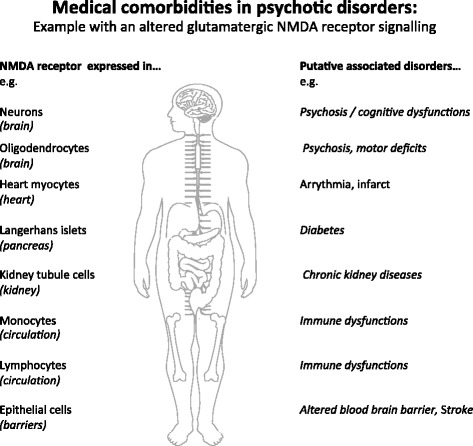
Example of the putative molecular link between medical comorbidities in psychotic disorders. An alteration of the glutamatergic NMDA receptor signalling, proposed to be central in the aetiology of psychotic disorders, may have varying impact in the various organs of these patients

References

    1. Berk M, Nierenberg AA. Three paths to drug discovery in psychiatry. Am J Psychiatry. 2015;172(5):412–414. doi: 10.1176/appi.ajp.2014.14070858. - DOI - PubMed
    1. Berk M, Williams LJ, Jacka FN, O'Neil A, Pasco JA, Moylan S, Allen NB, Stuart AL, Hayley AC, Byrne ML, et al. So depression is an inflammatory disease, but where does the inflammation come from? BMC Med. 2013;11:200. doi: 10.1186/1741-7015-11-200. - DOI - PMC - PubMed
    1. Khandaker GM, Cousins L, Deakin J, Lennox BR, Yolken R, Jones PB. Inflammation and immunity in schizophrenia: implications for pathophysiology and treatment. Lancet Psychiatry. 2015;2(3):258–270. doi: 10.1016/S2215-0366(14)00122-9. - DOI - PMC - PubMed
    1. Modabbernia A, Taslimi S, Brietzke E, Ashrafi M. Cytokine alterations in bipolar disorder: a meta-analysis of 30 studies. Biol Psychiatry. 2013;74(1):15–25. doi: 10.1016/j.biopsych.2013.01.007. - DOI - PubMed
    1. Miller BJ, Buckley P, Seabolt W, Mellor A, Kirkpatrick B. Meta-analysis of cytokine alterations in schizophrenia: clinical status and antipsychotic effects. Biol Psychiatry. 2011;70(7):663–671. doi: 10.1016/j.biopsych.2011.04.013. - DOI - PMC - PubMed

Publication types