


Do empowered stroke patients perform better at self-management and functional recovery after a stroke? A randomized controlled trial
- PMID: 27789938
- PMCID: PMC5072569
- DOI: 10.2147/CIA.S109560
Do empowered stroke patients perform better at self-management and functional recovery after a stroke? A randomized controlled trial
Abstract
Background: Self-management after a stroke is a challenge because of multifaceted care needs and complex disabling consequences that cause further hindrance to patient participation. A 13-week stroke patient empowerment intervention (Health Empowerment Intervention for Stroke Self-management [HEISS]) was developed to enhance patients' ability to participate in self-management.
Purpose: To examine the effects of the empowerment intervention on stroke patients' self-efficacy, self-management behavior, and functional recovery.
Methods: This is a single-blind randomized controlled trial with stroke survivors assigned to either a control group (CG) receiving usual ambulatory rehabilitation care or the HEISS in addition to usual care (intervention group [IG]). Outcome data were collected at baseline (T0), 1 week (T1), 3 months (T2), and 6 months (T3) postintervention. Data were analyzed on the intention-to-treat principle. The generalized estimating equation model was used to assess the differential change of self-efficacy in illness management, self-management behaviors (cognitive symptom management, communication with physician, medication adherence, and self-blood pressure monitoring), and functional recovery (Barthel and Lawton indices) across time points (baseline = T0, 1 week = T1, 3 months = T2, and 6 months = T3 postintervention) between the two groups.
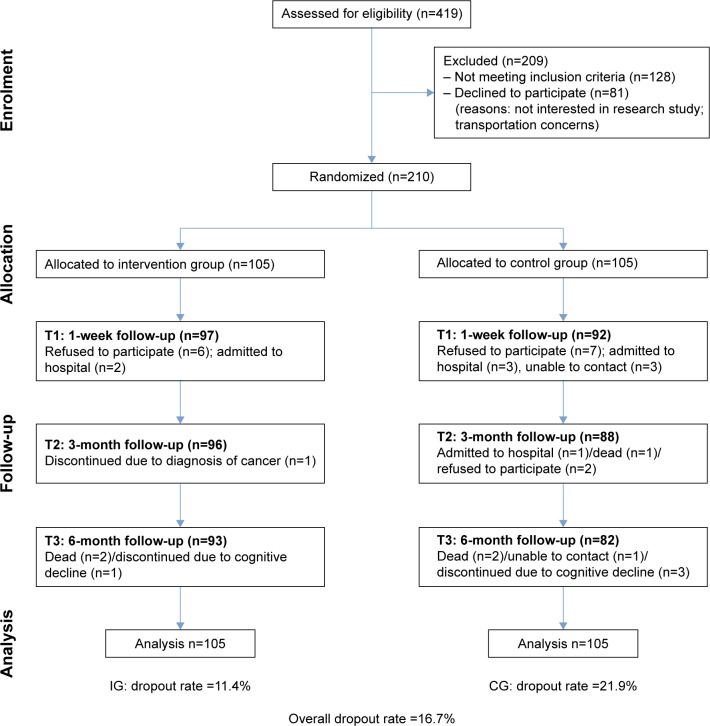
Results: A total of 210 (CG =105, IG =105) Hong Kong Chinese stroke survivors (mean age =69 years, 49% women, 72% ischemic stroke, 89% hemiparesis, and 63% tactile sensory deficit) were enrolled in the study. Those in IG reported better self-efficacy in illness management 3-month (P=0.011) and 6-month (P=0.012) postintervention, along with better self-management behaviors at all follow-up time points (all P<0.05), apart from medication adherence (P>0.05). Those in IG had significantly better functional recovery (Barthel, all P<0.05; Lawton, all P<0.001), compared to CG. The overall dropout rate was 16.7%.
Conclusion: Patient empowerment intervention (HEISS) may influence self-efficacy in illness management and improve self-management behavior and functional recovery of stroke survivors. Furthermore, the HEISS can be conducted in parallel with existing ambulatory stroke rehabilitation services and provide added value in sustaining stroke self-management and functional improvement in the long term.
Keywords: activities of daily living; functional recovery; patient empowerment; rehabilitation; self-management; stroke.
Conflict of interest statement
The authors report no conflicts of interest in this work.
Figures
References
-
- WHO, editor. Global Status Health Report on Non-Communicable Diseases. Vol. 2011. Geneva: WHO; 2010.
-
- Hospital Authority [homepage on the Internet] HA Statistical Report. 2015. [Accessed February 1, 2016]. [updated 2015]. Available from: www.ha.org.hk.
-
- Jones F, Riazi A, Norris M. Self-management after stroke: time for some more questions? Disabil Rehabil. 2013;35(3):257–264. - PubMed
-
- Sit JW, Wong TK, Clinton M, Li LS. Associated factors of post-stroke depression among Hong Kong Chinese: a longitudinal study. Psychol Health Med. 2007;12(2):117–125. - PubMed
-
- Jones F. Strategies to enhance chronic disease self-management: how can we apply this to stroke? Disabil Rehabil. 2006;28(13–14):841–847. - PubMed
Publication types
MeSH terms
LinkOut - more resources
Full Text Sources
Other Literature Sources
Medical
