. 2016 Oct 13:10:443.
doi: 10.3389/fnins.2016.00443. eCollection 2016.

Interference Impacts Working Memory in Mild Cognitive Impairment

Affiliations

Interference Impacts Working Memory in Mild Cognitive Impairment

Sara Aurtenetxe et al. Front Neurosci. .

Abstract

Mild cognitive impairment (MCI) is considered a transitional stage between healthy aging and dementia, specifically Alzheimer's disease (AD). The most common cognitive impairment of MCI includes episodic memory loss and difficulties in working memory (WM). Interference can deplete WM, and an optimal WM performance requires an effective control of attentional resources between the memoranda and the incoming stimuli. Difficulties in handling interference lead to forgetting. However, the interplay between interference and WM in MCI is not well-understood and needs further investigation. The current study investigated the effect of interference during a WM task in 20 MCIs and 20 healthy elder volunteers. Participants performed a delayed match-to-sample paradigm which consisted in two interference conditions, distraction and interruption, and one control condition without any interference. Results evidenced a disproportionate impact of interference on the WM performance of MCIs, mainly in the presence of interruption. These findings demonstrate that interference, and more precisely interruption, is an important proxy for memory-related deficits in MCI. Thus, the current findings reveal novel evidence regarding the causes of WM forgetting in MCI patients, associated with difficulties in the mechanisms of attentional control.

Keywords: aging; behavioral research; interference; mild cognitive impairment; working memory.


Figures
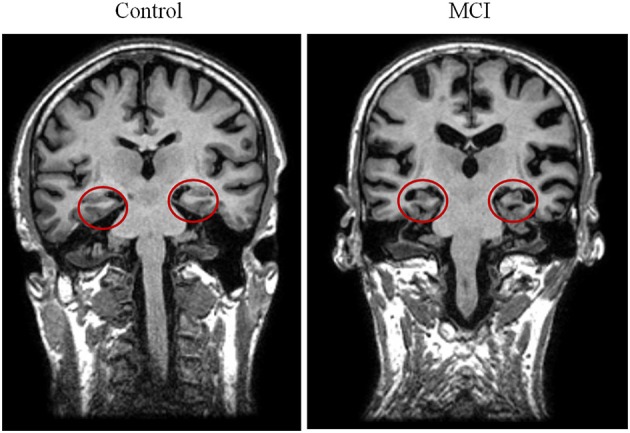
Figure 1
Figure 1
Two illustrative T1 MRI images of one control (left) and one MCI (right) participant. The red circles highlight the hippocampal volumes and evidence atrophy in the group of patients.
Figure 2
Figure 2
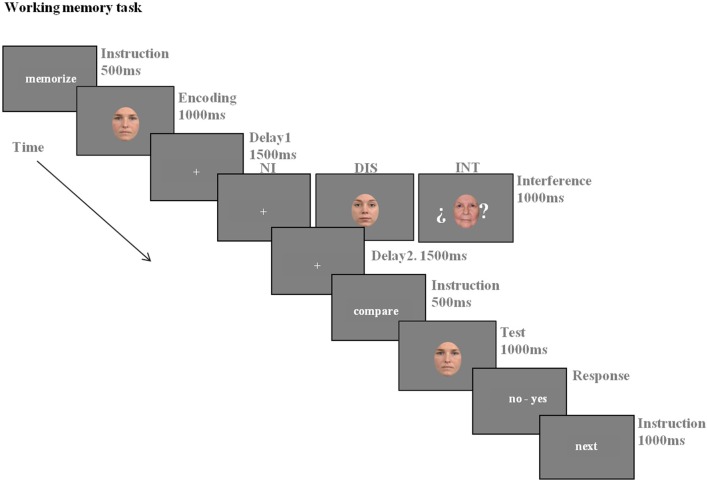
The working memory task consisted of three conditions: Non-Interference (NI), Distraction (DIS), and Interruption (INT). All of the conditions were structured in three main phases: encoding, delay and recognition (See Experimental Paradigm section for details).
Figure 3
Figure 3
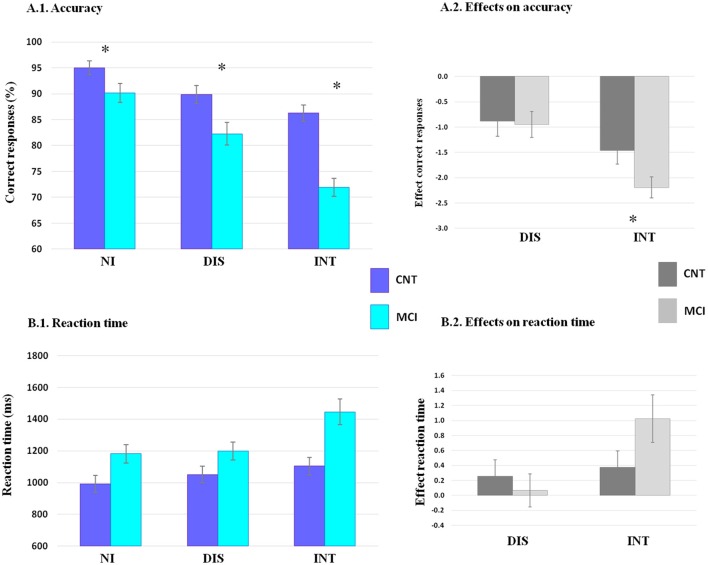
Results for accuracy and reaction time (RT) are shown. The percentage of correct responses (A.1) and RT in milliseconds (B.1) are shown for each condition (non-interference, NI, distraction, DIS, and interruption, INT) in each group (controls, CNT, dark blue, and MCIs in light blue). The effects of interference on accuracy (A.2) and RTs (B.2) are shown for distraction (DIS) and for interruption (INT) in each group (controls, CNT, in dark gray and MCIs in light gray). Error bars denote standard error of the mean. Statistical analysis of the accuracy revealed main effect of diagnosis and condition (p < 0.001), and a condition × group interaction (p < 0.005). The effect of interruption on accuracy was significantly greater in patients than with controls (p < 0.05). Reaction times showed main effect of diagnosis and condition (p < 0.001). *indicates significant difference between groups (p < 0.05).

References

    1. Agrell B., Dehlin O. (1998). The clock-drawing test. Age Ageing 27, 399–403. 10.1093/ageing/27.3.399 - DOI - PubMed
    1. Albert M. S., DeKosky S. T., Dickson D., Dubois B., Feldman H. H., Fox N. C., et al. (2011). The diagnosis of mild cognitive impairment due to Alzheimer's disease: recommendations from the National Institute on Aging-Alzheimer's Association workgroups on diagnostic guidelines for Alzheimer's disease. Alzheimers Dement. 7, 270–279. 10.1016/j.jalz.2011.03.008 - DOI - PMC - PubMed
    1. Albert M. S., Moss M. B., Tanzi R., Jones K. (2001). Preclinical prediction of AD using neuropsychological tests. J. Int. Neuropsychol. Soc. 7, 631–639. 10.1017/S1355617701755105 - DOI - PubMed
    1. Alescio-Lautier B., Michel B. F., Herrera C., Elahmadi A., Chambon C., Touzet C., et al. (2007). Visual and visuospatial shortterm memory in mild cognitive impairment and Alzheimer disease: role of attention. Neuropsychologia 45, 1948–1960. 10.1016/j.neuropsychologia.2006.04.033 - DOI - PubMed
    1. Amieva H., Phillips L. H., Della Sala S., Henry J. D. (2004). Inhibitory functioning in Alzheimer's disease. Brain 127, 949–964. 10.1093/brain/awh045 - DOI - PubMed

LinkOut - more resources