


Hurricane Sandy's flood frequency increasing from year 1800 to 2100
- PMID: 27790992
- PMCID: PMC5087008
- DOI: 10.1073/pnas.1604386113
Hurricane Sandy's flood frequency increasing from year 1800 to 2100
Abstract
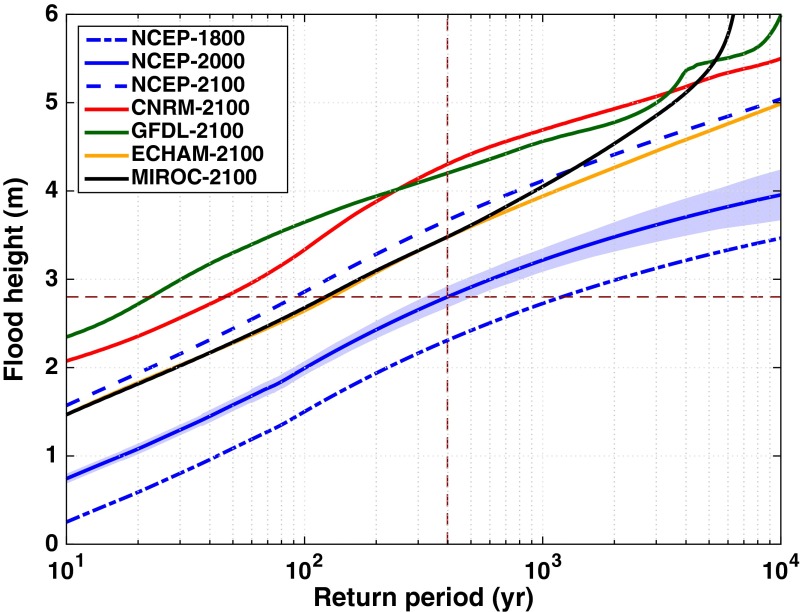
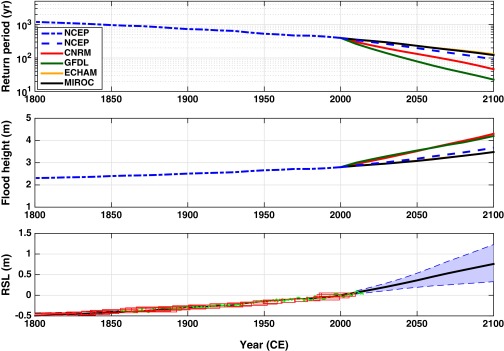
Coastal flood hazard varies in response to changes in storm surge climatology and the sea level. Here we combine probabilistic projections of the sea level and storm surge climatology to estimate the temporal evolution of flood hazard. We find that New York City's flood hazard has increased significantly over the past two centuries and is very likely to increase more sharply over the 21st century. Due to the effect of sea level rise, the return period of Hurricane Sandy's flood height decreased by a factor of ∼3× from year 1800 to 2000 and is estimated to decrease by a further ∼4.4× from 2000 to 2100 under a moderate-emissions pathway. When potential storm climatology change over the 21st century is also accounted for, Sandy's return period is estimated to decrease by ∼3× to 17× from 2000 to 2100.
Keywords: Hurricane Sandy; New York City; climate change; sea level rise; storm surge.
Conflict of interest statement
The authors declare no conflict of interest.
Figures
References
-
- Hall TM, Sobel AH. On the impact angle of Hurricane Sandy’s New Jersey landfall. Geophys Res Lett. 2013;40(10):2312–2315.
-
- Sweet W, Zervas C, Gill S, Park J. Hurricane Sandy inundation probabilities today and tomorrow. Bull Am Meteorol Soc. 2013;94(9):S17–S20.
-
- Lopeman M, Deodatis G, Franco G. Extreme storm surge hazard estimation in lower Manhattan. Nat Hazards. 2015;78(1):1–37.
-
- Nicholls RJ, Cazenave A. Sea-level rise and its impact on coastal zones. Science. 2010;328(5985):1517–1520. - PubMed
Publication types
LinkOut - more resources
Full Text Sources
Other Literature Sources
Miscellaneous
