


Cerebrospinal Fluid Aβ42/40 Corresponds Better than Aβ42 to Amyloid PET in Alzheimer's Disease
- PMID: 27792012
- PMCID: PMC5147502
- DOI: 10.3233/JAD-160722
Cerebrospinal Fluid Aβ42/40 Corresponds Better than Aβ42 to Amyloid PET in Alzheimer's Disease
Abstract
Background: Decreased concentrations of amyloid-β 1-42 (Aβ42) in cerebrospinal fluid (CSF) and increased retention of Aβ tracers in the brain on positron emission tomography (PET) are considered the earliest biomarkers of Alzheimer's disease (AD). However, a proportion of cases show discrepancies between the results of the two biomarker modalities which may reflect inter-individual differences in Aβ metabolism. The CSF Aβ42/40 ratio seems to be a more accurate biomarker of clinical AD than CSF Aβ42 alone.
Objective: We tested whether CSF Aβ42 alone or the Aβ42/40 ratio corresponds better with amyloid PET status and analyzed the distribution of cases with discordant CSF-PET results.
Methods: CSF obtained from a mixed cohort (n = 200) of cognitively normal and abnormal research participants who had undergone amyloid PET within 12 months (n = 150 PET-negative, n = 50 PET-positive according to a previously published cut-off) was assayed for Aβ42 and Aβ40 using two recently developed immunoassays. Optimal CSF cut-offs for amyloid positivity were calculated, and concordance was tested by comparison of the areas under receiver operating characteristic (ROC) curves (AUC) and McNemar's test for paired proportions.
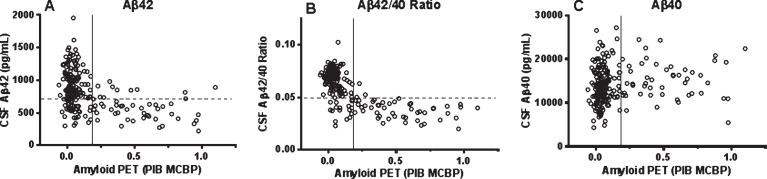
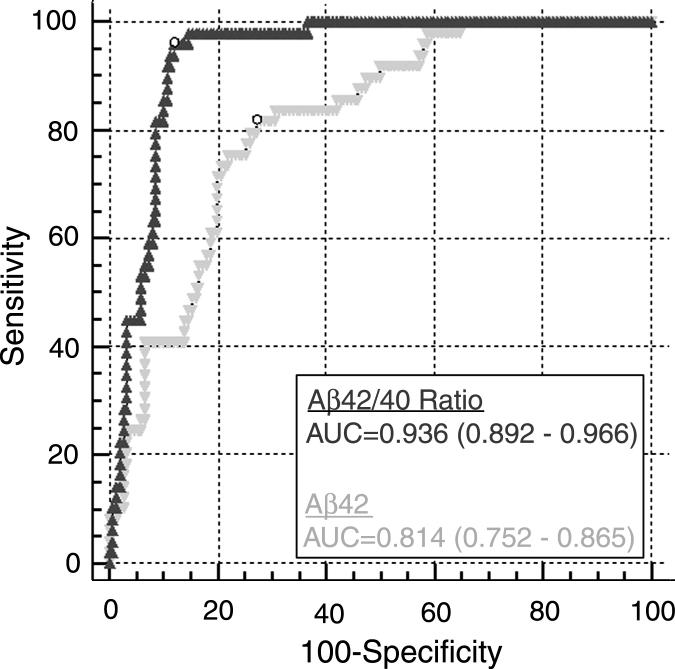
Results: CSF Aβ42/40 corresponded better than Aβ42 with PET results, with a larger proportion of concordant cases (89.4% versus 74.9%, respectively, p < 0.0001) and a larger AUC (0.936 versus 0.814, respectively, p < 0.0001) associated with the ratio. For both CSF biomarkers, the percentage of CSF-abnormal/PET-normal cases was larger than that of CSF-normal/PET-abnormal cases.
Conclusion: The CSF Aβ42/40 ratio is superior to Aβ42 alone as a marker of amyloid-positivity by PET. We hypothesize that this increase in performance reflects the ratio compensating for general between-individual variations in CSF total Aβ.
Keywords: Alzheimer’s disease; amyloid-β; biomarker; cerebrospinal fluid; positron emission tomography.
Figures
References
-
- Fagan AM, Mintun MA, Mach RH, Lee SY, Dence CS, Shah AR, LaRossa GN, Spinner ML, Klunk WE, Mathis CA, DeKosky ST, Morris JC, Holtzman DM (2006) Inverse relation between in vivo amyloid imaging load and cerebrospinal fluid Abeta42 in humans. Ann Neurol 59, 512–519. - PubMed
-
- Forsberg A, Engler H, Almkvist O, Blomquist G, Hagman G, Wall A, Ringheim A, Langstrom B, Nordberg A (2008) PET imaging of amyloid deposition in patients with mild cognitive impairment. Neurobiol Aging 29, 1456–1465. - PubMed
-
- Tolboom N, van der Flier WM, Yaqub M, Boellaard R, Verwey NA, Blankenstein MA, Windhorst AD, Scheltens P, Lammertsma AA, van Berckel BN (2009) Relationship of cerebrospinal fluid markers to 11C-PiB and 18F-FDDNP binding. J Nucl Med 50, 1464–1470. - PubMed
Publication types
MeSH terms
Substances
Grants and funding
LinkOut - more resources
Full Text Sources
Other Literature Sources
Medical
