


Genotyping-by-sequencing provides the discriminating power to investigate the subspecies of Daucus carota (Apiaceae)
- PMID: 27793080
- PMCID: PMC5084430
- DOI: 10.1186/s12862-016-0806-x
Genotyping-by-sequencing provides the discriminating power to investigate the subspecies of Daucus carota (Apiaceae)
Abstract
Background: The majority of the subspecies of Daucus carota have not yet been discriminated clearly by various molecular or morphological methods and hence their phylogeny and classification remains unresolved. Recent studies using 94 nuclear orthologs and morphological characters, and studies employing other molecular approaches were unable to distinguish clearly many of the subspecies. Fertile intercrosses among traditionally recognized subspecies are well documented. We here explore the utility of single nucleotide polymorphisms (SNPs) generated by genotyping-by-sequencing (GBS) to serve as an effective molecular method to discriminate the subspecies of the D. carota complex.
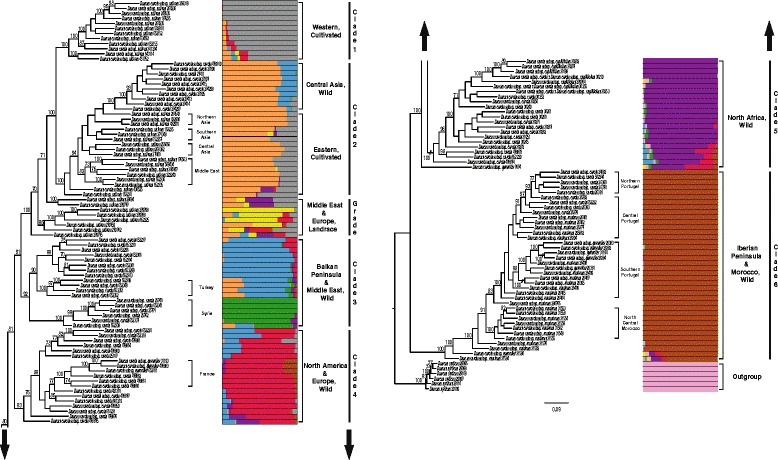
Results: We used GBS to obtain SNPs covering all nine Daucus carota chromosomes from 162 accessions of Daucus and two related genera. To study Daucus phylogeny, we scored a total of 10,814 or 38,920 SNPs with a maximum of 10 or 30 % missing data, respectively. To investigate the subspecies of D. carota, we employed two data sets including 150 accessions: (i) rate of missing data 10 % with a total of 18,565 SNPs, and (ii) rate of missing data 30 %, totaling 43,713 SNPs. Consistent with prior results, the topology of both data sets separated species with 2n = 18 chromosome from all other species. Our results place all cultivated carrots (D. carota subsp. sativus) in a single clade. The wild members of D. carota from central Asia were on a clade with eastern members of subsp. sativus. The other subspecies of D. carota were in four clades associated with geographic groups: (1) the Balkan Peninsula and the Middle East, (2) North America and Europe, (3) North Africa exclusive of Morocco, and (4) the Iberian Peninsula and Morocco. Daucus carota subsp. maximus was discriminated, but neither it, nor subsp. gummifer (defined in a broad sense) are monophyletic.
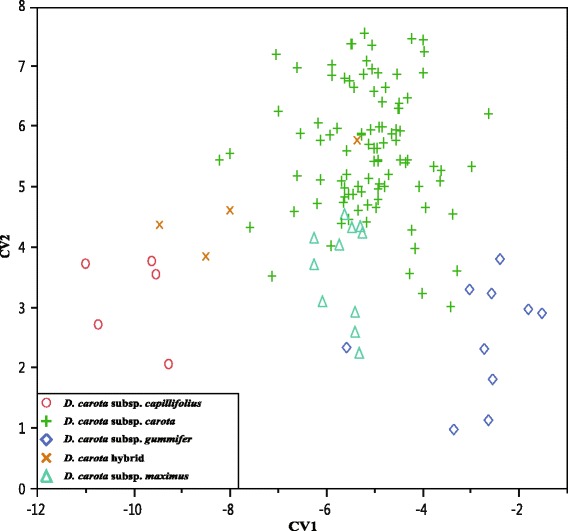
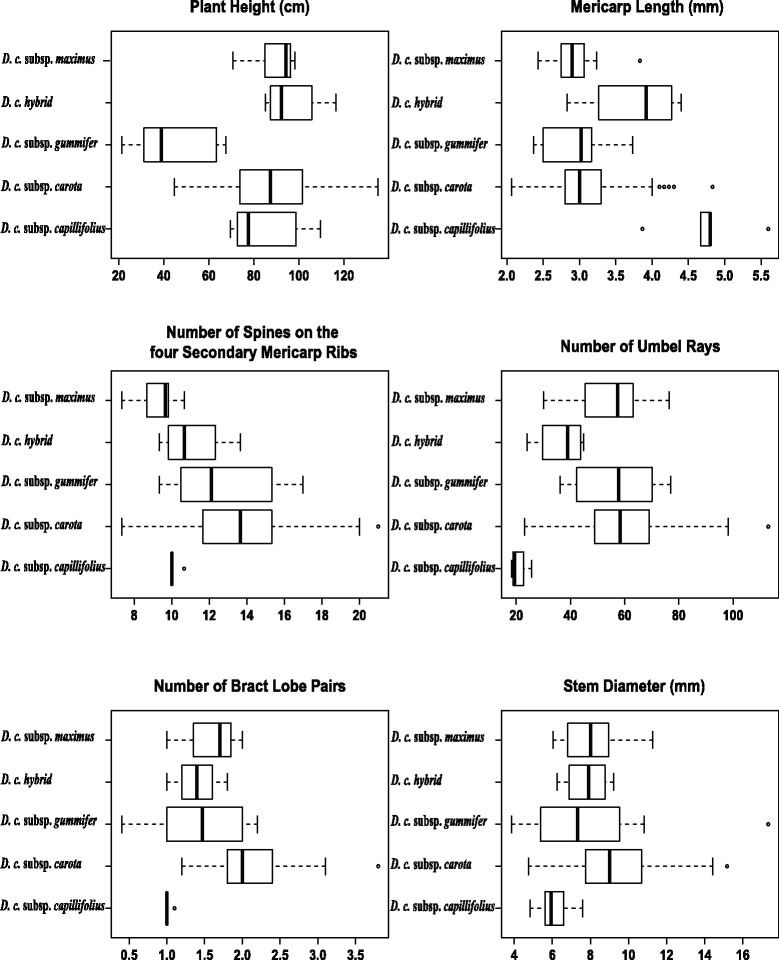
Conclusions: Our study suggests that (1) the morphotypes identified as D. carota subspecies gummifer (as currently broadly circumscribed), all confined to areas near the Atlantic Ocean and the western Mediterranean Sea, have separate origins from sympatric members of other subspecies of D. carota, (2) D. carota subsp. maximus, on two clades with some accessions of subsp. carota, can be distinguished from each other but only with poor morphological support, (3) D. carota subsp. capillifolius, well distinguished morphologically, is an apospecies relative to North African populations of D. carota subsp. carota, (4) the eastern cultivated carrots have origins closer to wild carrots from central Asia than to western cultivated carrots, and (5) large SNP data sets are suitable for species-level phylogenetic studies in Daucus.
Keywords: Carrot; Daucus carota; Genotyping-by-sequencing (GBS); Phylogeny; Single nucleotide polymorphisms (SNPs).
Figures
References
-
- Sáenz Laín C. Research on Daucus L. (Umbelliferae) An Jard Bot Mad. 1981;37:481–533.
-
- Heywood VH. The Daucus carota-gingidium complex. Flora Europaea Notulae Systematicae. 1968;7:65–68.
-
- Small E. A numerical taxonomic analysis of the Daucus carota complex. Can J Bot. 1978;56:248–276.
-
- Thellung A: Daucus. In: Hegi G, editor. Illustrierte Flora von Mitteleuropa. München: JF Lehmanns Verlag; 1926. p. 1501–26.
-
- Quézel P, Santa S: Daucus. In: Quézel P, Santa S, editors. Nouvelle Flore de L’Algérie et des Régions Désertiques Méridionales. Paris: Éditions du Centre National de la Recherche Scientifique; 1963. p. 659–63.
MeSH terms
Associated data
LinkOut - more resources
Full Text Sources
Other Literature Sources
