


Network analysis of psoriasis reveals biological pathways and roles for coding and long non-coding RNAs
- PMID: 27793094
- PMCID: PMC5084355
- DOI: 10.1186/s12864-016-3188-y
Network analysis of psoriasis reveals biological pathways and roles for coding and long non-coding RNAs
Abstract
Background: Psoriasis is an immune-mediated, inflammatory disorder of the skin characterized by chronic inflammation and hyperproliferation of the epidermis. Differential expression analysis of microarray or RNA-seq data have shown that thousands of coding and non-coding genes are differentially expressed between psoriatic and healthy control skin. However, differential expression analysis may fail to detect perturbations in gene coexpression networks. Sensitive detection of such networks may provide additional insight into important disease-associated pathways. In this study, we applied weighted gene coexpression network analysis (WGCNA) on RNA-seq data from psoriasis patients and healthy controls.
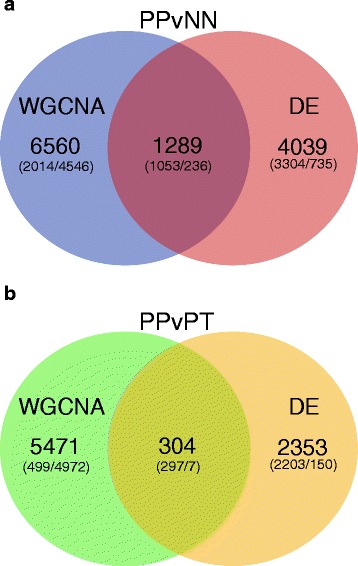
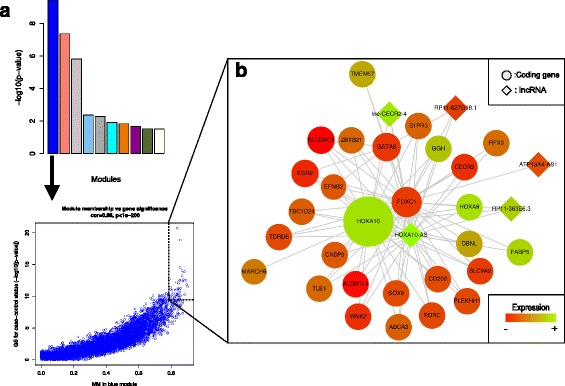
Results: RNA-seq was performed on skin samples from 18 psoriasis patients (pre-treatment and post-treatment with the TNF-α inhibitor adalimumab) and 16 healthy controls, generating an average of 52.3 million 100-bp paired-end reads per sample. Using WGCNA, we identified 3 network modules that were significantly correlated with psoriasis and 6 network modules significantly correlated with biologic treatment, with only 16 % of the psoriasis-associated and 5 % of the treatment-associated coexpressed genes being identified by differential expression analysis. In a majority of these correlated modules, more than 50 % of coexpressed genes were long non-coding RNAs (lncRNA). Enrichment analysis of these correlated modules revealed that short-chain fatty acid metabolism and olfactory signaling are amongst the top pathways enriched for in modules associated with psoriasis, while regulation of leukocyte mediated cytotoxicity and regulation of cell killing are amongst the top pathways enriched for in modules associated with biologic treatment. A putative autoantigen, LL37, was coexpressed in the module most correlated with psoriasis.
Conclusions: This study has identified several networks of coding and non-coding genes associated with psoriasis and biologic drug treatment, including networks enriched for short-chain fatty acid metabolism and olfactory receptor activity, pathways that were not previously identified through differential expression analysis and may be dysregulated in psoriatic skin. As these networks are comprised mostly of non-coding genes, it is likely that non-coding genes play critical roles in the regulation of pathways involved in the pathogenesis of psoriasis.
Keywords: Gene expression; Long non-coding RNA (lncRNA); Psoriasis; RNA-seq; Weighted gene coexpression network analysis (WGCNA).
Figures
References
-
- Zhou X, Krueger JGJG, Kao M-CJMC, Lee E, Du F, Menter A, Wong WHWH, Bowcock AMAM. Novel mechanisms of T-cell and dendritic cell activation revealed by profiling of psoriasis on the 63,100-element oligonucleotide array. Physiol Genomics. 2003;13:69–78. doi: 10.1152/physiolgenomics.00157.2002. - DOI - PubMed
-
- Gudjonsson JE, Ding J, Johnston A, Tejasvi T, Guzman AM, Nair RP, Voorhees JJ, Abecasis GR, Elder JT. Assessment of the psoriatic transcriptome in a large sample: additional regulated genes and comparisons with in vitro models. J Invest Dermatol. 2010;130:1829–1840. doi: 10.1038/jid.2010.36. - DOI - PMC - PubMed
-
- Li B, Tsoi LC, Swindell WR, Gudjonsson JE, Tejasvi T, Johnston A, Ding J, Stuart PE, Xing X, Kochkodan JJ, Voorhees JJ, Kang HM, Nair RP, Abecasis GR, Elder JT. Transcriptome Analysis of Psoriasis in a Large Case–control Sample: RNA-Seq Provides Insights into Disease Mechanisms. J Invest Dermatol. 2014;134:1828–1838. doi: 10.1038/jid.2014.28. - DOI - PMC - PubMed
Publication types
MeSH terms
Substances
Grants and funding
LinkOut - more resources
Full Text Sources
Other Literature Sources
Medical
Molecular Biology Databases
