


Operative treatment of 2-part surgical neck fractures of the proximal humerus (AO 11-A3) in the elderly: Cement augmented locking plate Philos™ vs. proximal humerus nail MultiLoc®
- PMID: 27793135
- PMCID: PMC5084335
- DOI: 10.1186/s12891-016-1302-6
Operative treatment of 2-part surgical neck fractures of the proximal humerus (AO 11-A3) in the elderly: Cement augmented locking plate Philos™ vs. proximal humerus nail MultiLoc®
Abstract
Background: Proximal humeral fractures are with an incidence of 4-5 % the third most common fractures in the elderly. In 20 % of humeral fractures there is an indication for surgical treatment according to the modified Neer-Criteria. A secondary varus dislocation of the head fragment and cutting-out are the most common complications of angle stable locking plates in AO11-A3 fractures of the elderly. One possibility to increase the stability of the screw-bone-interface is the cement augmentation of the screw tips. A second is the use of a multiplanar angle stablentramedullary nail that might provide better biomechanical properties after fixation of 2-part-fractures. A comparison of these two treatment options augmented locking plate versus multiplanar angle stable locking nail in 2-part surgical neck fractures of the proximal humerus has not been carried out up to now.
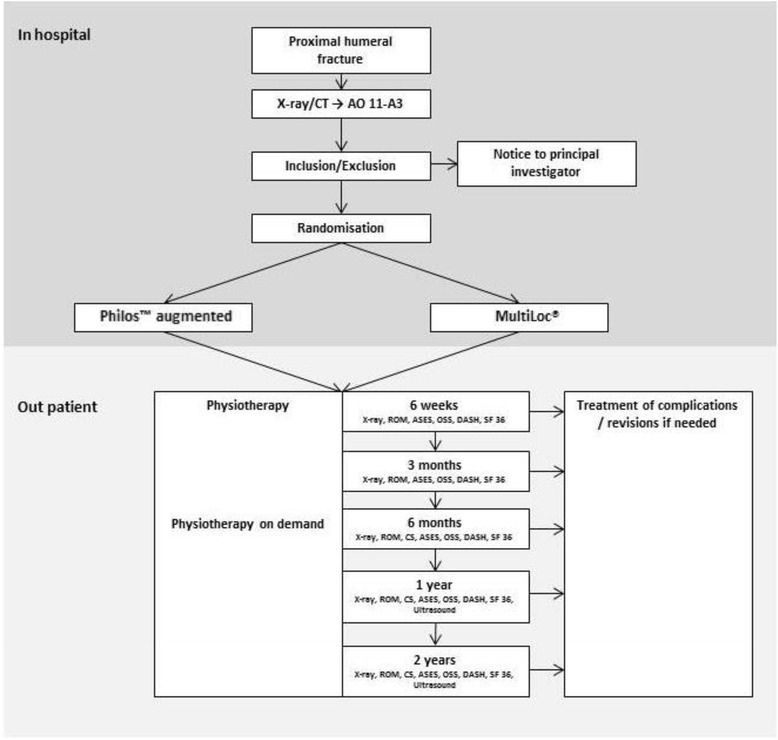
Methods/design: Forty patients (female/male, ≥60 years or female postmenopausal) with a 2-part-fracture of the proximal humerus (AO type 11-A3) will be randomized to either to augmented plate fixation group (PhilosAugment) or to multiplanar intramedullary nail group (MultiLoc). Outcome parameters are Disabilities of the Shoulder, Arm and Hand-Score (DASH) Constant Score (CS), American Shoulder and Elbow Score (ASES), Oxford Shoulder Score (OSS), Range of motion (ROM) and Short Form 36 (SF-36) after 3 weeks, 6 weeks, 3 months, 6 months, 12 and 24 months.
Discussion: Because of the lack of clinical studies that compare cement augmented locking plates with multiplanar humeral nail systems after 2-part surgical neck fractures of the proximal humerus, the decision of surgical method currently depends only on surgeons preference. Because only a randomized clinical trial (RCT) can sufficiently answer the question if one treatment option provides advantages compared to the other method we are planning to perform a RCT.
Trial registration: Clinical Trial ( NCT02609906 ), November 18, 2015, registered retrospectively.
Keywords: Humeral head; Nail; Osteoporosis; Osteosynthesis; Plate.
References
Publication types
MeSH terms
Substances
Associated data
LinkOut - more resources
Full Text Sources
Other Literature Sources
Medical
