


Myocardial function at the early phase of traumatic brain injury: a prospective controlled study
- PMID: 27793208
- PMCID: PMC5084439
- DOI: 10.1186/s13049-016-0323-3
Myocardial function at the early phase of traumatic brain injury: a prospective controlled study
Abstract
Background: The concept of brain-heart interaction has been described in several brain injuries. Traumatic brain injury (TBI) may also lead to cardiac dysfunction but evidences are mainly based upon experimental and clinical retrospective studies.
Methods: We conducted a prospective case-control study in a level I trauma center. Twenty consecutive adult patients with severe TBI were matched according to age and gender with 20 control patients. The control group included adult patients undergoing a general anesthesia for a peripheral trauma surgery. Conventional and Speckle Tracking Echocardiography (STE) was performed within the first 24 post-traumatic hours in the TBI group and PRE/PER-operative in the control group. The primary endpoint was the left ventricle ejection fraction (LVEF) measured by the Simpson's method. Secondary endpoints included the diastolic function and the STE analysis.
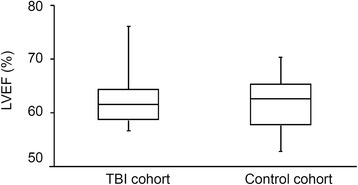
Results: We found similar LVEF between the TBI group and the PER-operative control group (61 % [56-76]) vs. 62 % [52-70]). LV morphological parameters and the systolic function were also similar between the two groups. Regarding the diastolic function, the isovolumic relaxation time was significantly higher in the TBI cohort (125 s [84-178] versus 107 s [83-141], p = 0.04), suggesting a subclinical diastolic dysfunction. Using STE parameters, we observed a trend toward higher strains in the TBI group but only the apical circumferential strain and the basal rotation reached statistical significance. STE-derived parameters of the diastolic function tended to be lower in TBI patients.
Discussion: No systematic myocardial depression was found in a cohort of severe TBI patients.
Conclusions: STE revealed a correct adaptation of the left systolic function, while the diastolic function slightly impaired.
Trial registration: NCT02380482.
Figures
References
-
- Oppenheimer SM, Hachinski VC. The cardiac consequences of stroke. Neurol Clin. 1992;10(1):167–76. - PubMed
Publication types
MeSH terms
Associated data
LinkOut - more resources
Full Text Sources
Other Literature Sources
Medical
Research Materials
