


Review
doi: 10.1016/j.tig.2016.09.006.
Epub 2016 Oct 25.
Update: Mechanisms Underlying N6-Methyladenosine Modification of Eukaryotic mRNA
Affiliations
- PMID: 27793360
- PMCID: PMC5123927
- DOI: 10.1016/j.tig.2016.09.006
Item in Clipboard
Review
Update: Mechanisms Underlying N6-Methyladenosine Modification of Eukaryotic mRNA
Trends Genet.
2016 Dec.
Abstract
Eukaryotic mRNA undergoes chemical modification both at the 5' cap and internally. Among internal modifications, N6-methyladensone (m6A), by far the most abundant, is present in all eukaryotes examined so far, including mammals, flies, plants, and yeast. m6A modification has an essential role in diverse biological processes. Over the past few years, our knowledge relevant to the establishment and function of this modification has grown rapidly. In this review, we focus on technologies that have facilitated m6A detection in mRNAs, the identification of m6A methylation enzymes and binding proteins, and potential functions of the modification at the molecular level.
Copyright © 2016 Elsevier Ltd. All rights reserved.
Figures
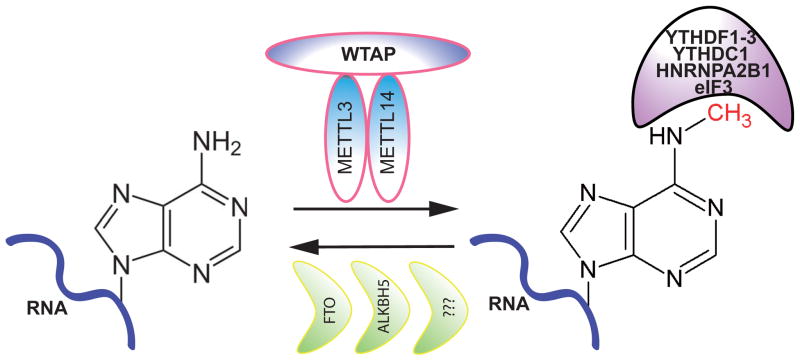
METTL3/METTL14 were identified as core components of an N6-methyladenosine methyltransferase complex. Both form a heterodimer catalyzing m6A formation. WTAP has been identified as a METTL3- and METTL14-interacting protein. The presence of WTAP does not alter METTL3/METTL14 methyltransferase activity in vitro, but WTAP has a critical role in m6A formation in vivo through an unknown mechanism. Other METTL3/METTL14-interacting proteins have been identified, but their activities remain to be determined. Two Alkb family members, FTO and ALKBH5, reportedly serve as m6A demethylases and remove m6A in an oxidative manner, although additional unknown m6A demethylases may also serve this function. Several m6A binding proteins are reported, including multiple YTH family members (YTHDF1–3 and YTHDC1), heterogeneous ribonucleoprotein HNRNPA2B1, and eIF3.
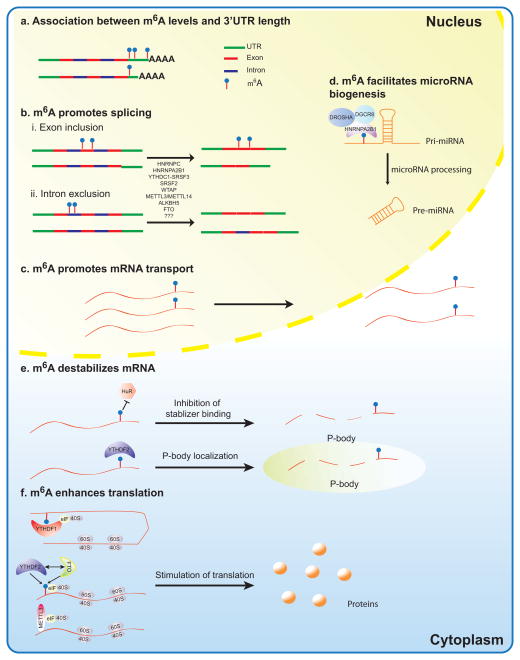
Diverse molecular mechanisms of m6A. (a) Association between m6A levels and 3′UTR length, (b) m6A promotes splicing, (c) m6A promotes mRNA transport, (d) m6A facilitates microRNA biogenesis, (e) m6A destabilizes mRNA, and (f) m6A enhances translation. As indicated, these activities occur in the nucleus, cytoplasm, or both.
References
-
- Wei CM, et al. Methylated nucleotides block 5′ terminus of HeLa cell messenger RNA. Cell. 1975;4(4):379–86. - PubMed
-
- Adams JM, Cory S. Modified nucleosides and bizarre 5′-termini in mouse myeloma mRNA. Nature. 1975;255(5503):28–33. - PubMed
-
- Perry RP, et al. The methylated constituents of L cell messenger RNA: evidence for an unusual cluster at the 5′ terminus. Cell. 1975;4(4):387–94. - PubMed
Publication types
MeSH terms
Substances
Grants and funding
LinkOut - more resources
Full Text Sources
Other Literature Sources
Molecular Biology Databases
Miscellaneous
