. 2016 Dec 15;5(12):1806-1820.
doi: 10.1242/bio.021402.

Strigolactone regulates shoot development through a core signalling pathway

Affiliations

Strigolactone regulates shoot development through a core signalling pathway

Tom Bennett et al. Biol Open. .

Abstract

Strigolactones are a recently identified class of hormone that regulate multiple aspects of plant development. The DWARF14 (D14) α/β fold protein has been identified as a strigolactone receptor, which can act through the SCFMAX2 ubiquitin ligase, but the universality of this mechanism is not clear. Multiple proteins have been suggested as targets for strigolactone signalling, including both direct proteolytic targets of SCFMAX2, and downstream targets. However, the relevance and importance of these proteins to strigolactone signalling in many cases has not been fully established. Here we assess the contribution of these targets to strigolactone signalling in adult shoot developmental responses. We find that all examined strigolactone responses are regulated by SCFMAX2 and D14, and not by other D14-like proteins. We further show that all examined strigolactone responses likely depend on degradation of SMXL proteins in the SMXL6 clade, and not on the other proposed proteolytic targets BES1 or DELLAs. Taken together, our results suggest that in the adult shoot, the dominant mode of strigolactone signalling is D14-initiated, MAX2-mediated degradation of SMXL6-related proteins. We confirm that the BRANCHED1 transcription factor and the PIN-FORMED1 auxin efflux carrier are plausible downstream targets of this pathway in the regulation of shoot branching, and show that BRC1 likely acts in parallel to PIN1.

Keywords: Shoot branching; Signal transduction; Strigolactone.


Conflict of interest statement

The authors declare no competing or financial interests.

Figures
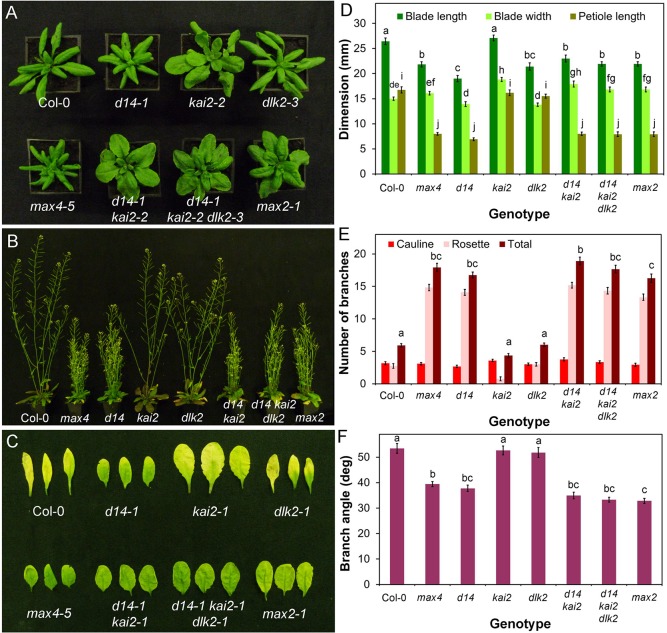
Fig. 1.
Fig. 1.
D14 mediates SL signalling in the adult shoot. (A) Rosette leaf phenotypes in candidate SL signalling mutants 4 weeks after germination. (B) Branching phenotypes in candidate SL signalling mutants 6 weeks after germination. (C) Dark-induced leaf senescence phenotypes in candidate SL signalling mutants. Rosette leaves were wrapped in foil for 8 days then imaged. (D) Leaf dimensions in candidate SL signalling mutants. Measurements were made on the seventh rosette leaf, 35 days after germination. n=10-12, bars indicate s.e.m. Bars with the same letter are not significantly different from each other (ANOVA, Tukey HSD test). (E) Branching levels in candidate SL signalling mutants. Numbers of primary cauline and rosette branches were measured at proliferative arrest, n=10-12, bars indicate s.e.m. Bars with the same letter are not significantly different from each other (ANOVA, Tukey HSD test). (F) Branch angle (measured in degrees) in candidate SL signalling mutants, n=10-12, bars indicate s.e.m. Bars with the same letter are not significantly different from each other (ANOVA, Tukey HSD test).
Fig. 2.
Fig. 2.
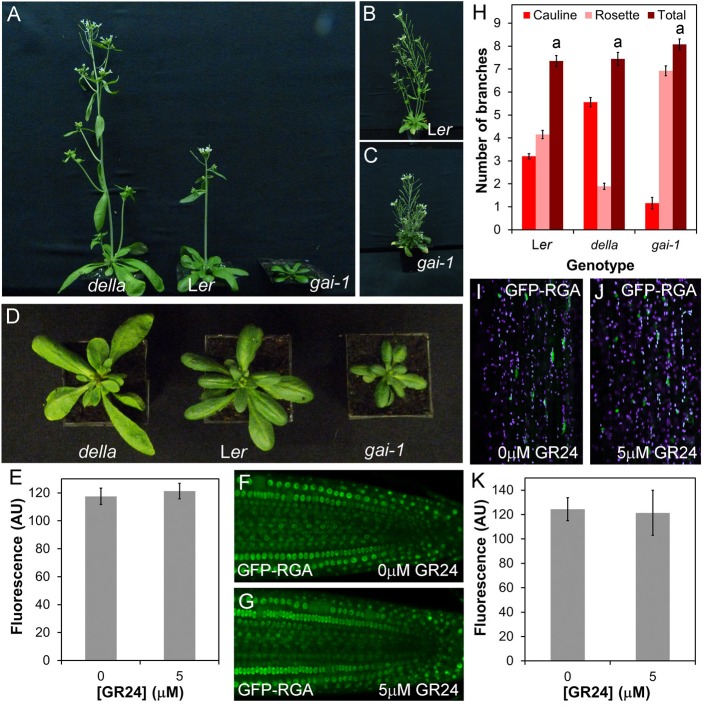
DELLA proteins are not targets of SL signalling in shoot development. (A) Shoot morpohology in age-matched plants of gai-t6 rga-t2 rgl1-1 rgl2-1 rgl3-1 (della), Ler and gai-1. (B) Ler plant at later developmental stage than A showing branching habit. (C) gai-1 plant at later developmental stage than A showing branching habit. (D) Rosette morphology phenotypes in age-matched plants of della, Ler and gai-1. (E-G) Effect of rac-GR24 treatment on stability of the GFP-RGA fusion protein in roots. (F,G) Representative images of roots treated with 0 µM or 5 µM rac-GR24 for 45 min respectively, and (E) quantification of relative fluorescence in the two treatments; n=5 nuclei in each of 12 roots per treatment. The mean value per root is shown, along with the standard error of this mean. (H) Numbers of primary branches in long-day grown Ler, della and gai-1 plants, measured at proliferative arrest, n=13-20, bars indicate s.e.m. Under our growth conditions, all cauline nodes produce branches. Bars with the same letter are not significantly different from each other (ANOVA, Tukey's HSD test). (I-K) Effect of rac-GR24 treatment on stability of the GFP-RGA fusion protein in shoots. (J,K) Representative images of hand-sectioned 6-week-old stems treated with 0 µM or 5 µM rac-GR24 for 45 min, and (I) quantification of relative fluorescence in the two treatments; n=5 nuclei in each of eight shoots per treatment. The mean value per stem is shown, along with the standard error of this mean.
Fig. 3.
Fig. 3.
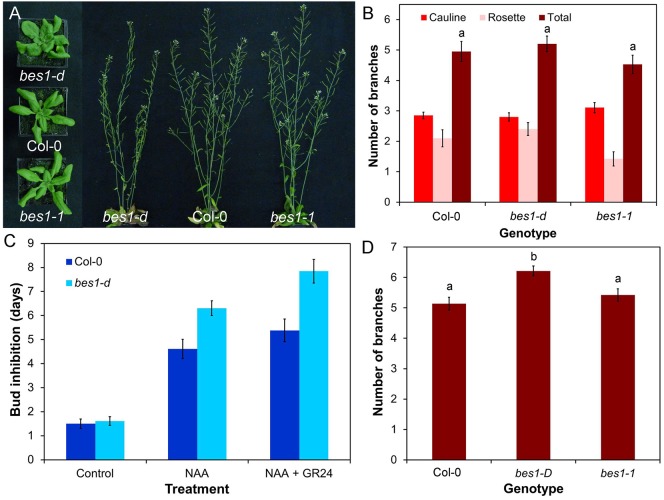
BES1 is not a target of SL signalling in shoot branching. (A) Leaf and branching phenotypes in Col-0, bes1-D and bes1-1 at 4 and 6 weeks post-germination, respectively. (B) Numbers of primary branches in long-day grown Col-0, bes1-D and bes1-1. Branching was measured at proliferative arrest, n=19-20, bars indicate s.e.m. Bars with the same letter are not significantly different from each other (ANOVA, Tukey HSD test). (C) Growth responses of Col-0 and bes1-D buds on excised nodal stem segments. Stem segments were treated with either solvent control, 1 μM NAA applied apically, or 1 μM NAA apically+5 μM rac-GR24 basally. The mean number of days that buds took to reach a length greater than 1.5 mm is shown for each genotype and treatment, n=12-13 nodes per treatment, bars indicate s.e.m. (D) Numbers of primary rosette branches in decapitated Col-0, bes1-D and bes1-1 plants grown in short photoperiods and then shifted to long photoperiods, 10 days after decapitation. n=22-37, bars indicate s.e.m. Bars with the same letter are not significantly different from each other (ANOVA, Tukey HSD test).
Fig. 4.
Fig. 4.
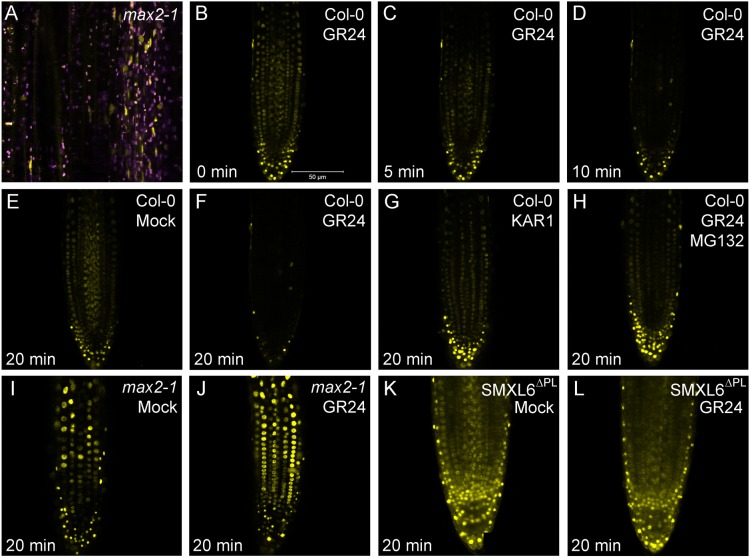
SMXL6 is degraded in response to SL treatment. (A) Expression of SMXL6-YFP in vascular cambium cells of max2-1 stems (yellow). Purple signal indicates chloroplast autofluorescence. (B-D) Response of SMXL6-YFP protein levels in Col-0 roots to treatment with 5 µM rac-GR24 over a 10 min time course. (E-H) Comparison of SMXL6-YFP protein levels in Col-0 roots after 20 min treatment with solvent control (E) 5 µM KAR1 (G) or 5 µM rac-GR24 in the presence (H) or absence (F) of MG132, an inhibitor of the 26S proteasome. (I,J) Comparison of SMXL6 protein levels in max2-1 roots after 20 min treatment with solvent control (I) or 5 µM rac-GR24 (J). (K,L) Comparison of SMXL6Δpl-YFP protein levels in roots after 20 min treatment with solvent control (K) or 5 µM rac-GR24 (L).
Fig. 5.
Fig. 5.
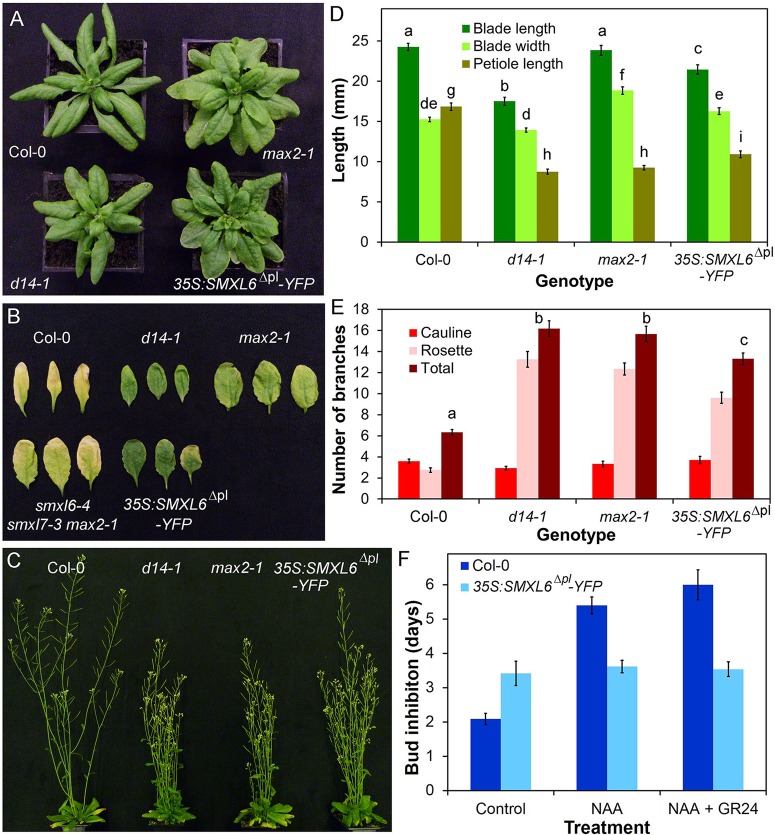
SMXL6 is functionally similar to SMXL7. (A) Rosette leaf phenotypes in 4-week old Col-0, max2-1, d14-1, and 35S:SMXL76Δpl-YFP plants. (B) Dark-induced senescence in Col-0, d14-1, max2-1, smxl6-4 smxl7-1 max2-1 and 35S:SMXL76Δpl-YFP leaves from 5-week-old plants. Leaves were wrapped in foil and imaged after 7 days. (C) Branching phenotypes in 6-week-old Col-0, d14-1, max2-1 and 35S:SMXL76Δpl-YFP plants. (D) Leaf dimensions in Col-0, d14-1, max2-1 and 35S:SMXL76Δpl-YFP lines. Measurements were made on the seventh rosette leaf, 35 days after germination. n=11-12, bars indicate s.e.m. Bars with the same letter are not significantly different from each other (ANOVA, Tukey HSD test). (E) Numbers of primary rosette branches in long-day grown Col-0, d14-1, max2-1 and 35S:SMXL6Δpl-YFP. Number of primary rosette branches was measured at proliferative arrest, n=10-12, bars indicate s.e.m. Bars with the same letter are not significantly different from each other (ANOVA, Tukey HSD test). (F) Growth responses of Col-0 and 35S:SMXL6Δpl-YFP buds on excised nodal sections. Nodes were treated with either solvent control, 0.3 μM NAA applied apically, or 0.3 μM NAA apically+5 μM rac-GR24 basally. The mean number of days that buds took to reach a length greater than 2 mm is shown for each genotype and treatment, n=5-13 nodes per treatment, bars indicate s.e.m.
Fig. 6.
Fig. 6.
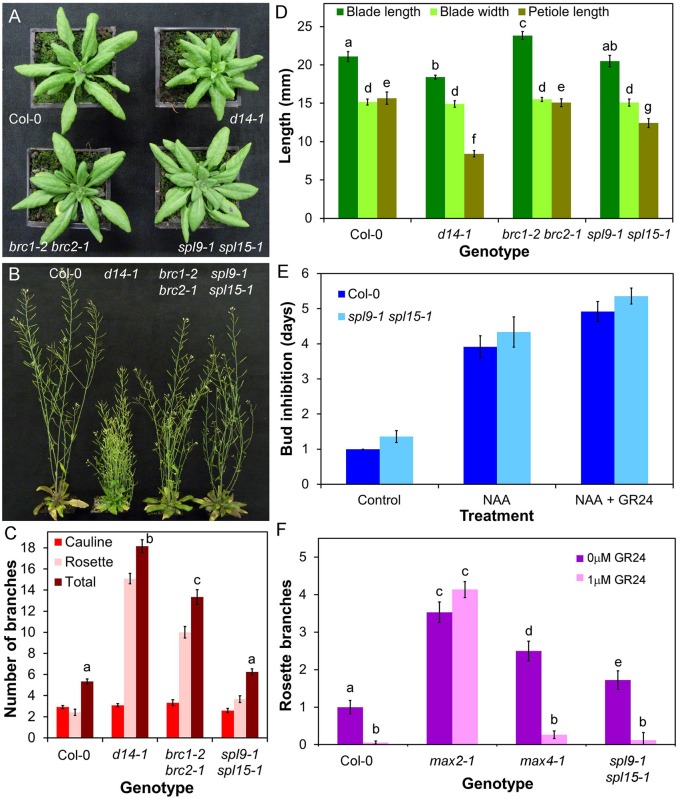
The role of BRC1/BRC2 and SPL9/SPL15 in shoot development. (A) Rosette leaf phenotypes in 4-week-old Col-0, d14-1, brc1-2 brc2-1 and spl9-1 spl15-1 plants. (B) Branching phenotypes in 6-week-old Col-0, d14-1, brc1-2 brc2-1 and spl9-1 spl15-1 plants. (C) Numbers of primary rosette branches in long-day grown Col-0, d14-1, brc1-2 brc2-1 and spl9-1 spl15-1. Number of primary rosette branches was measured at proliferative arrest, n=12, bars indicate s.e.m. Bars with the same letter are not significantly different from each other (ANOVA, Tukey HSD test). (D) Leaf dimensions in candidate SL signalling mutants. Measurements were made on the seventh rosette leaf, 35 days after germination. n=12, bars indicate s.e.m. Bars with the same letter are not significantly different from each other (ANOVA, Tukey HSD test). (E) Growth responses of Col-0 and spl9-1 spl15-1 buds on excised nodal sections. Nodes were treated with either solvent control, 0.5 μM NAA applied apically, or 0.5 μM NAA apically+5 μM rac-GR24 basally. The mean number of days that buds took to reach a length greater than 2 mm is shown for each genotype and treatment, n=11-14 nodes per treatment, bars indicate s.e.m. (F) Numbers of primary rosette branches in Col-0, max2-1, max4-1 and spl9-1 spl15-1 grown on agar solidified media supplemented with 1 μM rac-GR24 or a solvent control. Number of primary rosette branches was measured at proliferative arrest, n=15-36, bars indicate s.e.m. Bars with the same letter are not significantly different from each other (ANOVA, Tukey HSD test).
Fig. 7.
Fig. 7.
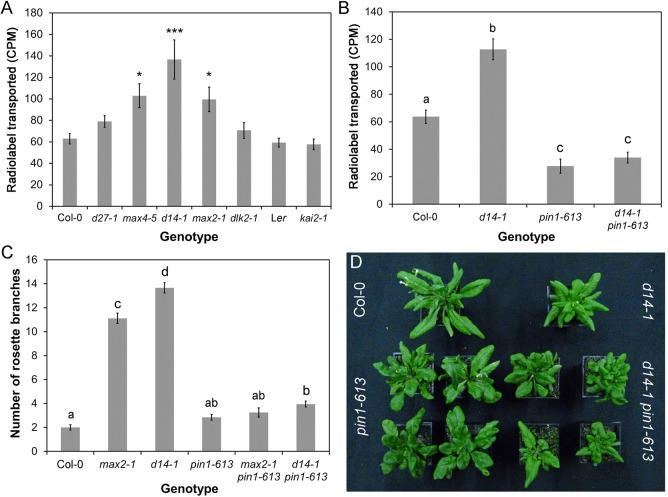
Canonical SL signalling affects stem auxin transport. (A) Bulk auxin transport levels in candidate SL signalling mutants. The amount of radiolabel (assessed as counts per minute, CPM) transported in 6 h through basal inflorescence internodes was measured in the indicated genotypes 6 weeks after germination, n=18-20, bars indicate s.e.m. Asterisks indicate genotypes that are significantly different from Col-0 (ANOVA, Dunnett's test, *P<0.05, **P<0.01, ***P<0.001). (B) Effect of pin1-613 mutation on bulk auxin transport in wild type and d14-1 mutant backgrounds. The amount of radiolabelled auxin (CPM) transported in 6 h through basal inflorescence internodes was measured in the indicated genotypes 6 weeks after germination, n=18-22, bars indicate s.e.m. Bars with the same letter are not significantly different from each other (ANOVA, Tukey HSD test). (C) Rosette branching in d14-1 pin1-613 and max2-1 pin1-613 double mutants. The number of first order rosette branches was measured at the proliferative arrest point of Col-0, n=15-34, bars indicate s.e.m. Bars with the same letter are not significantly different from each other (ANOVA, Tukey HSD test). (D) Morphology of rosette leaves in Col-0, d14-1, pin1-613 and d14-1 pin1-613. Although lack of PIN1 causes severe effects on leaf morphology, the overall shape of pin1-613 and d14-1 pin1-613 leaves is still characteristic of their SL signalling status.
Fig. 8.
Fig. 8.
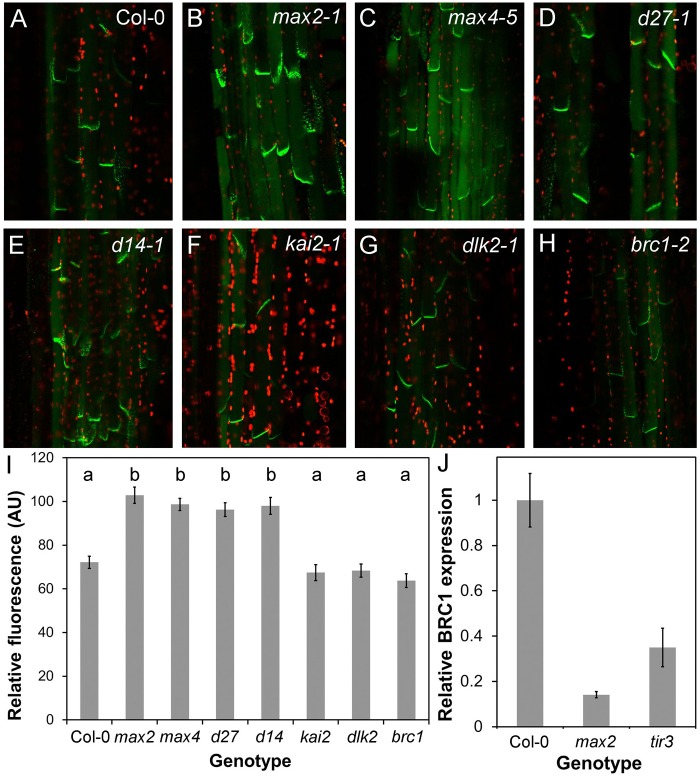
BRC1 and PIN1 act in parallel. (A-H) PIN1:PIN1-GFP expression in wild type, SL synthesis mutants and candidate SL signalling mutants. All images taken with identical settings, using hand sections through the basal inflorescence internode. (I) Quantification of PIN1-GFP fluorescence on the basal plasma membrane in candidate SL signalling mutants, n=40 membranes per genotype (five in each of eight plants, except max4-5 with 10 in each of four plants), bars indicate s.e.m. Bars with the same letter are not significantly different from each other (ANOVA, Tukey HSD test). (J) Relative expression in max2-1 and tir3-101 of BRC1 in actively growing buds normalised to Col-0, as assessed by qPCR. n=3 biological replicates per genotype, and three technical replicates per biological replicate. Error bars indicated s.e.m. of biological replicates.

References

    1. Abe S., Sado A., Tanaka K., Kisugi T., Asami K., Ota S., Kim H. I., Yoneyama K., Xie X., Ohnishi T. et al. (2014). Carlactone is converted to carlactonoic acid by MAX1 in Arabidopsis and its methyl ester can directly interact with AtD14 in vitro. Proc. Natl. Acad. Sci. USA 111, 18084-18089. 10.1073/pnas.1410801111 - DOI - PMC - PubMed
    1. Aguilar-Martinez J. A., Poza-Carrion C. and Cubas P. (2007). Arabidopsis BRANCHED1 acts as an integrator of branching signals within axillary buds. Plant Cell 19, 458-472. 10.1105/tpc.106.048934 - DOI - PMC - PubMed
    1. Alder A., Jamil M., Marzorati M., Bruno M., Vermathen M., Bigler P., Ghisla S., Bouwmeester H., Beyer P. and Al-Babili S. (2012). The path from β-carotene to carlactone, a strigolactone-like plant hormone. Science 335, 1348-1351. 10.1126/science.1218094 - DOI - PubMed
    1. Arite T., Iwata H., Ohshima K., Maekawa M., Nakajima M., Kojima M., Sakakibara H. and Kyozuka J. (2007). DWARF10, an RMS1/MAX4/DAD1 ortholog, controls lateral bud outgrowth in rice. Plant J. 51, 1019-1029. 10.1111/j.1365-313X.2007.03210.x - DOI - PubMed
    1. Arite T., Umehara M., Ishikawa S., Hanada A., Maekawa M., Yamaguchi S. and Kyozuka J. (2009). d14, a strigolactone-insensitive mutant of rice, shows an accelerated outgrowth of tillers. Plant Cell Physiol. 50, 1416-1424. 10.1093/pcp/pcp091 - DOI - PubMed