


Flavoured non-cigarette tobacco product use among US adults: 2013-2014
- PMID: 27794065
- PMCID: PMC5515238
- DOI: 10.1136/tobaccocontrol-2016-053373
Flavoured non-cigarette tobacco product use among US adults: 2013-2014
Abstract
Introduction: Limited data exist on flavoured non-cigarette tobacco product (NCTP) use among US adults.
Methods: Data from the 2013 to 2014 National Adult Tobacco Survey (N=75 233), a landline and cellular telephone survey of US adults aged ≥18, were assessed to estimate past 30-day NCTP use, flavoured NCTP use and flavour types using bivariate analyses.
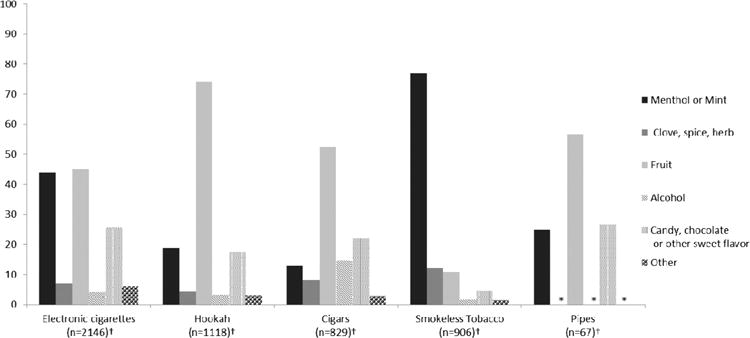
Results: During 2013-2014, 14.4% of US adults were past 30-day NCTP users. Nationally, an estimated 10.2 million e-cigarette users (68.2%), 6.1 million hookah users (82.3%), 4.1 million cigar smokers (36.2%) and 4.0 million smokeless tobacco users (50.6%) used flavoured products in the past 30 days. The most prevalent flavours reported were menthol/mint (76.9%) for smokeless tobacco; fruit (74.0%) for hookah; fruit (52.4%), candy/chocolate/other sweet flavours (22.0%) and alcohol (14.5%) for cigars/cigarillos/filtered little cigars; fruit (44.9%), menthol/mint (43.9%) and candy/chocolate/other sweet flavours (25.7%) for e-cigarettes and fruit (56.6%), candy/chocolate/other sweet flavours (26.5%) and menthol/mint (24.8%) for pipes. Except for hookah and pipes, past 30-day flavoured product use was highest among 18-24-year olds. By cigarette smoking, never smoking e-cigarette users (84.8%) were more likely to report flavoured e-cigarette use, followed by recent former smokers (78.1%), long-term former smokers (70.4%) and current smokers (63.2%).
Conclusions: Flavoured NCTP use is prominent among US adult tobacco users, particularly among e-cigarette, hookah and cigar users. Flavoured product use, especially fruit and sweet-flavoured products, was higher among younger adults. It is important for tobacco prevention and control strategies to address all forms of tobacco use, including flavoured tobacco products.
Keywords: Disparities; Electronic nicotine delivery devices; Non-cigarette tobacco products; Priority/special populations; Surveillance and monitoring.
Published by the BMJ Publishing Group Limited. For permission to use (where not already granted under a licence) please go to http://www.bmj.com/company/products-services/rights-and-licensing/.
Figures
References
-
- US Department of Health and Human Services. The health consequences of smoking—50 years of progress: a report of the Surgeon General. Atlanta (GA): US Department of Health and Human Services, Centers for Disease Control and Prevention, National Center for Chronic Disease Prevention and Health Promotion, Office on Smoking and Health; 2014. http://www.cdc.gov/tobacco/data_statistics/sgr/50th-anniversary/index.htm (accessed 4 Aug 2016).
-
- Jamal A, Homa DM, O’Connor E, et al. Current cigarette smoking among adults— United States, 2005–2014. MMWR Morb Mortal Wkly Rep. 2015;64:8. https://www.cdc.gov/mmwr/preview/mmwrhtml/mm6444a2.htm (accessed 29 Apr 2016). - PubMed
-
- NCHS. Chapter 8. Current smoking. In: Clark TC, Ward BW, Freeman G, et al., editors. Early release of selected estimates based on data from the January – March 2015 National Health Interview Survey. National Center for Health Statistics; 2015. pp. 52–8. http://www.cdc.gov/nchs/nhis.htm (accessed 24 May 2016)
-
- SAMHSA Center for Behavioral Health Statistics and Quality. (HHS Publication No. SMA 15-4927, NSDUH Series H-50).Behavioral and health trends in the United States: results from the 2014 National Survey on Drug Use and Health. 2015 http://www.samhsa.gov/data (accessed 12 Jul 2016)
Publication types
MeSH terms
Substances
Grants and funding
LinkOut - more resources
Full Text Sources
Other Literature Sources
Medical
Miscellaneous
