


Natural Selection in the Great Apes
- PMID: 27795229
- PMCID: PMC5100057
- DOI: 10.1093/molbev/msw215
Natural Selection in the Great Apes
Abstract
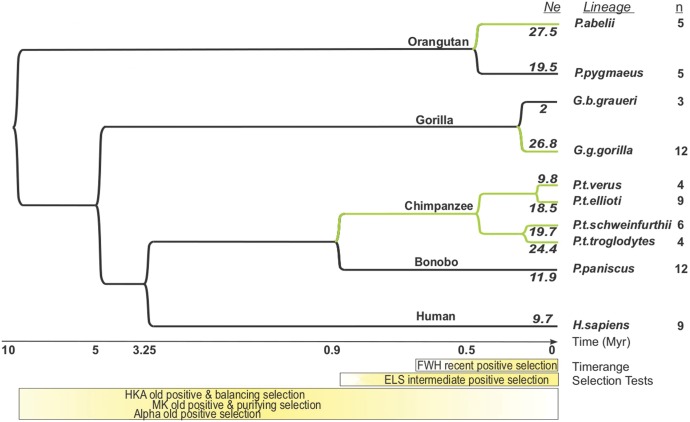
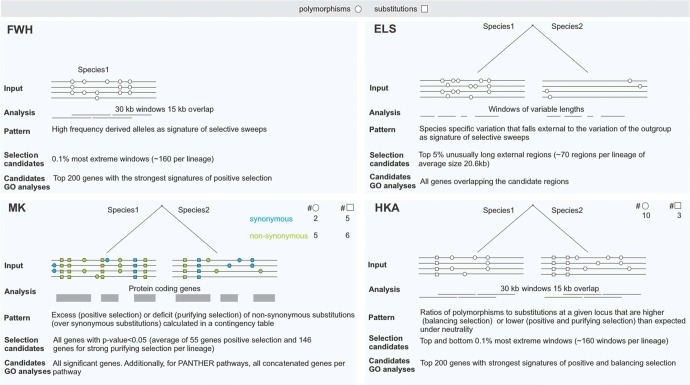
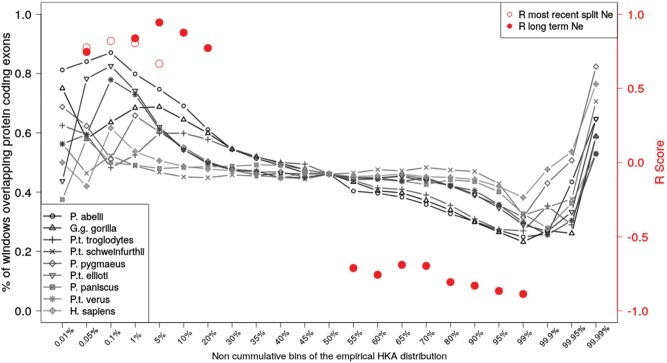
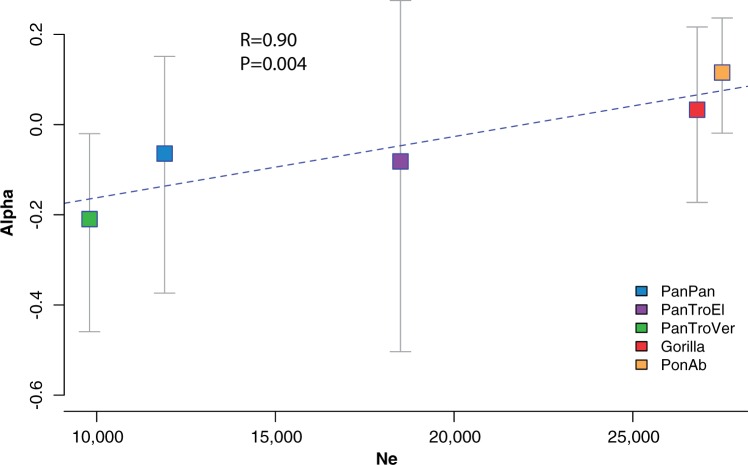
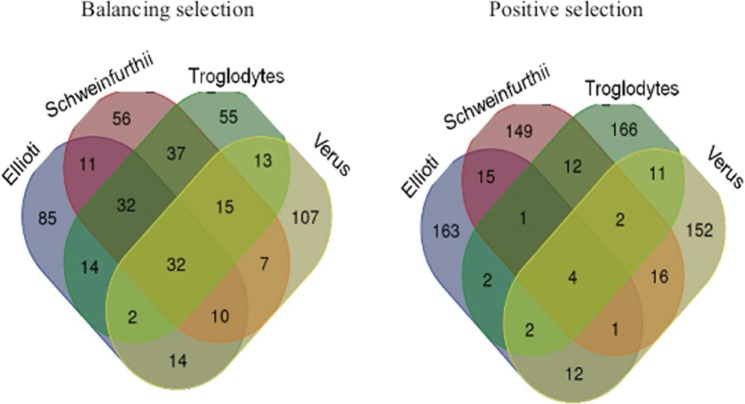
Natural selection is crucial for the adaptation of populations to their environments. Here, we present the first global study of natural selection in the Hominidae (humans and great apes) based on genome-wide information from population samples representing all extant species (including most subspecies). Combining several neutrality tests we create a multi-species map of signatures of natural selection covering all major types of natural selection. We find that the estimated efficiency of both purifying and positive selection varies between species and is significantly correlated with their long-term effective population size. Thus, even the modest differences in population size among the closely related Hominidae lineages have resulted in differences in their ability to remove deleterious alleles and to adapt to changing environments. Most signatures of balancing and positive selection are species-specific, with signatures of balancing selection more often being shared among species. We also identify loci with evidence of positive selection across several lineages. Notably, we detect signatures of positive selection in several genes related to brain function, anatomy, diet and immune processes. Our results contribute to a better understanding of human evolution by putting the evidence of natural selection in humans within its larger evolutionary context. The global map of natural selection in our closest living relatives is available as an interactive browser at http://tinyurl.com/nf8qmzh.
Keywords: adaptation; comparative genomics; evolution; primates..
© The Author 2016. Published by Oxford University Press on behalf of the Society for Molecular Biology and Evolution.
Figures
References
-
- Anderson RM, May RM. 1982. Coevolution of hosts and parasites. Parasitology 85(02):411–426. - PubMed
-
- Andrés AM, Dennis MY, Kretzschmar WW, Cannons JL, Lee-Lin S-Q, Hurle B, Schwartzberg PL, Williamson SH, Bustamante CD, Nielsen R, et al. 2010. Balancing selection maintains a form of ERAP2 that undergoes nonsense-mediated decay and affects antigen presentation. PLoS Genet. 6:e1001157. - PMC - PubMed
-
- Bejerano G, Lowe CB, Ahituv N, King B, Siepel A, Salama SR, Rubin EM, Kent WJ, Haussler D. 2006. A distal enhancer and an ultraconserved exon are derived from a novel retroposon. Nature 441(7089):87–90. - PubMed
Publication types
MeSH terms
LinkOut - more resources
Full Text Sources
Other Literature Sources
