


Correlation analysis between ultrasound findings and abnormal karyotypes in the embryos from early pregnancy loss after in vitro fertilization-embryo transfer
- PMID: 27796806
- PMCID: PMC5330976
- DOI: 10.1007/s10815-016-0821-2
Correlation analysis between ultrasound findings and abnormal karyotypes in the embryos from early pregnancy loss after in vitro fertilization-embryo transfer
Abstract
Purpose: The purpose of the study is to evaluate the correlation between ultrasound findings and abnormal karyotypes in early pregnancy losses (EPLs) after in vitro fertilization-embryo transfer (IVF-ET).
Methods: This retrospective analysis assessed 2172 cases of EPL after IVF-ET occurring between January 2008 and December 2013. The cases were examined via transvaginal ultrasonography (TVS). Embryonic tissue karyotyping following miscarriage was performed using a comparative genomic hybridization (CGH) analysis with fluorescence in situ hybridization (FISH). The correlations between the ultrasound findings and the karyotypes were evaluated.
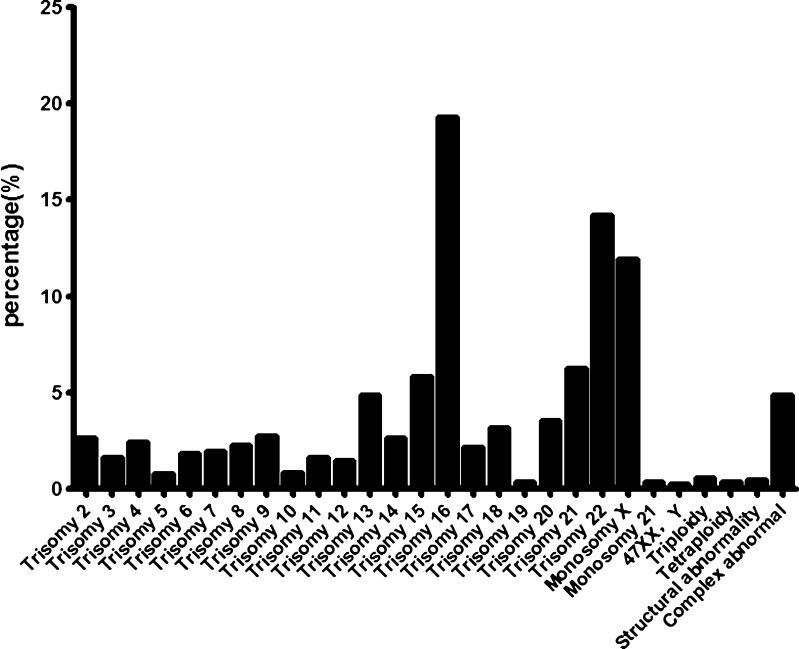
Results: Six categories of ultrasound findings were observed: normal ultrasound, empty sac, yolk sac only, small gestational sac, small embryonic pole, and early symmetrical arrested growth. The overall rate of abnormal karyotypes was 44.9 % (976/2172), and the rate of abnormal karyotypes associated with a normal ultrasound, empty sac, yolk sac only, small gestational sac, small embryonic pole, and early symmetrical arrested growth was 49.5 % (218/440), 28.1 % (138/491), 43.4 % (197/454), 50.0 % (43/86), 49.8 % (155/311), and 57.7 % (225/390), respectively. Compared with the other groups, the prevalence of chromosomal abnormalities was significantly higher in the early symmetrical arrested growth group but was markedly lower in the empty sac group in all cases and when cases of 46,XX were excluded (p < 0.05). Trisomy 16 was the most common chromosomal abnormality in the yolk sac only, small embryonic pole and early symmetrical arrested growth groups. In the empty sac, small gestational sac and normal ultrasound groups, monosomy X was the most frequent abnormality.
Conclusions: Chromosomal anomalies may be associated with specific types of ultrasound findings in EPLs after IVF-ET.
Keywords: Early pregnancy loss; In vitro fertilization-embryo transfer; Karyotype; Transvaginal ultrasonography; Ultrasound findings.
Conflict of interest statement
Funding
This study was supported by the National Natural Science (No. 81471432), State Key Development Program for Basic Research of China (No.2012CB944901) and the Scientific Research Foundation of Reproductive and Genetic Hospital of Citic-Xiangya.
Conflict of interest
The authors declare that they have no conflict of interest.
Figures
References
-
- Morales C, Sanchez A, Bruguera J, Margarit E, Borrell A, Borobio V, et al. Cytogenetic study of spontaneous abortions using semi-direct analysis of chorionic villi samples detects the broadest spectrum of chromosome abnormalities. Am J Med Genet A. 2008;146A:66–70. doi: 10.1002/ajmg.a.32058. - DOI - PubMed
-
- Shearer BM, Thorland EC, Carlson AW, Jalal SM, Ketterling RP. Reflex fluorescent in situ hybridization testing for unsuccessful product of conception cultures: a retrospective analysis of 5555 samples attempted by conventional cytogenetics and fluorescent in situ hybridization. Genet Med. 2011;13:545–552. doi: 10.1097/GIM.0b013e31820c685b. - DOI - PubMed
MeSH terms
LinkOut - more resources
Full Text Sources
Other Literature Sources
Medical
