


Why do general practitioners prescribe antibiotics for upper respiratory tract infections to meet patient expectations: a mixed methods study
- PMID: 27798010
- PMCID: PMC5093394
- DOI: 10.1136/bmjopen-2016-012244
Why do general practitioners prescribe antibiotics for upper respiratory tract infections to meet patient expectations: a mixed methods study
Abstract
Objectives: To describe the role patient expectations play in general practitioners (GPs) antibiotic prescribing for upper respiratory tract infections (URTI).
Methods: Concurrent explanatory mixed methods approach using a cross-sectional survey and semistructured interviews.
Settings: Primary care GPs in Australia.
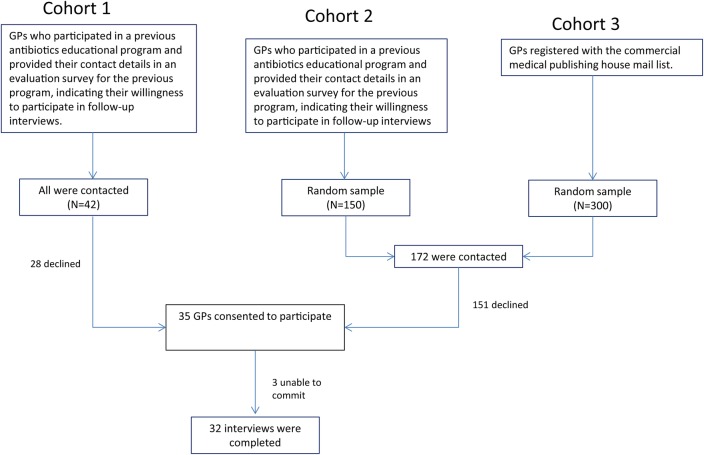
Participants: 584 GPs (response rate of 23.6%) completed the cross-sectional survey. 32 GPs were interviewed individually.
Outcome measure: Prescribing of antibiotics for URTI.
Results: More than half the GP respondents to the survey in Australia self-reported that they would prescribe antibiotics for an URTI to meet patient expectations. Our qualitative findings suggest that 'patient expectations' may be the main reason given for inappropriate prescribing, but it is an all-encompassing phrase that includes other reasons. These include limited time, poor doctor-patient communication and diagnostic uncertainty. We have identified three role archetypes to explain the behaviour of GPs in reference to antibiotic prescribing for URTIs. The main themes emerging from the qualitative component was that many GPs did not think that antibiotic prescribing in primary care was responsible for the development of antibiotic resistance nor that their individual prescribing would make any difference in light of other bigger issues like hospital prescribing or veterinary use. For them, there were negligible negative consequences from their inappropriate prescribing.
Conclusions: There is a need to increase awareness of the scope and magnitude of antibiotic resistance and the role primary care prescribing plays, and of the contribution of individual prescribing decisions to the problem of antibiotic resistance.
Keywords: PRIMARY CARE; antibiotics; inappropriate prescribing; upper respiratory tract infection.
Published by the BMJ Publishing Group Limited. For permission to use (where not already granted under a licence) please go to http://www.bmj.com/company/products-services/rights-and-licensing/.
Conflict of interest statement
Conflicts of Interest: None declared.
Figures
References
-
- SCRGSP (Steering Committee for the Review of Government Service Provision). Report on Government Services 2015. Canberra: Health, Productivity Commission, 2015.
-
- Sung L, Arroll J, Arroll B et al. Antibiotic use for upper respiratory tract infections before and after a education campaign as reported by general practitioners in New Zealand. N Z Med J 2006;119:U1956. - PubMed
Publication types
MeSH terms
Substances
LinkOut - more resources
Full Text Sources
Other Literature Sources
Medical
