


Factors associated with the difficulty in hospital acceptance at the scene by emergency medical service personnel: a population-based study in Osaka City, Japan
- PMID: 27798040
- PMCID: PMC5093624
- DOI: 10.1136/bmjopen-2016-013849
Factors associated with the difficulty in hospital acceptance at the scene by emergency medical service personnel: a population-based study in Osaka City, Japan
Abstract
Objectives: To investigate the association between the difficulty in hospital acceptance at the scene by emergency medical service (EMS) personnel and prehospital demographic factors and reasons for EMS calls.
Design: A retrospective, observational study.
Setting: Osaka City, Japan.
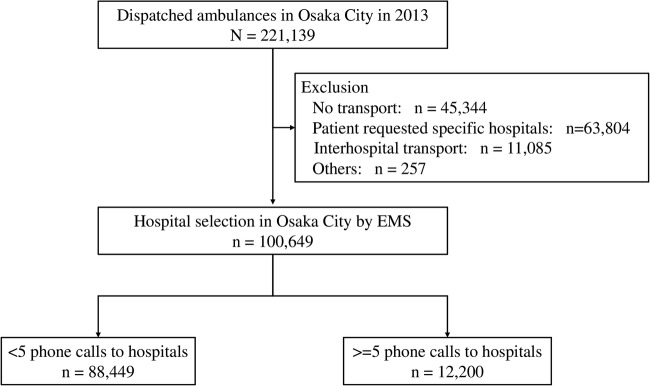
Participants: A total of 100 649 patients transported to medical institutions by EMS from January 2013 to December 2013.
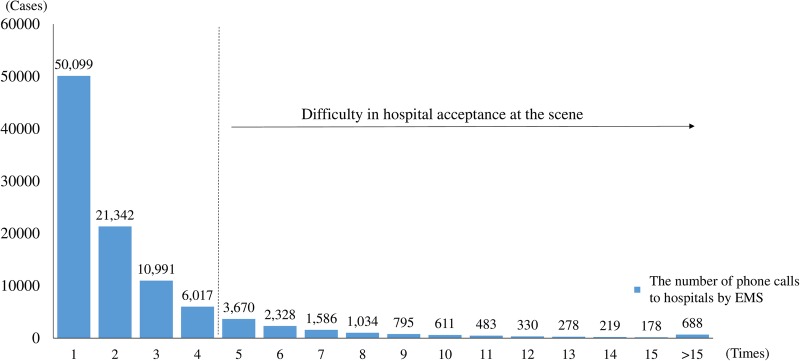
Primary outcome measurements: The definition of difficulty in hospital acceptance at the scene was EMS personnel making ≥5 phone calls to medical institutions until a decision to transport was determined. Multivariable analysis was used to assess the relationship between difficulty in hospital acceptance and prehospital factors and reasons for EMS calls.
Results: Multivariable analysis showed the elderly, foreigners, loss of consciousness, holiday/weekend, and night-time to be positively associated with difficulty in hospital acceptance at the scene. As reasons for EMS calls, gas poisoning (adjusted OR 3.281, 95% CI 1.201 to 8.965), trauma by assault (adjusted OR 2.662, 95% CI 2.390 to 2.966), self-induced drug abuse/gas poisoning (adjusted OR 4.527, 95% CI 3.921 to 5.228) and self-induced trauma (adjusted OR 1.708, 95% CI 1.369 to 2.130) were positively associated with the difficulty in hospital acceptance at the scene.
Conclusions: Ambulance records in Osaka City showed that certain prehospital factors such as night-time were positively associated with difficulty in hospital acceptance at the scene, and reasons for EMS calls, such as self-induced drug abuse/gas poisoning, were also positive predictors for difficulty in hospital acceptance at the scene.
Keywords: emergency medical service; hospital acceptance; pre-hospital factors.
Published by the BMJ Publishing Group Limited. For permission to use (where not already granted under a licence) please go to http://www.bmj.com/company/products-services/rights-and-licensing/.
Conflict of interest statement
Conflicts of Interest: None declared.
Figures
References
-
- Ambulance Service Planning Office of Fire and Disaster Management Agency of Japan: 2014 Effect of first aid for emergency patients. http://www.fdma.go.jp/neuter/topics/fieldList9_3.html (accessed 3 Nov 2015).
-
- Fire and Disaster Management Agency of Japan: 2014 White book on Emergency Systems in Japan. http://www.fdma.go.jp/html/hakusho/h26/h26/pdf/part2_section5.pdf (accessed 3 Nov 2015).
-
- Glushak C, Delbridge TR, Garrison HG. Ambulance diversion. Standards and Clinical Practices Committee, National Association of EMS Physicians. Prehosp Emerg Care 1997;1:100–3. - PubMed
MeSH terms
LinkOut - more resources
Full Text Sources
Other Literature Sources
Medical
