


Soy-Dairy Protein Blend or Whey Protein Isolate Ingestion Induces Similar Postexercise Muscle Mechanistic Target of Rapamycin Complex 1 Signaling and Protein Synthesis Responses in Older Men
- PMID: 27798330
- PMCID: PMC5118761
- DOI: 10.3945/jn.116.231159
Soy-Dairy Protein Blend or Whey Protein Isolate Ingestion Induces Similar Postexercise Muscle Mechanistic Target of Rapamycin Complex 1 Signaling and Protein Synthesis Responses in Older Men
Abstract
Background: Previous work demonstrated that a soy-dairy protein blend (PB) prolongs hyperaminoacidemia and muscle protein synthesis in young adults after resistance exercise.
Objective: We investigated the effect of PB in older adults. We hypothesized that PB would prolong hyperaminoacidemia, enhancing mechanistic target of rapamycin complex 1 (mTORC1) signaling and muscle protein anabolism compared with a whey protein isolate (WPI).
Methods: This double-blind, randomized controlled trial studied men 55-75 y of age. Subjects consumed 30 g protein from WPI or PB (25% soy, 25% whey, and 50% casein) 1 h after leg extension exercise (8 sets of 10 repetitions at 70% one-repetition maximum). Blood and muscle amino acid concentrations and basal and postexercise muscle protein turnover were measured by using stable isotopic methods. Muscle mTORC1 signaling was assessed by immunoblotting.
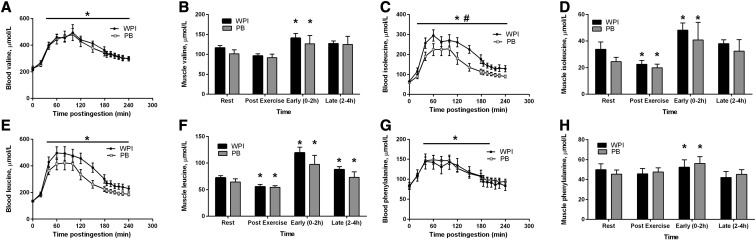
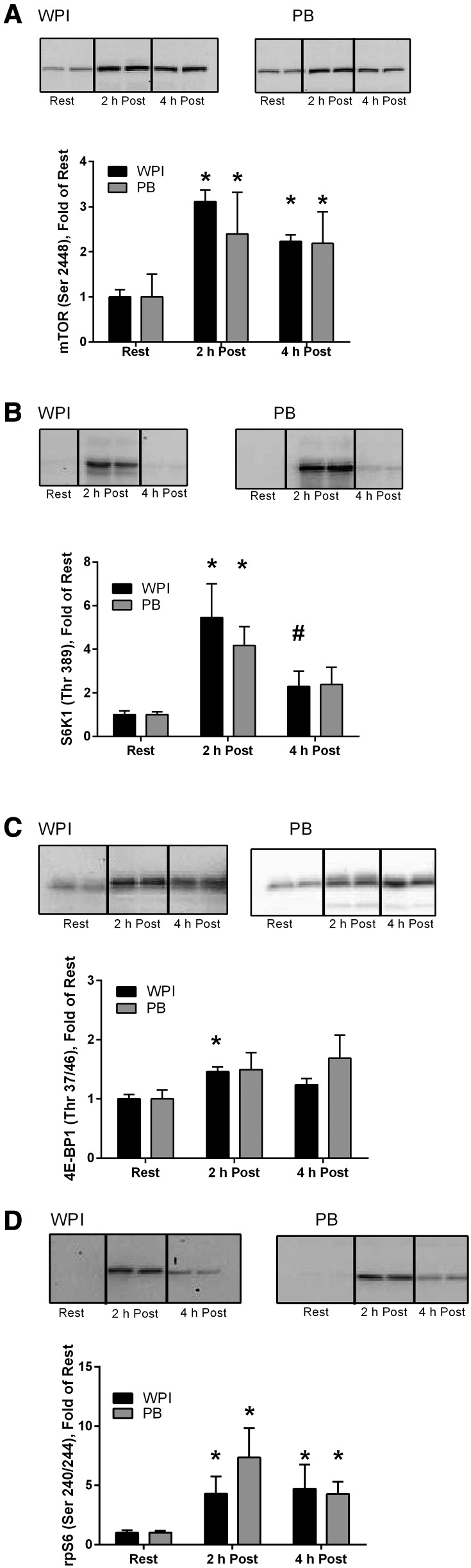
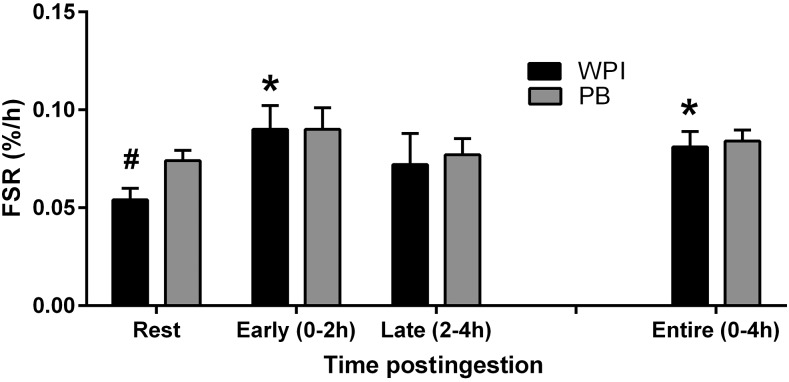
Results: Both groups increased amino acid concentrations (P < 0.05) and mTORC1 signaling after protein ingestion (P < 0.05). Postexercise fractional synthesis rate (FSR; P ≥ 0.05), fractional breakdown rate (FBR; P ≥ 0.05), and net balance (P = 0.08) did not differ between groups. WPI increased FSR by 67% (mean ± SEM: rest: 0.05% ± 0.01%; postexercise: 0.09% ± 0.01%; P < 0.05), decreased FBR by 46% (rest: 0.17% ± 0.01%; postexercise: 0.09% ± 0.03%; P < 0.05), and made net balance less negative (P < 0.05). PB ingestion did not increase FSR (rest: 0.07% ± 0.03%; postexercise: 0.09% ± 0.01%; P ≥ 0.05), tended to decrease FBR by 42% (rest: 0.25% ± 0.08%; postexercise: 0.15% ± 0.08%; P = 0.08), and made net balance less negative (P < 0.05). Within-group percentage of change differences were not different between groups for FSR, FBR, or net balance (P ≥ 0.05).
Conclusions: WPI and PB ingestion after exercise in older men induced similar responses in hyperaminoacidemia, mTORC1 signaling, muscle protein synthesis, and breakdown. These data add new evidence for the use of whey or soy-dairy PBs as targeted nutritional interventions to counteract sarcopenia. This trial was registered at clinicaltrials.gov as NCT01847261.
Keywords: aging; leucine; muscle protein turnover; protein supplementation; sarcopenia.
© 2016 American Society for Nutrition.
Conflict of interest statement
2 Author disclosures: MS Borack, PT Reidy, SH Husaini, MM Markofski, RR Deer, AB Richison, BS Lambert, MB Cope, R Mukherjea, K Jennings, E Volpi, and BB Rasmussen, no conflicts of interest. Representatives from DuPont Nutrition & Health were not involved with data collection and analysis.
Figures
References
-
- Wandrag L, Brett SJ, Frost G, Hickson M. Impact of supplementation with amino acids or their metabolites on muscle wasting in patients with critical illness or other muscle wasting illness: a systematic review. J Hum Nutr Diet 2015;28:313–30. - PubMed
-
- Biolo G, Tipton KD, Klein S, Wolfe RR. An abundant supply of amino acids enhances the metabolic effect of exercise on muscle protein. Am J Physiol 1997;273:E122–9. - PubMed
Publication types
MeSH terms
Substances
Associated data
Grants and funding
LinkOut - more resources
Full Text Sources
Other Literature Sources
Medical
