


Influence of Fatigue on Tackling Ability in Rugby League Players: Role of Muscular Strength, Endurance, and Aerobic Qualities
- PMID: 27798634
- PMCID: PMC5087954
- DOI: 10.1371/journal.pone.0163161
Influence of Fatigue on Tackling Ability in Rugby League Players: Role of Muscular Strength, Endurance, and Aerobic Qualities
Abstract
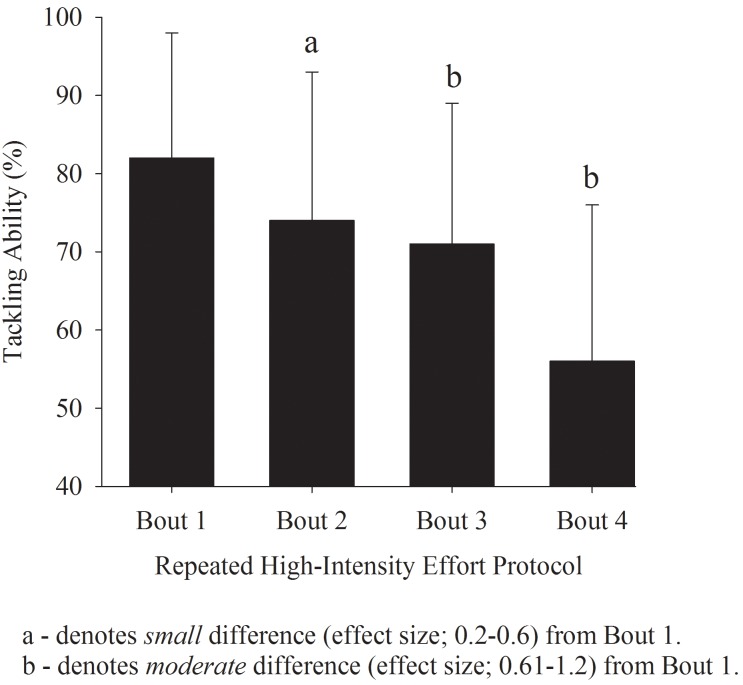
This study investigated the influence of repeated high-intensity effort exercise on tackling ability in rugby league players, and determined the relationship between physical qualities and tackling ability under fatigued conditions in these athletes. Eleven semi-professional rugby league players underwent measurements of speed (10 m and 40 m sprint), upper-body strength (4 repetition maximum [RM] bench press and weighted chin-up), upper-body muscular endurance (body mass maximum repetition chin-up, body mass maximum repetition dips), lower-body strength (4RM squat), and estimated maximal aerobic power (multi-stage fitness test). Tackling ability was assessed using a standardized one-on-one tackling test, before, during, and following four bouts of repeated high-intensity effort (RHIE) exercise. The relationship between physical qualities and fatigue-induced decrements in tackling ability were determined using Pearson product moment correlation coefficients. Each cycle of the RHIE protocol induced progressive reductions in tackling ability. A moderate reduction (Effect Size = ~-1.17 ± 0.60, -34.1 ± 24.3%) in tackling ability occurred after the fourth cycle of the RHIE protocol. Players with greater relative lower-body strength (i.e. 4RM squat/kg) had the best tackling ability under fatigued conditions (r = 0.72, p = 0.013). There were no significant relationships between tackling ability under fatigued conditions and any other physical quality. These findings suggest that lower-body strength protects against fatigue-induced decrements in tackling ability. The development of lower-body strength should be a priority to facilitate the development of robust tackling skills that are maintained under fatigue.
Conflict of interest statement
The author was employed by Gabbett Performance Solutions (http://gabbettperformance.com.au/), a commercial company, during this study. There are no patents, products in development or marketed products to declare. This does not alter the author's adherence to all the PLOS ONE policies on sharing data and materials.
Figures
References
-
- Gabbett T, Ryan P. Tackling technique, injury risk, and playing performance in high performance collision sport athletes. Int J Sports Sci Coach 2009;4:521–533.
-
- Hendricks S, Matthews B, Roode B, Lambert M. Tackler characteristics associated with tackle performance in rugby union. Eur J Sports Sci 2014;14:753–762. - PubMed
MeSH terms
LinkOut - more resources
Full Text Sources
Other Literature Sources
Medical
