


A novel accelerometer-based method to describe day-to-day exposure to potentially osteogenic vertical impacts in older adults: findings from a multi-cohort study
- PMID: 27798733
- PMCID: PMC5306163
- DOI: 10.1007/s00198-016-3810-5
A novel accelerometer-based method to describe day-to-day exposure to potentially osteogenic vertical impacts in older adults: findings from a multi-cohort study
Abstract
This observational study assessed vertical impacts experienced in older adults as part of their day-to-day physical activity using accelerometry and questionnaire data. Population-based older adults experienced very limited high-impact activity. The accelerometry method utilised appeared to be valid based on comparisons between different cohorts and with self-reported activity.
Introduction: We aimed to validate a novel method for evaluating day-to-day higher impact weight-bearing physical activity (PA) in older adults, thought to be important in protecting against osteoporosis, by comparing results between four cohorts varying in age and activity levels, and with self-reported PA levels.
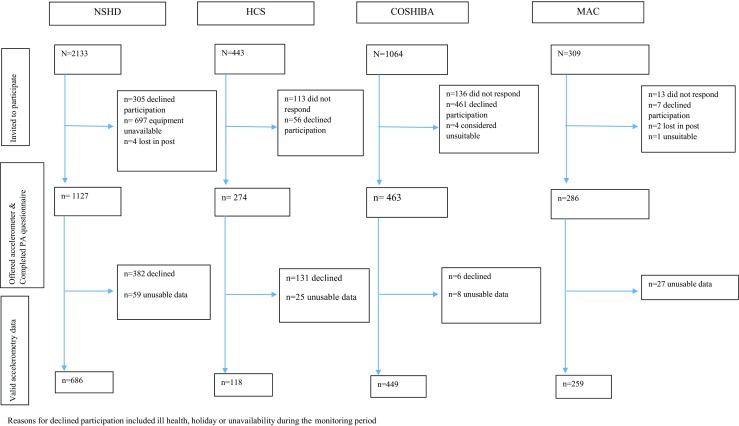
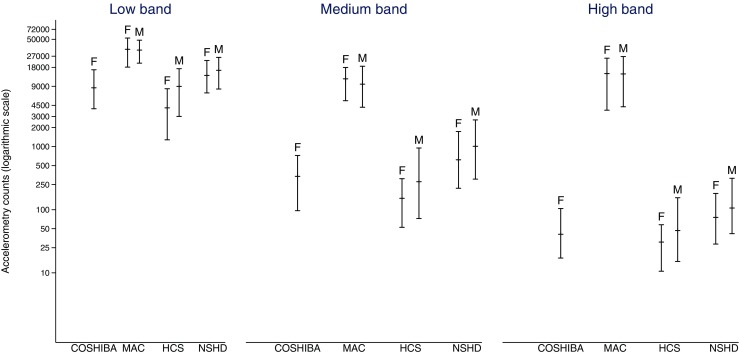
Methods: Participants were from three population-based cohorts, MRC National Survey of Health and Development (NSHD), Hertfordshire Cohort Study (HCS) and Cohort for Skeletal Health in Bristol and Avon (COSHIBA), and the Master Athlete Cohort (MAC). Y-axis peaks (reflecting the vertical when an individual is upright) from a triaxial accelerometer (sampling frequency 50 Hz, range 0-16 g) worn at the waist for 7 days were classified as low (0.5-1.0 g), medium (1.0-1.5 g) or higher (≥1.5 g) impacts.
Results: There were a median of 90, 41 and 39 higher impacts/week in NSHD (age 69.5), COSHIBA (age 76.8) and HCS (age 78.5) participants, respectively (total n = 1512). In contrast, MAC participants (age 68.5) had a median of 14,322 higher impacts/week. In the three population cohorts combined, based on comparison of beta coefficients, moderate-high-impact activities as assessed by PA questionnaire were suggestive of stronger association with higher impacts from accelerometers (0.25 [0.17, 0.34]), compared with medium (0.18 [0.09, 0.27]) and low impacts (0.13 [0.07,0.19]) (beta coefficient, with 95 % CI). Likewise in MAC, reported moderate-high-impact activities showed a stronger association with higher impacts (0.26 [0.14, 0.37]), compared with medium (0.14 [0.05, 0.22]) and low impacts (0.03 [-0.02, 0.08]).
Conclusions: Our new accelerometer method appears to provide valid measures of higher vertical impacts in older adults. Results obtained from the three population-based cohorts indicate that older adults generally experience very limited higher impact weight-bearing PA.
Keywords: Accelerometry; Bone; Older adults; Physical activity.
Conflict of interest statement
Compliance with ethical standards Separate regional ethical approval was obtained for VIBE study data collection in NSHD (14/LO/1073 and 14/SS/1009), HCS (10/HO311/59), COSHIBA (14/SW/0138) and MAC (14/NW0275), and written informed consent was obtained from all participants. Conflicts of interest None.
Figures
References
-
- Burge RT. The cost of osteoporotic fractures in the UK: projections for 2000-2020. J Med Econ. 2001;4:51–62. doi: 10.3111/200104051062. - DOI
Publication types
MeSH terms
Grants and funding
- MC_UU_12019/4/MRC_/Medical Research Council/United Kingdom
- MC_U147574237/MRC_/Medical Research Council/United Kingdom
- MR/K024973/1/MRC_/Medical Research Council/United Kingdom
- MC_U147574234/MRC_/Medical Research Council/United Kingdom
- MC_U147585819/MRC_/Medical Research Council/United Kingdom
- MC_UP_A620_1014/MRC_/Medical Research Council/United Kingdom
- 19583/VAC_/Versus Arthritis/United Kingdom
- MC_UU_12011/1/MRC_/Medical Research Council/United Kingdom
- G0400491/MRC_/Medical Research Council/United Kingdom
- MC_U147585824/MRC_/Medical Research Council/United Kingdom
- MC_U147585827/MRC_/Medical Research Council/United Kingdom
- MC_U147574212/MRC_/Medical Research Council/United Kingdom
LinkOut - more resources
Full Text Sources
Other Literature Sources
Medical
