. 2017 Jan 4;45(D1):D457-D465.
doi: 10.1093/nar/gkw1030. Epub 2016 Oct 30.

IMG/VR: a database of cultured and uncultured DNA Viruses and retroviruses

Affiliations

IMG/VR: a database of cultured and uncultured DNA Viruses and retroviruses

David Paez-Espino et al. Nucleic Acids Res. .

Abstract

Viruses represent the most abundant life forms on the planet. Recent experimental and computational improvements have led to a dramatic increase in the number of viral genome sequences identified primarily from metagenomic samples. As a result of the expanding catalog of metagenomic viral sequences, there exists a need for a comprehensive computational platform integrating all these sequences with associated metadata and analytical tools. Here we present IMG/VR (https://img.jgi.doe.gov/vr/), the largest publicly available database of 3908 isolate reference DNA viruses with 264 413 computationally identified viral contigs from >6000 ecologically diverse metagenomic samples. Approximately half of the viral contigs are grouped into genetically distinct quasi-species clusters. Microbial hosts are predicted for 20 000 viral sequences, revealing nine microbial phyla previously unreported to be infected by viruses. Viral sequences can be queried using a variety of associated metadata, including habitat type and geographic location of the samples, or taxonomic classification according to hallmark viral genes. IMG/VR has a user-friendly interface that allows users to interrogate all integrated data and interact by comparing with external sequences, thus serving as an essential resource in the viral genomics community.


Figures

Figure 1.
Figure 1.
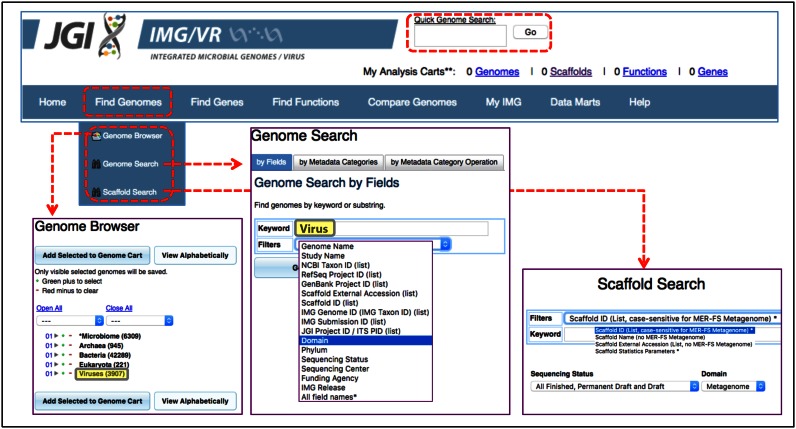
General IMG/VR search functionality. Basic search tools from IMG/M's top menu bar (dashed red boxes) can be used to access the viral content of IMG/VR. ‘Quick Genome Search’ at the top menu can be used to query specific viral names, taxon identifiers or keywords. Alternatively, all isolate viral content can be retrieved from the ‘Find Genome’ tab, either selecting Viruses (boxed in grey with yellow background) from the ‘Genome browser’ display (bottom left panel) or searching for Virus (boxed in grey with yellow background) in the Domain filter of the ‘Genome Search’ tool (bottom central panel). To search for metagenomic viral contigs users need to access first the metagenomic sample (using any of the above tools). Then the ‘Scaffold Search’ tool can be used to select specific scaffolds (bottom right panel).
Figure 2.
Figure 2.
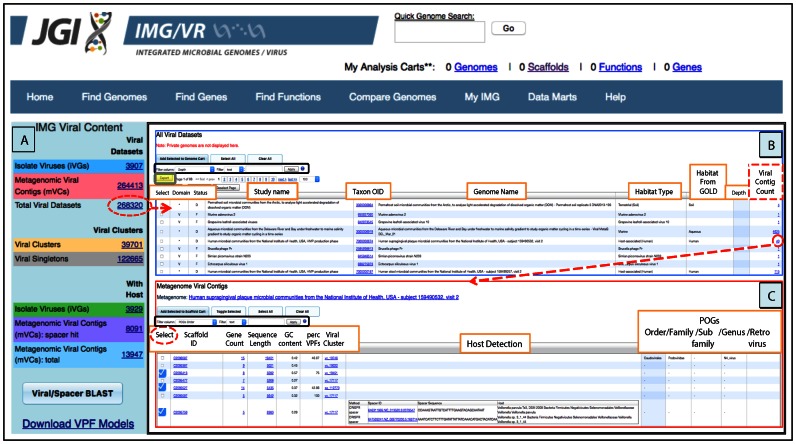
Browsing IMG/VR viral datasets. (A) Total counts and access to the list of viral sequences from isolate viruses, metagenomic viral contigs, or their combination (dashed red oval). (B) Detailed table from ‘Total Viral Datasets’ link displaying study and sample name, Taxon OID, habitat information and number of metagenomic viral contigs. (C) List of viral metagenomic contigs found in a single sample. Columns in (B) and (C) can be sorted by clicking on the column header, and different filters can be used for specific searches (black boxes). Tables can be also exported in a tab-delimited text format by using the Export button (grey box with yellow background).
Figure 3.
Figure 3.
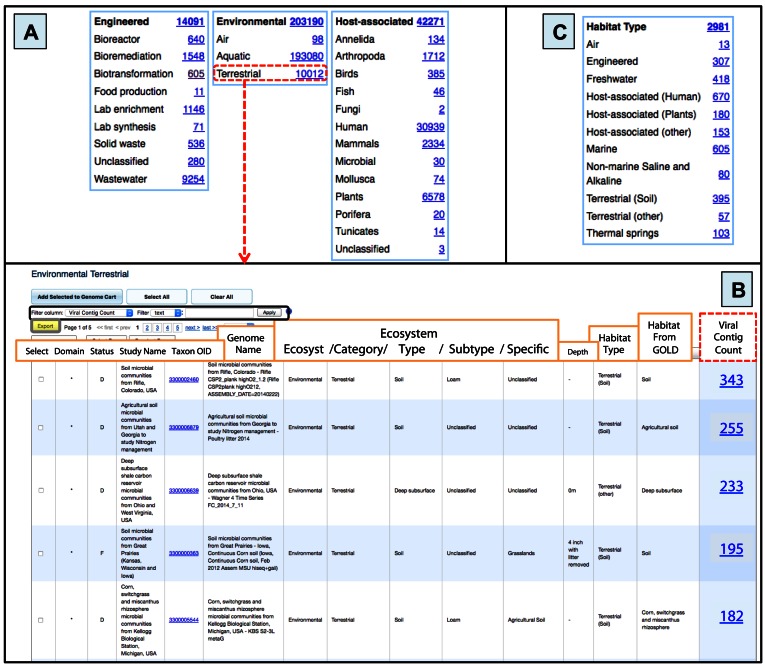
Accessing metagenomic viral contigs via associated environmental metadata. (A) Distribution of metagenomic viral contigs per ecosystem and ecosystem category information of samples according to GOLD classification. When a category is selected (e.g. Terrestrial samples—boxed in dashed red) a new table is displayed. (B) Detailed information of the selected Terrestrial samples. The total number of metagenomic viral contigs per sample (boxed in dashed red) can be viewed. Columns can be sorted by clicking on the column header, and different filters can be used for specific searches (black box). The table can be also exported in a tab-delimited text format by using the Export button (gray box with yellow background). (C) Number of mVCs per Habitat Type category of the sample where the mVCs were found.
Figure 4.
Figure 4.
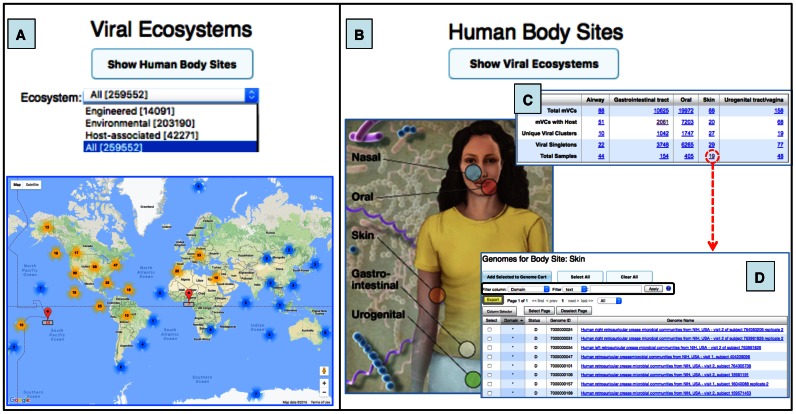
Maps of samples containing viral contigs from environmental and human-associated metagenomes. (A) World interactive Google Map with a geographic location of metagenomic samples. All samples can be selected together or only those from any of the three major ecosystems. Map pins (in red) represent location counts of viral contigs and may contain multiple samples. Map pins are grouped into clusters and clusters themselves into larger clusters (bold number with a coloured halo based on number of members within the cluster) according to the Google Map javascript API utility library. As you zoom into any of the cluster locations, the number on the cluster decreases, and you begin to see the individual markers on the map. Zooming out of the map consolidates the markers into clusters again. (B) Human Body image showing the five body sites with available samples. All the metagenomic viral contigs identified in each body site can be accessed from the circles in the image. (C) Table provides information about mVC clusters/singletons, number of samples, and viral contigs with a host. (D) List of human skin samples with viral contigs. Columns can be sorted by clicking on the column header. Different filters can be used for specific searches (black box). This table can be exported by using the Export button (grey box with yellow background). Human body image credit: NIH Medical Arts and Printing.
Figure 5.
Figure 5.
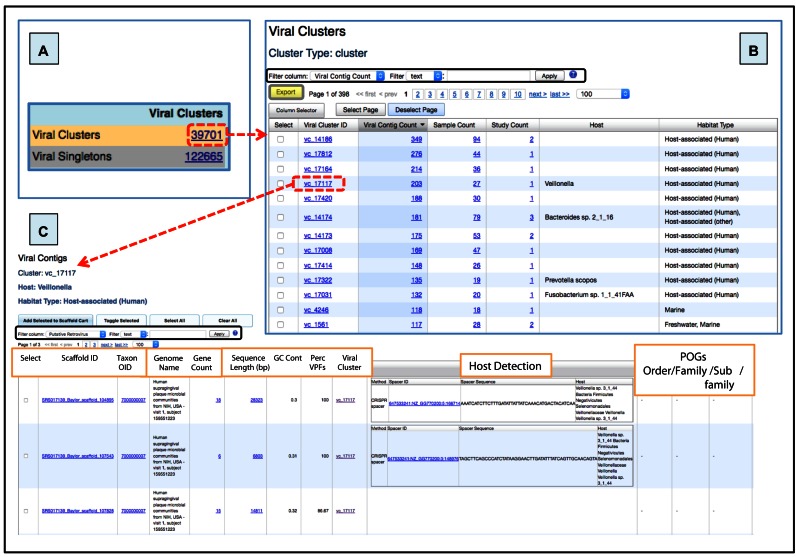
Viral diversity in IMG/VR. (A) Accession link with the number of viral clusters or singletons available in the system. (B) Detailed table from ‘Viral Clusters’ (boxed in dashed red from panel a) showing the number of metagenomic viral contigs per cluster. The number of distinct samples, and unique projects (‘Study Count’) is shown, besides information regarding host and habitat. (C) Viral cluster details table with host (via microbial CRISPR-spacer sequence matches) and taxonomic (via hallmark genes) information when available. Columns in (B) and (C) can be sorted by clicking on the column header, and different filters can be used for specific searches (black boxes). Tables can be also exported in a tab-delimited text format by using the Export button (grey box with yellow background).
Figure 6.
Figure 6.
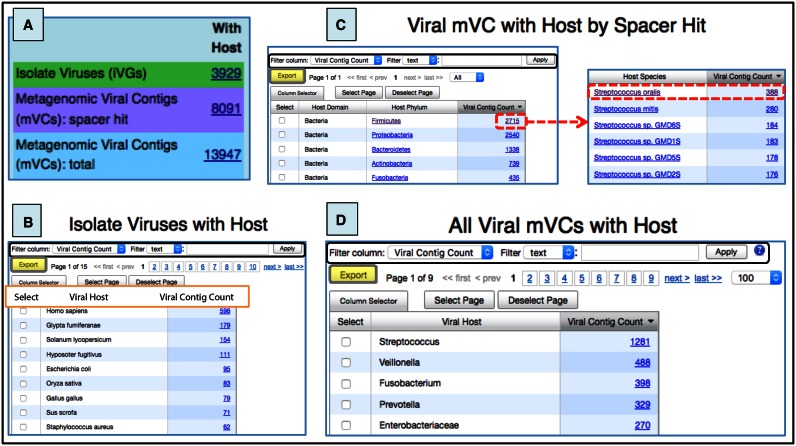
Viral data sets with host assignment. (A) Number of isolate viruses or metagenomic viral contigs with a predicted host. (B) ‘Isolate viruses with host’ table sorted by the hosts infected by the highest number of viral genomes. (C) Top microbial host species containing metagenomic viral contigs. (D) Microbial hosts (at different taxonomic levels) with the highest number of metagenomic viral contigs assigned. Columns in (B), (C), and (D) can be sorted by clicking on the column header and different filters can be used for specific searches (black boxes). Tables can be also exported in a tab-delimited text format by using the Export button (grey box with yellow background).
Figure 7.
Figure 7.
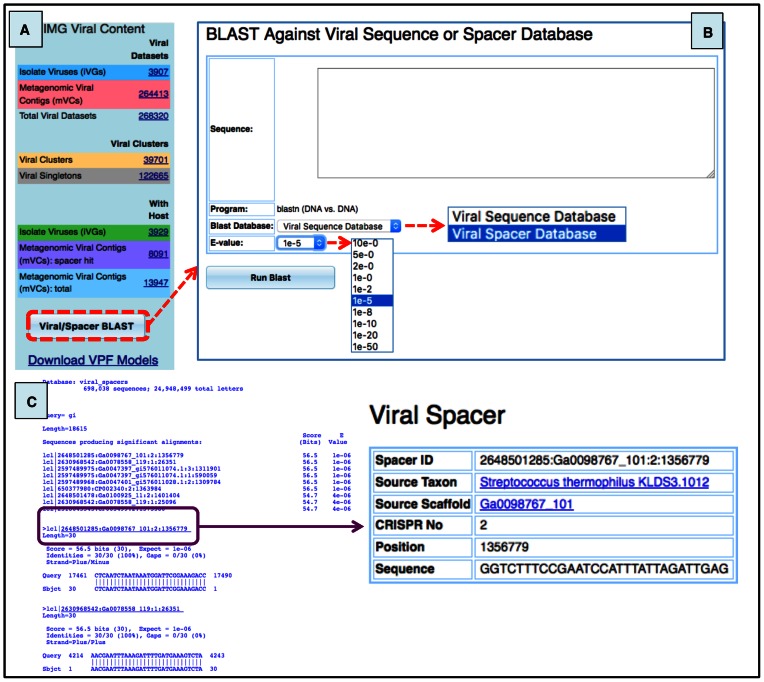
Viral searches against IMG/VR databases. (A) Location of blast tool in IMG/VR (dashed red box). (B) User interface to blast sequences. Exclusively nucleotide sequences can be queried currently in the system. Sequence(s) must be added into the blank area. Users can blast their sequence(s) against any of the two databases integrated into IMG/VR: ‘Viral Sequence’ or ‘Viral Spacer’ and customize the e-value cutoff. (C) Example of a blast output of an external partial viral sequence (Streptococcus phage 858) against the spacer database. When a sequence hit (purple box) is selected, a new panel (‘Viral Spacer’) is displayed showing details of the sequence spacer and the putative corresponding microbial host.

References

    1. Suttle C.A. Marine viruses—major players in the global ecosystem. Nat. Rev. Microbiol. 2007;5:801–812. - PubMed
    1. Gomez P., Buckling A. Bacteria-phage antagonistic coevolution in soil. Science. 2011;332:106–109. - PubMed
    1. Pal C., Macia M.D., Oliver A., Schachar I., Buckling A. Coevolution with viruses drives the evolution of bacterial mutation rates. Nature. 2007;450:1079–1081. - PubMed
    1. Brum J.R., Sullivan M.B. Rising to the challenge: accelerated pace of discovery transforms marine virology. Nat. Rev. Microbiol. 2015;13:147–159. - PubMed
    1. Fuhrman J.A. Marine viruses and their biogeochemical and ecological effects. Nature. 1999;399:541–548. - PubMed

Publication types