. 2016 Oct 24:13:28.
doi: 10.1186/s12014-016-9130-0. eCollection 2016.

Antibody-based proteomics to identify an apoptosis signature for early recurrence of hepatocellular carcinoma

Affiliations

Antibody-based proteomics to identify an apoptosis signature for early recurrence of hepatocellular carcinoma

Noriaki Morofuji et al. Clin Proteomics. .

Abstract

Background: Early recurrence after surgical resection is a hallmark of poor prognosis in hepatocellular carcinoma (HCC). To determine the proteomic background of early recurrence of HCC, we focused on apoptosis-related proteins.

Methods: Surgically resected tumor tissues were obtained from 80 patients, including HCC tumor tissues, non-tumor tissues, and normal liver tissues. These samples were grouped in the discovery and validation sample sets. The expression level of 192 apoptosis-related proteins was monitored using 247 commercially available antibodies and western blotting. The intensity of protein bands was compared between the tumor and non-tumor tissues as well as between the patients who had recurrence within 2 years after surgery and those who did not.

Results: In the first screening, we used pooled samples. The intensity of 53 protein bands detected by 37 unique antibodies was higher in tumor tissues compared with normal liver tissues, especially tumor tissues from patients who had recurrence within 2 years after surgery. In the second screening, we examined individual samples used to make the pooled samples. Among the selected bands and antibodies, the intensity of 18 protein bands detected by 11 antibodies was higher in tumor tissues compared with that in normal tissues, especially tumor tissues from the patients with early recurrence after surgery. For the third screening, we examined the samples from newly enrolled patients using these 11 antibodies. Eighteen protein bands detected by six antibodies were selected by using the same criteria. The corresponding antigens included ERK1, PKG, Apaf1, BclX, phosphorylated c-abl, and PIASx1/2.

Conclusions: We screened 192 apoptosis-related proteins using specific antibodies and western blotting. We identified 6 apoptosis-related proteins associated with carcinogenesis and early recurrence in HCC. The biological and clinical significance of the identified proteins are worth further investigation.

Keywords: Antibody-based proteomics; Apoptosis; Biomarker; Early recurrence; Hepatocellular carcinoma.


Figures
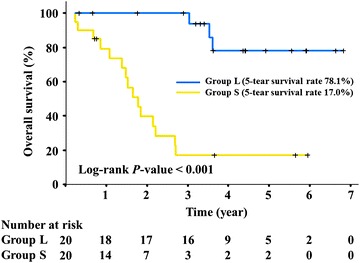
Fig. 1
Fig. 1
Survival curves of the 40 patients with HCC included in this study. Overall survival is shown for the two groups of patients: group S did and group L did not have recurrence within 2 years of surgery (n = 20 each). The two groups presented distinct prognoses
Fig. 2
Fig. 2
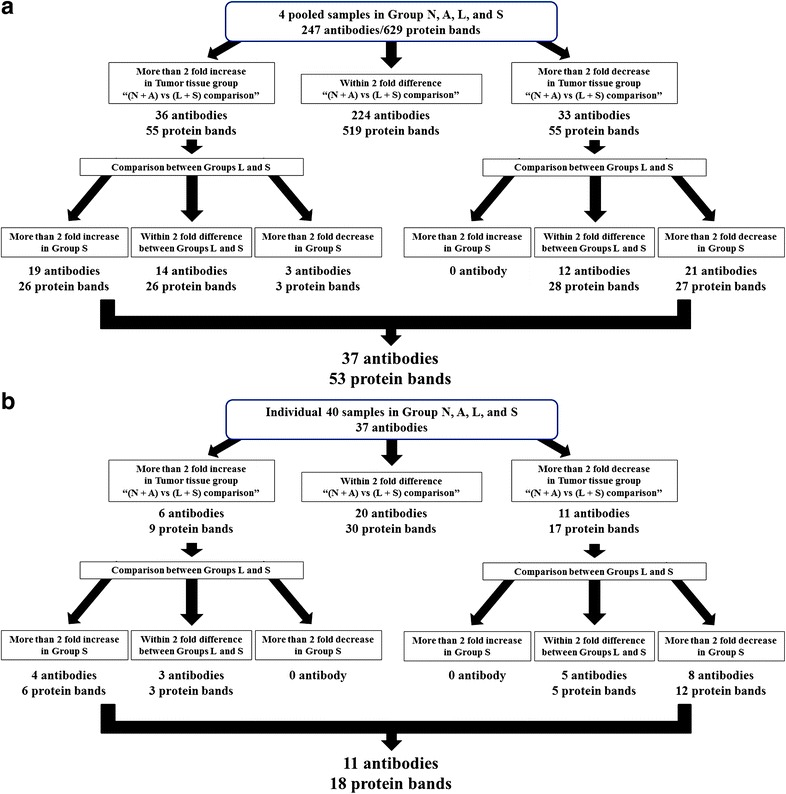
Flow chart of the experimental procedure and results of first and second screenings. A panel of 247 antibodies for 192 apoptosis-associated proteins was screened in surgically resected HCC and adjacent normal tissue samples. Single antibodies generated multiple protein bands by western blotting. Band intensity was compared between samples. a First screening using four sample pools such as group N (normal liver tissue), A (adjacent liver tissue), L (tumor tissue without recurrence), and S (tumor tissue with recurrence within 2 years of surgery). b Second screening for the selected 37 antibodies
Fig. 3
Fig. 3
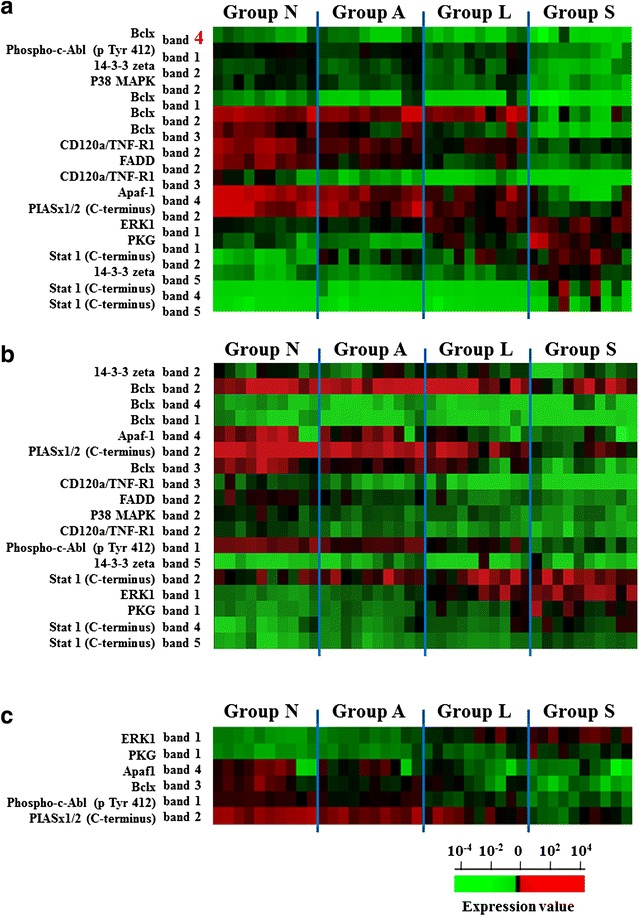
Heat map of antigens recognized by 11 selected antibodies. Band intensities were normalized among samples and blots. Measured intensities are displayed as a heat map. a In the first screening, the intensity of 18 protein bands for 11 antibodies was up- or downregulated in HCC carcinogenesis and progression. b In the next screening, we examined the selected 11 antibodies using the 40 samples from the newly enrolled patients. c In the independent validation study, the intensity of six bands for six antibodies differed among sample groups. The quantitative data for western blotting images are presented in Additional file 3: Table S2, Additional file 4: Table S3, Additional file 5: Table S4
Fig. 4
Fig. 4
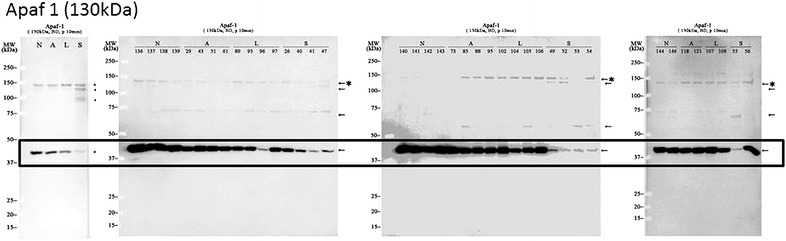
Western blot analysis of apaf-1 expression. Signals were observed in multiple locations in the blot and showed different intensities among sample groups. The theoretical molecular mass of apaf-1 is 130 kDa. The locations of the apaf-1 bands are indicated by arrows. The expected location of the apaf-1 band is indicated by an asterisk. The locations of apaf-1 bands associated with cancer progression and recurrence are boxed

References

    1. McGlynn KA, Tsao L, Hsing AW, Devesa SS, Fraumeni JF., Jr International trends and patterns of primary liver cancer. Int J Cancer. 2001;94:290–296. doi: 10.1002/ijc.1456. - DOI - PubMed
    1. Taylor-Robinson SD, Foster GR, Arora S, Hargreaves S, Thomas HC. Increase in primary liver cancer in the UK, 1979–94. Lancet. 1997;350:1142–1143. doi: 10.1016/S0140-6736(05)63789-0. - DOI - PubMed
    1. El-Serag HB, Davila JA, Petersen NJ, McGlynn KA. The continuing increase in the incidence of hepatocellular carcinoma in the United States: an update. Ann Intern Med. 2003;139:817–823. doi: 10.7326/0003-4819-139-10-200311180-00009. - DOI - PubMed
    1. El-Serag HB, Mason AC. Rising incidence of hepatocellular carcinoma in the United States. N Engl J Med. 1999;340:745–750. doi: 10.1056/NEJM199903113401001. - DOI - PubMed
    1. El-Serag HB, Mason AC, Key C. Trends in survival of patients with hepatocellular carcinoma between 1977 and 1996 in the United States. Hepatology. 2001;33:62–65. doi: 10.1053/jhep.2001.21041. - DOI - PubMed