


Change in sexual functioning over the menopausal transition: results from the Study of Women's Health Across the Nation
- PMID: 27801705
- PMCID: PMC5365345
- DOI: 10.1097/GME.0000000000000770
Change in sexual functioning over the menopausal transition: results from the Study of Women's Health Across the Nation
Abstract
Objective: The aim of the study was to identify whether there is a decline in sexual functioning related to the menopausal transition or to hysterectomy.
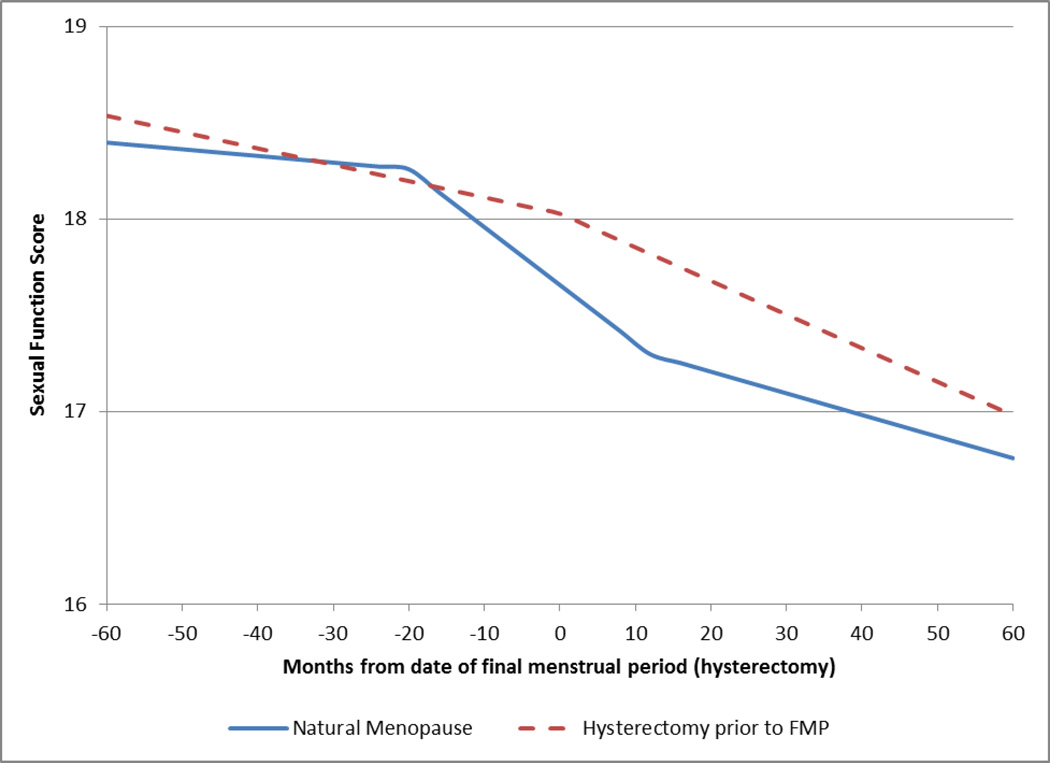
Methods: In a cohort of 1,390 women aged 42 to 52, with intact uterus and at least one ovary, not using hormone therapy, and pre- or early perimenopausal at baseline, we fit piecewise linear growth curves to 5,798 repeated measurements (seven visits spanning 14.5 y) of a sexual functioning score (range, 5-25) as a function of time relative to date of final menstrual period (FMP) or hysterectomy.
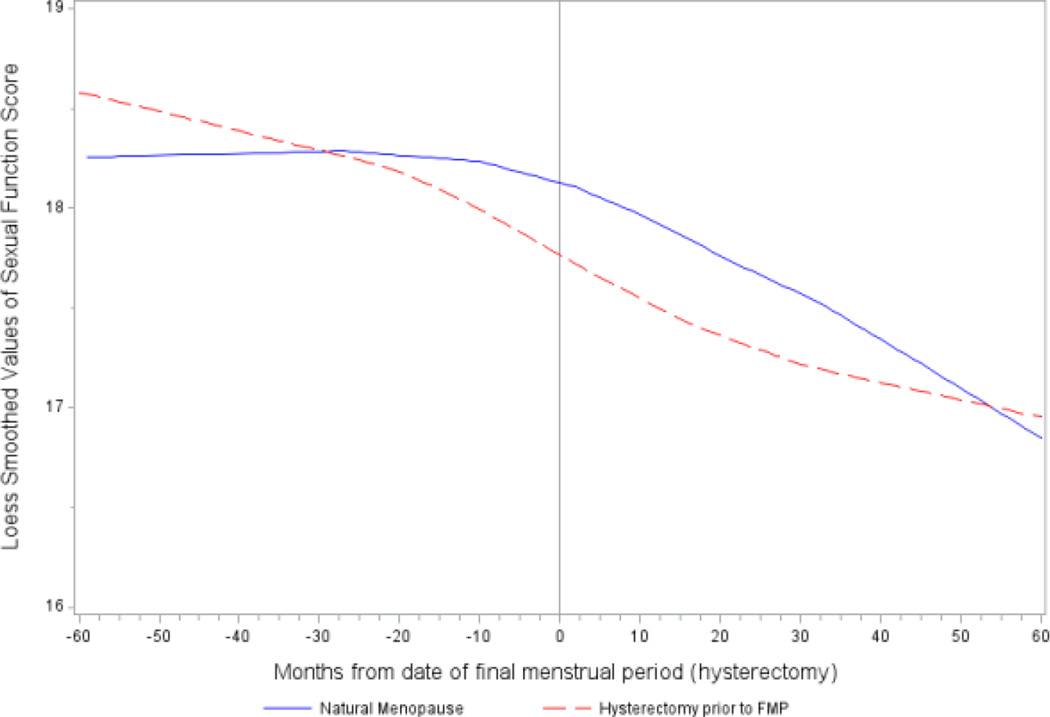
Results: Mean sexual functioning at baseline in women with a dateable FMP was 18.0 (SD, 3.4). There was no change in sexual function until 20 months before the FMP. From 20 months before until 1 year after the FMP, sexual function decreased by 0.35 annually (95% CI, -0.44 to -0.26) and continued to decline more than 1 year after the FMP, but at a slower rate (-0.13 annually, 95% CI, -0.17 to -0.10). The decline was smaller in African Americans and larger in Japanese than whites. Vaginal dryness, lubricant use, depressive symptoms, or anxiety did not explain decline in sexual function. Women who had a hysterectomy before the FMP did not show a decline in sexual function before hysterectomy, but scores declined afterward (0.21 annually, 95% CI, -0.28 to -0.14).
Conclusions: Decline in sexual function became apparent 20 months before FMP and slowed 1 year after FMP through 5 years afterward. A decline in sexual function was observed immediately after hysterectomy and persisted for the 5 years of observation.
Conflict of interest statement
Conflict of interest/financial disclosure: No other authors have any competing financial conflicts of interest.
Figures
Comment in
-
Declining sexuality at midlife.Menopause. 2017 Apr;24(4):358-359. doi: 10.1097/GME.0000000000000852. Menopause. 2017. PMID: 28225428 No abstract available.
References
-
- Laumann EO, Paik A, Rosen RC. Sexual dysfunction in the United States - Prevalence and predictors. JAMA. 1999;281:537–544. - PubMed
-
- Cain VS, Johannes CB, Avis NE, et al. Sexual functioning and practices in a multi-ethnic study of midlife women: baseline results from SWAN. J Sex Res. 2003;40:266–276. - PubMed
-
- Dennerstein L, Dudley EC, Burger H. Are changes in sexual functioning during midlife due to aging or menopause? Fertil Steril. 2001;76:456–460. - PubMed
-
- Gass MLS, Cochrane BB, Larson JC, et al. Patterns and predictors of sexual activity among women in the Hormone Therapy trials of the Women’s Health Initiative. Menopause. 2011;18:1160–1171. - PubMed
-
- Hallstrom T, Samuelsson S. Changes in women’s sexual desire in middle life: the longitudinal study of women in Gothenburg. Arch Sex Behav. 1990;19:259–268. - PubMed
Publication types
MeSH terms
Grants and funding
LinkOut - more resources
Full Text Sources
Other Literature Sources
