


Social support reduces stress hormone levels in wild chimpanzees across stressful events and everyday affiliations
- PMID: 27802260
- PMCID: PMC5097121
- DOI: 10.1038/ncomms13361
Social support reduces stress hormone levels in wild chimpanzees across stressful events and everyday affiliations
Abstract
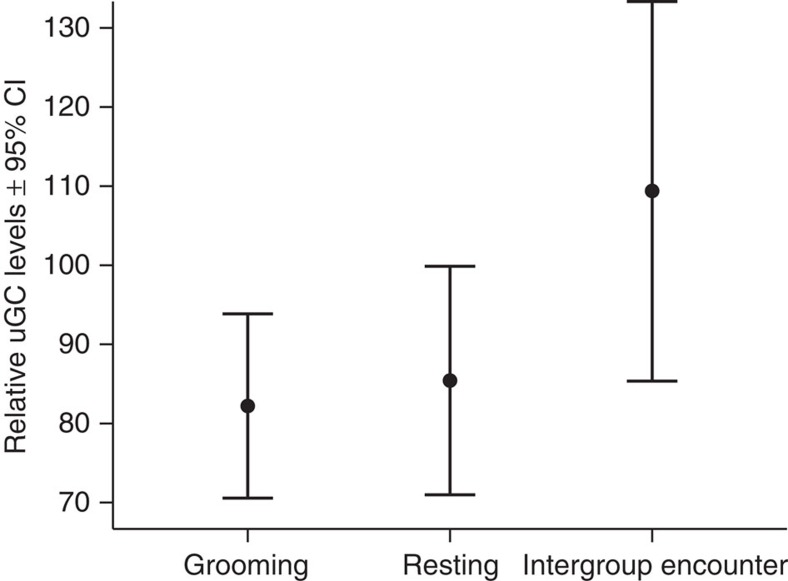
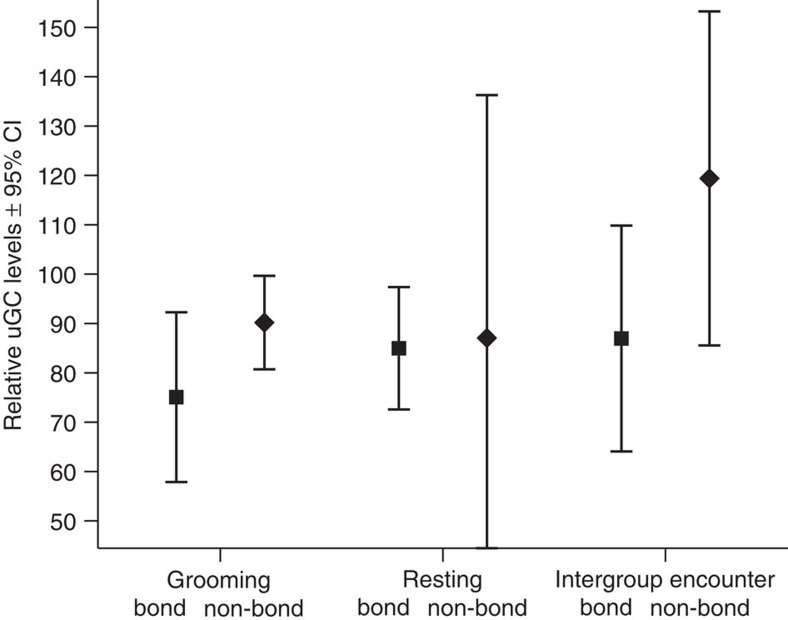
Stress is a major cause of poor health and mortality in humans and other social mammals. Close social bonds buffer stress, however much of the underlying physiological mechanism remains unknown. Here, we test two key hypotheses: bond partner effects occur only during stress (social buffering) or generally throughout daily life (main effects). We assess urinary glucocorticoids (uGC) in wild chimpanzees, with or without their bond partners, after a natural stressor, resting or everyday affiliation. Chimpanzees in the presence of, or interacting with, bond partners rather than others have lowered uGC levels across all three contexts. These results support the main effects hypothesis and indicate that hypothalamic-pituitary-adrenocortical (HPA) axis regulation is mediated by daily engagement with bond partners both within and out of stressful contexts. Regular social support with bond partners could lead to better health through daily 'micro-management' of the HPA axis, a finding with potential medical implications for humans.
Figures
References
-
- House J. S., Landis K. R. & Umberson D. Social relationships and health. Science 241, 540–545 (1988). - PubMed
-
- Silk J. B., Alberts S. C. & Altmann J. Social bonds of female baboons enhance infant survival. Science 302, 1231–1234 (2003). - PubMed
-
- Schülke O., Bhagavatula J., Vigilant L. & Ostner J. Social bonds enhance reproductive success in male macaques. Curr. Biol. 20, 2207–2210 (2010). - PubMed
-
- Silk J. B. et al. Strong and consistent social bonds enhance the longevity of female baboons. Curr. Biol. 20, 1359–1361 (2010). - PubMed
Publication types
MeSH terms
Substances
LinkOut - more resources
Full Text Sources
Other Literature Sources
Medical
