. 2016 Oct 11;17(1):211.
doi: 10.1186/s13059-016-1071-4.

Comparison of carnivore, omnivore, and herbivore mammalian genomes with a new leopard assembly

Affiliations

Comparison of carnivore, omnivore, and herbivore mammalian genomes with a new leopard assembly

Soonok Kim et al. Genome Biol. .

Abstract

Background: There are three main dietary groups in mammals: carnivores, omnivores, and herbivores. Currently, there is limited comparative genomics insight into the evolution of dietary specializations in mammals. Due to recent advances in sequencing technologies, we were able to perform in-depth whole genome analyses of representatives of these three dietary groups.

Results: We investigated the evolution of carnivory by comparing 18 representative genomes from across Mammalia with carnivorous, omnivorous, and herbivorous dietary specializations, focusing on Felidae (domestic cat, tiger, lion, cheetah, and leopard), Hominidae, and Bovidae genomes. We generated a new high-quality leopard genome assembly, as well as two wild Amur leopard whole genomes. In addition to a clear contraction in gene families for starch and sucrose metabolism, the carnivore genomes showed evidence of shared evolutionary adaptations in genes associated with diet, muscle strength, agility, and other traits responsible for successful hunting and meat consumption. Additionally, an analysis of highly conserved regions at the family level revealed molecular signatures of dietary adaptation in each of Felidae, Hominidae, and Bovidae. However, unlike carnivores, omnivores and herbivores showed fewer shared adaptive signatures, indicating that carnivores are under strong selective pressure related to diet. Finally, felids showed recent reductions in genetic diversity associated with decreased population sizes, which may be due to the inflexible nature of their strict diet, highlighting their vulnerability and critical conservation status.

Conclusions: Our study provides a large-scale family level comparative genomic analysis to address genomic changes associated with dietary specialization. Our genomic analyses also provide useful resources for diet-related genetic and health research.

Keywords: Carnivorous diet; Comparative genomics; De novo assembly; Evolutionary adaptation; Felidae; Leopard.


Figures
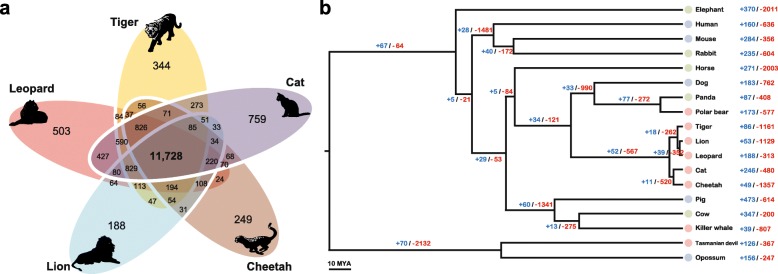
Fig. 1
Fig. 1
Relationship of Felidae to other mammalian species. a Orthologous gene clusters in Felidae species. Orthologous gene clusters were constructed using 18 mammalian genomes. Only Felidae species gene clusters are displayed in this figure. b Gene expansion or contraction in mammalian species. Branch numbers indicate the number of gene families that have expanded (blue) and contracted (red) after the split from the common ancestor. Colors of circles represent diet groups (light red: carnivore, light blue: omnivore, light green: herbivore). The time lines indicate divergence times among the species
Fig. 2
Fig. 2
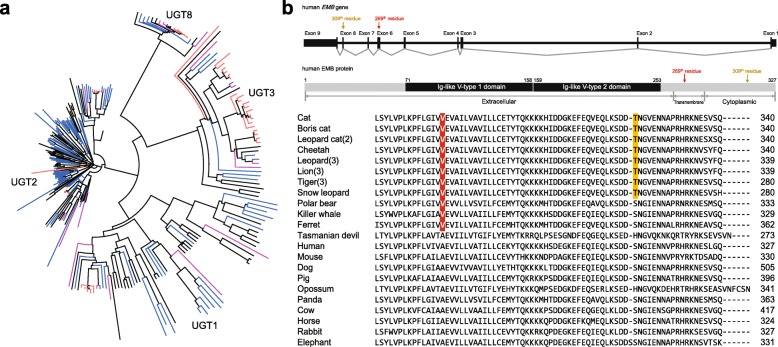
Gene copy evolution and amino acid changes (AACs) in Felidae and carnivores. a Contracted (UGT1 and UGT2) and expanded (UGT3) UDP-glucuronosyltransferase families in carnivores. The red, violet, blue, and black nodes are UGT family genes in the five cats, non-cat carnivores (polar bear, killer whale, and Tasmanian devil), five herbivores, and five omnivores, respectively. b Convergent AAC found in carnivores. Human embigin (EMB) gene and predicted protein structures are illustrated in the upper part. Amino acids specific to the carnivores (269th residue in human EMB protein, transmembrane region) and felids (309th residue, cytoplasmic region) in EMB protein are shown in red and yellow, respectively. The numbers in parentheses are number of genomes analyzed in this study
Fig. 3
Fig. 3
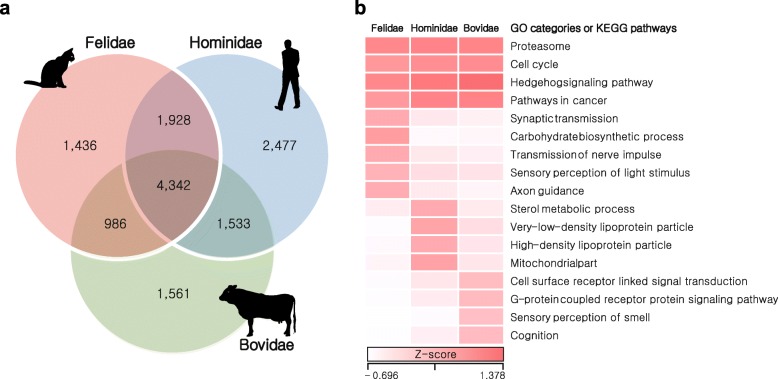
HCRs in Felidae, Hominidae, and Bovidae. HCRs in the same family species were identified by calculating the ratios between numbers of conserved and non-conserved positions. a Venn diagrams of genes in the HCRs. b Heatmap of enriched gene ontology (GO) categories or KEGG pathways in the HCRs. Z-scores for the average fractions of homozygous positions are shown as a white-to-red color scale
Fig. 4
Fig. 4
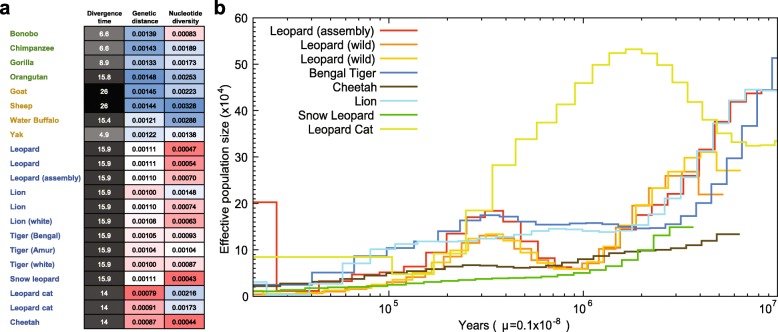
Genetic diversity in Felidae species. a Genetic distances and nucleotide diversities. Sequences of Felidae, Hominidae, and Bovidae were mapped to cat, human, and cow references, respectively. The genetic distances were calculated by dividing the number of homozygous SNVs to the reference genome by corresponding species genome size (bp) and divergence time (MYA). Nucleotide diversities were calculated by dividing the number of heterozygous SNVs by the genome size. The divergence times were from TimeTree database. b Estimated felids population sizes. Generation times of the leopard cat and big cats are three and five years, respectively. μ is mutation rate (per site, per year)

References

    1. Van Valkenburgh B. Major patterns in the history of carnivorous mammals. Annu Rev Earth Planet Sci. 1999;27:463–93. doi: 10.1146/annurev.earth.27.1.463. - DOI
    1. Van Valkenburgh B, Wang X, Damuth J. Cope’s rule, hypercarnivory, and extinction in North American canids. Science. 2004;306:101–4. doi: 10.1126/science.1102417. - DOI - PubMed
    1. Li R, Fan W, Tian G, Zhu H, He L, Cai J, et al. The sequence and de novo assembly of the giant panda genome. Nature. 2010;463:311–7. doi: 10.1038/nature08696. - DOI - PMC - PubMed
    1. Ripple WJ, Estes JA, Beschta RL, Wilmers CC, Ritchie EG, Hebblewhite M, et al. Status and ecological effects of the world’s largest carnivores. Science. 2014;343:1241484. doi: 10.1126/science.1241484. - DOI - PubMed
    1. Fedriani JM, Fuller TK, Sauvajot RM, York EC. Competition and intraguild predation among three sympatric carnivores. Oecologia. 2000;125:258–70. doi: 10.1007/s004420000448. - DOI - PubMed

Publication types