. 2016 Oct 18:7:1588.
doi: 10.3389/fmicb.2016.01588. eCollection 2016.

Transparent DNA/RNA Co-extraction Workflow Protocol Suitable for Inhibitor-Rich Environmental Samples That Focuses on Complete DNA Removal for Transcriptomic Analyses

Affiliations

Transparent DNA/RNA Co-extraction Workflow Protocol Suitable for Inhibitor-Rich Environmental Samples That Focuses on Complete DNA Removal for Transcriptomic Analyses

Natalie Y N Lim et al. Front Microbiol. .

Abstract

Adequate comparisons of DNA and cDNA libraries from complex environments require methods for co-extraction of DNA and RNA due to the inherent heterogeneity of such samples, or risk bias caused by variations in lysis and extraction efficiencies. Still, there are few methods and kits allowing simultaneous extraction of DNA and RNA from the same sample, and the existing ones generally require optimization. The proprietary nature of kit components, however, makes modifications of individual steps in the manufacturer's recommended procedure difficult. Surprisingly, enzymatic treatments are often performed before purification procedures are complete, which we have identified here as a major problem when seeking efficient genomic DNA removal from RNA extracts. Here, we tested several DNA/RNA co-extraction commercial kits on inhibitor-rich soils, and compared them to a commonly used phenol-chloroform co-extraction method. Since none of the kits/methods co-extracted high-quality nucleic acid material, we optimized the extraction workflow by introducing small but important improvements. In particular, we illustrate the need for extensive purification prior to all enzymatic procedures, with special focus on the DNase digestion step in RNA extraction. These adjustments led to the removal of enzymatic inhibition in RNA extracts and made it possible to reduce genomic DNA to below detectable levels as determined by quantitative PCR. Notably, we confirmed that DNase digestion may not be uniform in replicate extraction reactions, thus the analysis of "representative samples" is insufficient. The modular nature of our workflow protocol allows optimization of individual steps. It also increases focus on additional purification procedures prior to enzymatic processes, in particular DNases, yielding genomic DNA-free RNA extracts suitable for metatranscriptomic analysis.

Keywords: RNA extraction; environmental sample; enzyme inhibition; genomic DNA removal; purification.


Figures
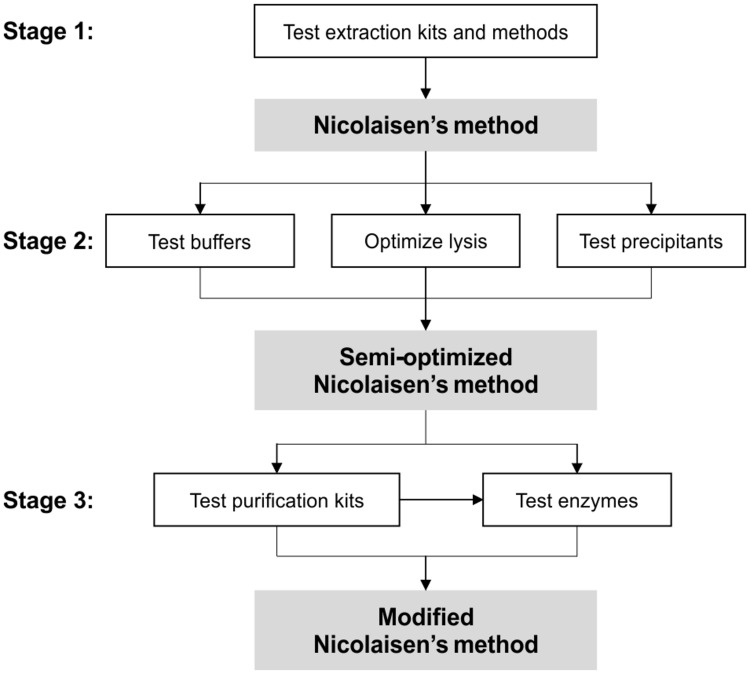
FIGURE 1
FIGURE 1
Schematic diagram of the optimization process. In Stage 1 of the process, various extraction kits and Nicolaisen’s method (as listed in Table 1) was tested on soils FH and FL (see text for soil descriptions). In Stage 2, various extraction buffers, lysis conditions, and nucleic acid precipitants were tested using Nicolaisen’s method as the base, creating a new “semi-optimized Nicolaisen’s method.” In the final Stage 3, DNases/reverse transcriptases and purification kits were tested concurrently for their ability to completely remove genomic DNA, and was briefly tested in combination. The end result is the “Modified Nicolaisen’s method,” which is based on the workflow as outlined in Figure 2.
FIGURE 2
FIGURE 2
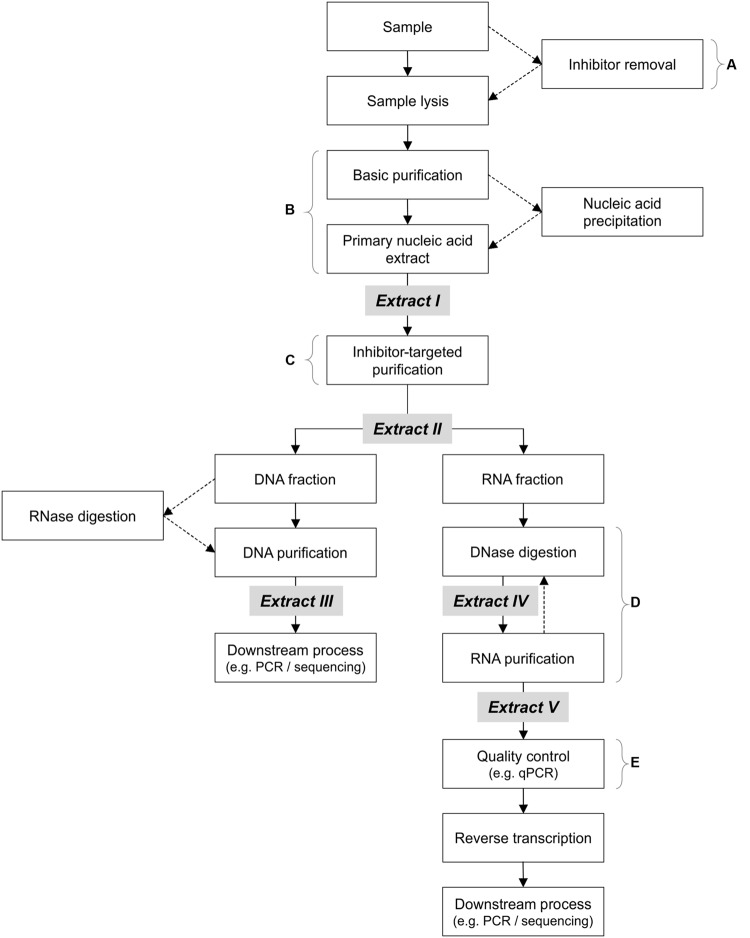
Suggested DNA/RNA co-extraction workflow for environmental samples, with stronger emphasis on thorough purification prior to all enzymatic steps (including DNase digestion). Optional steps are indicated by dotted arrows. Note that RNase digestion (between Extracts II and III) may be necessary for better results downstream, but may be omitted as a separate step (in the current study, RNase is present in the qPCR mix). (A) Pre-lysis inhibitor removal is only advisable if quick methods are used, or if mRNA is not the target molecule (lengthy inhibitor removal procedures compromise RNA integrity). (B) Various methods may be used, such as phenol/chloroform procedures or nucleic acid precipitation. (C) This purification step should target the removal of enzymatic-inhibitors (e.g., humic/fulvic acids and polyphenolics). (D) Purification of partially digested RNA extracts with residual genomic DNA aids in the removal of enduring inhibitors, prior to further digestion. (E) Stringent and well-documented quality control via rigorous and sensitive detection (preferably quantitative methods) is necessary to detect residual amplifiable gDNA prior to reverse transcription.
FIGURE 3
FIGURE 3
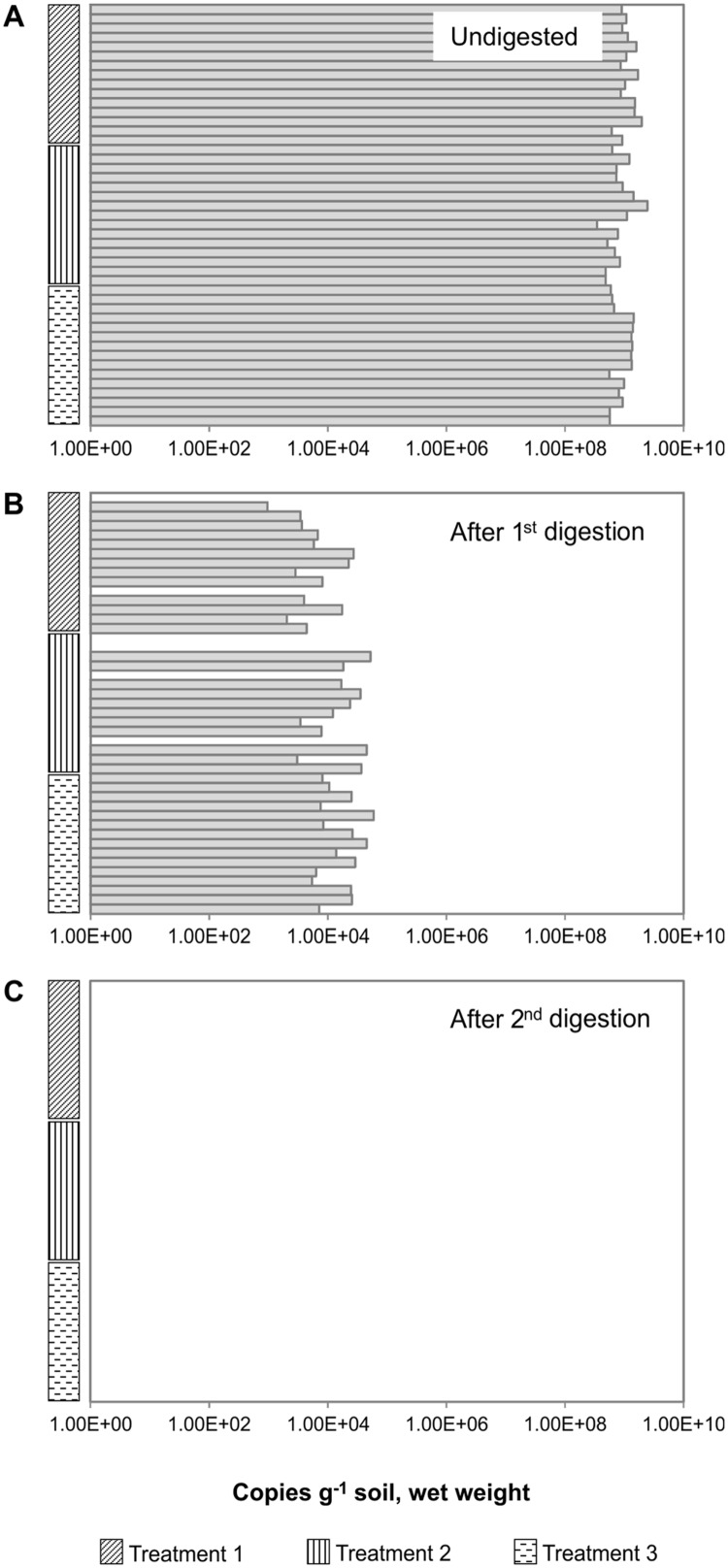
Removal of gDNA by consecutive DNase digestions of total nucleic acids (TNA) extracted from 45 Å soil samples. The soil had been exposed to different oxygen regimes (here called Treatments 1, 2, and 3), for details see section “Materials and Methods.” The soils were incubated anoxically to stimulate denitrification gene expression, and samples were taken at time intervals. TNA was extracted using the optimized and simplified method, and the nosZ was quantified by qPCR. (A) After extraction via the optimized method, all samples were tested for the presence of DNA. Neither the different oxygen regimes nor the stimulation of gene expression affected the number of nosZ genes in the gDNA from the different samples. (B) The first digest removed most amplifiable genomic DNA (gDNA) present. (C) The second DNase treatment removed amplifiable gDNA in all samples. There was no relationship between the starting DNA quantity and the success of complete gDNA removal (R2 = 0.0189). This highlights the importance of checking all RNA samples and not only representative samples, as there may be high variability among samples from the same source and extraction procedure.

References

    1. Abu Al-Soud W., Rådström P. (1998). Capacity of nine thermostable DNA polymerases to mediate DNA amplification in the presence of PCR-inhibiting samples. Appl. Environ. Microbiol. 64 3748–3753. - PMC - PubMed
    1. Arbeli Z., Fuentes C. L. (2007). Improved purification and PCR amplification of DNA from environmental samples. FEMS Microbiol. Lett. 272 269–275. 10.1111/j.1574-6968.2007.00764.x - DOI - PubMed
    1. Baar C., d’Abbadie M., Vaisman A., Arana M. E., Hofreiter M., Woodgate R., et al. (2011). Molecular breeding of polymerases for resistance to environmental inhibitors. Nucleic Acids Res. 39:e51 10.1093/nar/gkq1360 - DOI - PMC - PubMed
    1. Bachoon D. S., Otero E., Hodson R. E. (2001). Effects of humic substances on fluorometric DNA quantification and DNA hybridization. J. Microbiol. Methods 47 73–82. 10.1016/S0167-7012(01)00296-2 - DOI - PubMed
    1. Bolger A. M., Lohse M., Usadel B. (2014). Trimmomatic: a flexible trimmer for Illumina sequence data. Bioinformatics 30 2114–2120. 10.1093/bioinformatics/btu170 - DOI - PMC - PubMed

LinkOut - more resources