Localization of Insulinoma Using 68Ga-DOTATATE PET/CT Scan
- PMID: 27805844
- PMCID: PMC6083884
- DOI: 10.1210/jc.2016-3445
Localization of Insulinoma Using 68Ga-DOTATATE PET/CT Scan
Abstract
Context: Reliable localization of insulinoma is critical for successful treatment.
Objective: This study compared the accuracy of 68Gallium DOTA-(Tyr3)-octreotate (Ga-DOTATATE) positron emission tomography (PET)/computed tomography (CT) to anatomic imaging modalities, selective arterial secretagogue injection (SASI), and intraoperative ultrasound (IO ultrasound) and palpation for localizing insulinoma in patients who were biochemically cured.
Design, setting, and patients: We conducted a retrospective analysis of 31 patients who had an insulinoma. The results of CT, magnetic resonance imaging (MRI), ultrasound, IO ultrasound, 68Ga-DOTATATE PET/CT, SASI, and operative findings were analyzed.
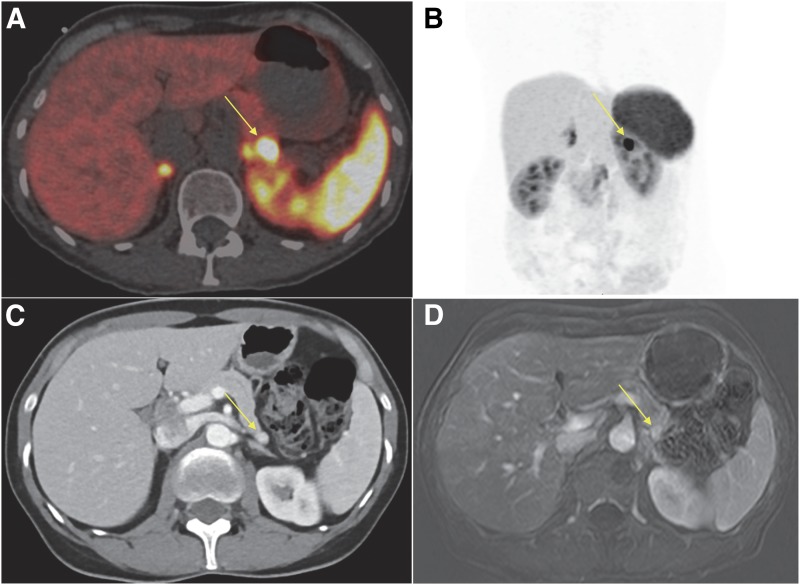
Intervention, main outcome measures, and results: The insulinomas were correctly localized in 17 out of 31 (55%) patients by CT, in 17 out of 28 (61%) by MRI, in 6 out of 28 (21%) by ultrasound, and in 9 out of 10 (90%) by 68Ga-DOTATATE. In 29 of 31 patients (93.5%) who had IO ultrasound, an insulinoma was successfully localized. Thirty patients underwent SASI, and the insulinoma was regionalized in 28 out of 30 patients (93%). In 19 out of 23 patients (83%), manual palpation identified insulinoma. In patients who had all 4 noninvasive imaging studies, CT was concordant with 68Ga-DOTATATE in 6 out of 9 patients (67%), MRI in 8 out of 9 (78%), ultrasound in 0 out of 9; the lesion was only seen by 68Ga-DOTATATE in 1 out of 9 (11%).
Conclusions: 68Ga-DOTATATE PET/CT identifies most insulinomas and may be considered as an adjunct imaging study when all imaging studies are negative and when a minimally invasive surgical approach is planned.
Copyright © 2017 by the Endocrine Society
Figures
References
-
- Zhou J, Enewold L, Stojadinovic A, Clifton GT, Potter JF, Peoples GE, Zhu K. Incidence rates of exocrine and endocrine pancreatic cancers in the United States. Cancer Causes Control. 2010;21(6):853–861. - PubMed
-
- Hirshberg B, Livi A, Bartlett DL, Libutti SK, Alexander HR, Doppman JL, Skarulis MC, Gorden P. Forty-eight-hour fast: the diagnostic test for insulinoma. J Clin Endocrinol Metab. 2000;85(9):3222–3226. - PubMed
-
- Mansour JC, Chen H. Pancreatic endocrine tumors. J Surg Res. 2004;120(1):139–161. - PubMed
MeSH terms
Substances
LinkOut - more resources
Full Text Sources
Other Literature Sources