


Benefits of virtual reality based cognitive rehabilitation through simulated activities of daily living: a randomized controlled trial with stroke patients
- PMID: 27806718
- PMCID: PMC5094135
- DOI: 10.1186/s12984-016-0204-z
Benefits of virtual reality based cognitive rehabilitation through simulated activities of daily living: a randomized controlled trial with stroke patients
Abstract
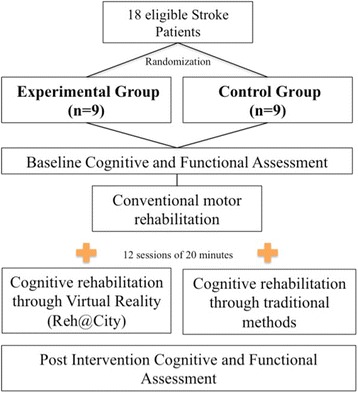
Background: Stroke is one of the most common causes of acquired disability, leaving numerous adults with cognitive and motor impairments, and affecting patients' capability to live independently. There is substancial evidence on post-stroke cognitive rehabilitation benefits, but its implementation is generally limited by the use of paper-and-pencil methods, insufficient personalization, and suboptimal intensity. Virtual reality tools have shown potential for improving cognitive rehabilitation by supporting carefully personalized, ecologically valid tasks through accessible technologies. Notwithstanding important progress in VR-based cognitive rehabilitation systems, specially with Activities of Daily Living (ADL's) simulations, there is still a need of more clinical trials for its validation. In this work we present a one-month randomized controlled trial with 18 stroke in and outpatients from two rehabilitation units: 9 performing a VR-based intervention and 9 performing conventional rehabilitation.
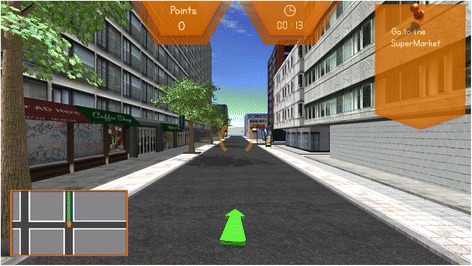
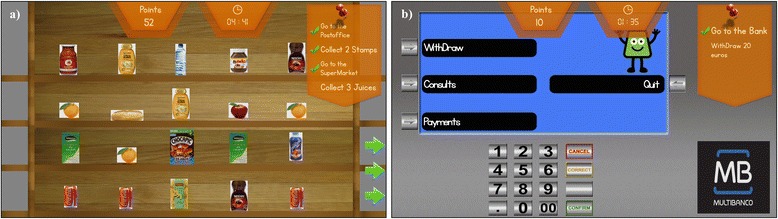
Methods: The VR-based intervention involved a virtual simulation of a city - Reh@City - where memory, attention, visuo-spatial abilities and executive functions tasks are integrated in the performance of several daily routines. The intervention had levels of difficulty progression through a method of fading cues. There was a pre and post-intervention assessment in both groups with the Addenbrooke Cognitive Examination (primary outcome) and the Trail Making Test A and B, Picture Arrangement from WAIS III and Stroke Impact Scale 3.0 (secondary outcomes).
Results: A within groups analysis revealed significant improvements in global cognitive functioning, attention, memory, visuo-spatial abilities, executive functions, emotion and overall recovery in the VR group. The control group only improved in self-reported memory and social participation. A between groups analysis, showed significantly greater improvements in global cognitive functioning, attention and executive functions when comparing VR to conventional therapy.
Conclusions: Our results suggest that cognitive rehabilitation through the Reh@City, an ecologically valid VR system for the training of ADL's, has more impact than conventional methods.
Trial registration: This trial was not registered because it is a small sample study that evaluates the clinical validity of a prototype virtual reality system.
Keywords: Cognitive rehabilitation; Ecological validity; Stroke; Virtual reality.
Figures
References
-
- World Health Organization. The top 10 causes of death. July 2013. 2015. Available at: who.int/mediacentre/factsheets/fs310/en/. [Accessed July 2015].
-
- Brainin M, Norrving B, Sunnerhagen KS, Goldstein LB, Cramer SC, Donnan GA, et al. Poststroke chronic disease management: towards improved identification and interventions for poststroke spasticity-related complications. Int J Stroke. 2011;6(1):42–6. doi: 10.1111/j.1747-4949.2010.00539.x. - DOI - PubMed
Publication types
MeSH terms
LinkOut - more resources
Full Text Sources
Other Literature Sources
Medical
