. 2016 Dec 14;36(50):12559-12569.
doi: 10.1523/JNEUROSCI.0626-16.2016. Epub 2016 Nov 2.

Aging Affects Dopaminergic Neural Mechanisms of Cognitive Flexibility

Affiliations

Aging Affects Dopaminergic Neural Mechanisms of Cognitive Flexibility

Anne S Berry et al. J Neurosci. .

Abstract

Aging is accompanied by profound changes in the brain's dopamine system that affect cognitive function. Evidence of powerful individual differences in cognitive aging has sharpened focus on identifying biological factors underlying relative preservation versus vulnerability to decline. Dopamine represents a key target in these efforts. Alterations of dopamine receptors and dopamine synthesis are seen in aging, with receptors generally showing reduction and synthesis demonstrating increases. Using the PET tracer 6-[18F]fluoro-l-m-tyrosine, we found strong support for upregulated striatal dopamine synthesis capacity in healthy older adult humans free of amyloid pathology, relative to young people. We next used fMRI to define the functional impact of elevated synthesis capacity on cognitive flexibility, a core component of executive function. We found clear evidence in young adults that low levels of synthesis capacity were suboptimal, associated with diminished cognitive flexibility and altered frontoparietal activation relative to young adults with highest synthesis values. Critically, these relationships between dopamine, performance, and activation were transformed in older adults with higher synthesis capacity. Variability in synthesis capacity was related to intrinsic frontoparietal functional connectivity across groups, suggesting that striatal dopamine synthesis influences the tuning of networks underlying cognitive flexibility. Together, these findings define striatal dopamine's association with cognitive flexibility and its neural underpinnings in young adults, and reveal the alteration in dopamine-related neural processes in aging.

Significance statement: Few studies have combined measurement of brain dopamine with examination of the neural basis of cognition in youth and aging to delineate the underlying mechanisms of these associations. Combining in vivo PET imaging of dopamine synthesis capacity, fMRI, and a sensitive measure of cognitive flexibility, we reveal three core findings. First, we find evidence supporting older adults' capacity to upregulate dopamine synthesis. Second, we define relationships between dopamine, cognition, and frontoparietal activity in young adults indicating high levels of synthesis capacity are optimal. Third, we demonstrate alteration of these relationships in older adults, suggesting neurochemical modulation of cognitive flexibility changes with age.

Keywords: PET; aging; cognitive flexibility; dopamine; fMRI; task switching.


Figures

Figure 1.
Figure 1.
FMT signal is elevated in older adults relative to young. a, ROIs in bilateral DCA, DPUT, and VST were drawn on each participant's structural scan and were coregistered with FMT Ki images. Above are one participant's ROIs overlaid on Ki image. The scale reflects Ki values. b, Dopamine synthesis capacity was elevated in older adults relative to young (F(1,34) = 18.94, p < 0.001). Partial volume corrected (PVC) Ki values are displayed. Data are mean ± SEM.
Figure 2.
Figure 2.
Relationship between FMT and switch cost. a, Participants performed a two-condition task switching paradigm. Cues indicated whether the odd/even rule or the >5/<5 rule applied. Switch cost was calculated as the percentage increase in response time for task switch trials relative to task repeat trials. b, There was a U-shaped quadratic relationship between dorsal caudate FMT Ki and switch cost (r2 = 0.36, p = 0.0002; y = 231,948.60x2 − 13,754.936x + 208.85). Dotted line indicates quadratic fit. Gray represents 90% confidence interval. There was a significant interaction between age group, FMT Ki, and switch cost (F(1,32) = 9.03, p = 0.005). Solid line indicates young adult linear fit line. Dashed line indicates older adult linear fit line.
Figure 3.
Figure 3.
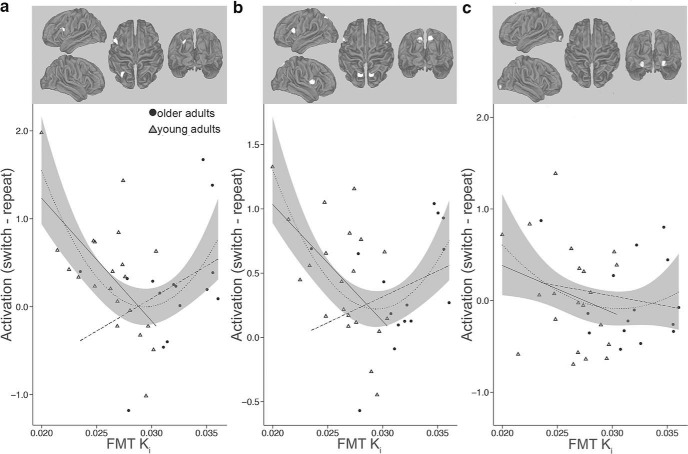
Relationship between FMT and frontoparietal activation. a, There was a quadratic relationship between dorsal caudate FMT Ki (average left and right) and frontoparietal activation in averaged a priori ROIs (r2 = 0.26, p = 0.002; y = 17477.89 x2 − 1027.98x + 15.11). a–c, Dotted line indicates quadratic fit. Gray represents 90% confidence interval. There was a significant interaction between age group, FMT Ki, and activation (F(1,32) = 11.22, p = 0.002). Solid line indicates young adult linear fit line. Dashed line indicates older adult linear fit line. ROIs were 8 mm spheres surrounding inferior frontal gyrus (−46, 14, 24), and superior parietal lobule (−28, −70, 45) defined by Braver et al. (2003). b, Similarly, there was a quadratic relationship between dorsal caudate FMT Ki and averaged frontoparietal activation in ROIs defined by the present study (r2 = 0.28, p = 0.002, y = 12,153.36x2 − 715.18x + 10.74). There was a significant interaction between age group, FMT Ki, and activation (F(1,32) = 8.53, p = 0.006). ROIs were 8 mm spheres surrounding bilateral inferior frontal gyrus (54, 6, 10; −54, 14, 18) and precuneus (12, −68, 52; −12, −68, 48). c, There was no quadratic relationship between dorsal caudate FMT Ki and primary visual cortex activation (r2 = 0.04, p = 0.20), and no interaction between age group, FMT Ki, and activation (F(1,32) < 1). ROIs were 8 mm spheres surrounding primary visual cortex (MNI ±28, −96, −6). All coordinates are in MNI space.
Figure 4.
Figure 4.
Univariate activation during task switching. Activation is displayed for the contrast switch > repeat trials for young and older adults. T-maps are displayed on CARET semi-inflated templates with a combined height threshold of p < 0.001 and 50 voxel extent threshold (AlphaSim cluster-level threshold, p < 0.05). Scale reflects t values.
Figure 5.
Figure 5.
Relationship between FMT and frontoparietal-dorsal caudate functional connectivity. a, Frontoparietal resting state functional connectivity maps were generated using seeds identified in the univariate analysis for the contrast switch > repeat. Seeds were 8 mm spheres surrounding bilateral inferior frontal gyrus (54, 6, 10; −54, 14, 18) and precuneus (12, −68, 52; −12, −68, 48). T-maps are displayed on CARET semi-inflated templates. Scale reflects t values. Coordinates are in MNI space. b, There was a quadratic relationship between dorsal caudate FMT Ki (average left and right) and frontoparietal-DCA functional connectivity (r2 = 0.16, p = 0.02, y = −1295.57x2 + 74.75 − 1.04). There was not a significant interaction between age group, FMT Ki, and connectivity (F(1,32) = 1.46, p = 0.24). b, c, Dotted line indicates quadratic fit. Gray represents 90% confidence interval. Solid line indicates young adult linear fit line. Dashed line indicates older adult linear fit line. c, There was no quadratic relationship between dorsal caudate FMT Ki and frontoparietal-primary visual cortex functional connectivity (r2 = 0.02, p = 0.27), and no interaction between age group, FMT Ki, and functional connectivity (F(1,32) < 1).

References

    1. Alexander GE, DeLong MR, Strick PL. Parallel organization of functionally segregated circuits linking basal ganglia and cortex. Annu Rev Neurosci. 1986;9:357–381. doi: 10.1146/annurev.ne.09.030186.002041. - DOI - PubMed
    1. Anderson JS, Ferguson MA, Lopez-Larson M, Yurgelun-Todd D. Reproducibility of single-subject functional connectivity measurements. AJNR Am J Neuroradiol. 2011;32:548–555. - PMC - PubMed
    1. Bäckman L, Ginovart N, Dixon RA, Wahlin TB, Wahlin A, Halldin C, Farde L. Age-related cognitive deficits mediated by changes in the striatal dopamine system. Am J Psychiatry. 2000;157:635–637. doi: 10.1176/ajp.157.4.635. - DOI - PubMed
    1. Bäckman L, Karlsson S, Fischer H, Karlsson P, Brehmer Y, Rieckmann A, MacDonald SW, Farde L, Nyberg L. Dopamine D(1) receptors and age differences in brain activation during working memory. Neurobiol Aging. 2011;32:1849–1856. doi: 10.1016/j.neurobiolaging.2009.10.018. - DOI - PubMed
    1. Bakeman R. Recommended effect size statistics for repeated measures designs. Behav Res Methods. 2005;37:379–384. doi: 10.3758/BF03192707. - DOI - PubMed

Publication types

MeSH terms

LinkOut - more resources