Review
. 2016 Nov;6(11):1215-1229.
doi: 10.1158/2159-8290.CD-16-0745. Epub 2016 Oct 19.

Emergence of the Noncoding Cancer Genome: A Target of Genetic and Epigenetic Alterations

Affiliations
Review

Emergence of the Noncoding Cancer Genome: A Target of Genetic and Epigenetic Alterations

Stanley Zhou et al. Cancer Discov. 2016 Nov.

Abstract

The emergence of whole-genome annotation approaches is paving the way for the comprehensive annotation of the human genome across diverse cell and tissue types exposed to various environmental conditions. This has already unmasked the positions of thousands of functional cis-regulatory elements integral to transcriptional regulation, such as enhancers, promoters, and anchors of chromatin interactions that populate the noncoding genome. Recent studies have shown that cis-regulatory elements are commonly the targets of genetic and epigenetic alterations associated with aberrant gene expression in cancer. Here, we review these findings to showcase the contribution of the noncoding genome and its alteration in the development and progression of cancer. We also highlight the opportunities to translate the biological characterization of genetic and epigenetic alterations in the noncoding cancer genome into novel approaches to treat or monitor disease.

Significance: The majority of genetic and epigenetic alterations accumulate in the noncoding genome throughout oncogenesis. Discriminating driver from passenger events is a challenge that holds great promise to improve our understanding of the etiology of different cancer types. Advancing our understanding of the noncoding cancer genome may thus identify new therapeutic opportunities and accelerate our capacity to find improved biomarkers to monitor various stages of cancer development. Cancer Discov; 6(11); 1215-29. ©2016 AACR.


Conflict of interest statement

of Potential Conflicts of Interest No potential conflicts of interest to disclose.

Figures
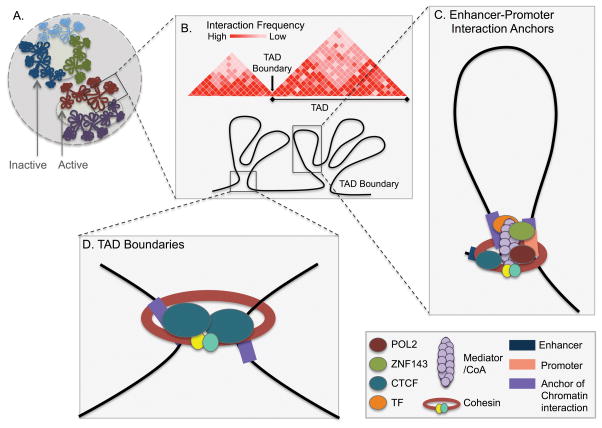
Figure 1
Figure 1. The genome is organized through a hierarchy of long-range interactions
A) Large chromosomal neighborhoods associate with each other in the nuclear space. Euchromatic regions that are associated with high transcriptional activity tend to cluster in the center of the nucleus. In contrast, heterochromatic regions associated with transcriptional repression tend to cluster at the nuclear periphery. B) Heat map representing virtual genome-wide chromatin interaction maps. Mega-base scale chromatin interaction partitions the genome into domains of interactions known as Topologically Associated Domains (TADs). TAD boundaries preclude interactions between neighboring TADs, therefore restricting most interactions to within their borders. C) Enhancer-promoter chromatin interactions are mediated by the chromatin-interaction factors ZNF143 and CTCF, in concert with several accessory/co-binding proteins. These factors act in concert with several co-binding/accessory/associated proteins to influence genome organization via enhancer-promoter interactions. Enhancer-promoter interactions are at the kilobase (Kb) scale and are highly cell-type specific. D) Anchors of chromatin interactions that define TAD boundaries are enriched for CTCF and cohesin binding. TADs are up to a megabase (Mb) in scale and are highly conserved across cell types.
Figure 2
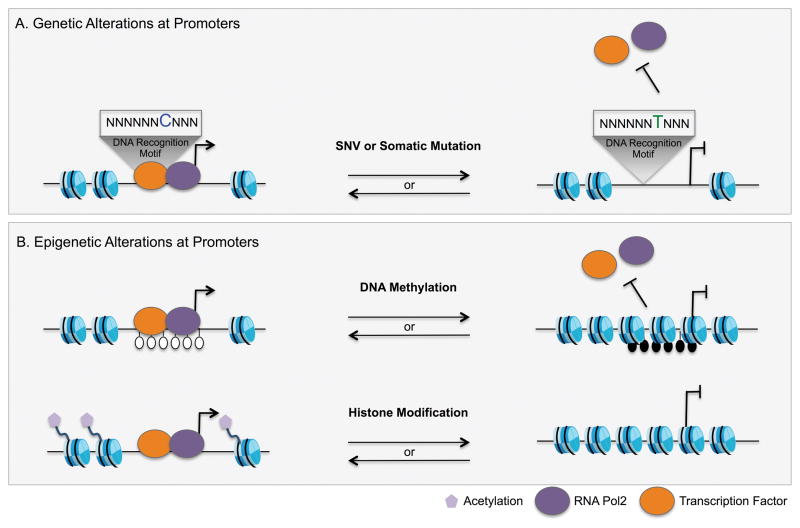
Figure 2. Genetic and epigenetic alterations are observed at gene promoters in cancer
A) Alterations in the sequences of promoters can modulate transcription factor binding affinity for the DNA to change the expression of the associated gene. This can arise through somatic mutations or inherited Single Nucleotide Variants (SNVs). B) Changes in the epigenetic identity, either based on changes in the DNA methylation or histone modifications was reported in cancer initiation and progression that influence promoter activity and results in altered gene expression in cancer.
Figure 3
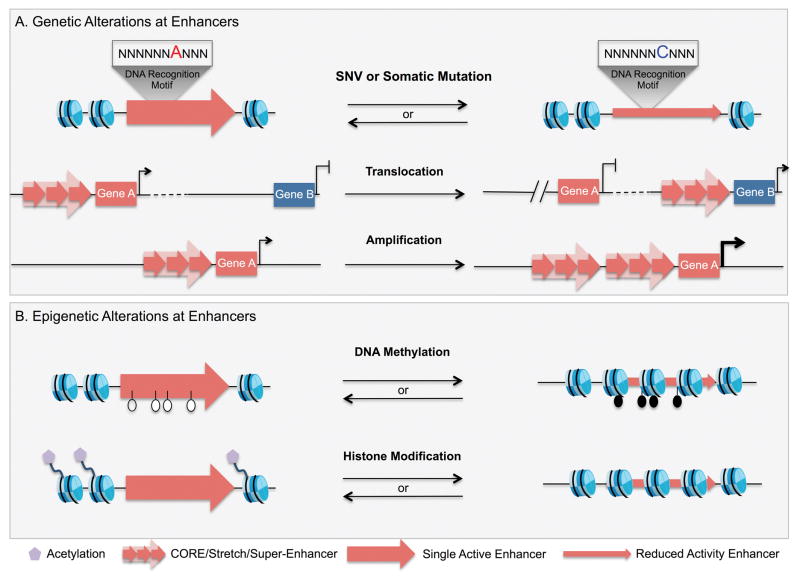
Figure 3. Genetic and epigenetic alterations are observed at enhancers in cancer
A) Single Nucleotide Variants (SNVs) and structural variations can alter enhancer activity. SNVs and somatic mutations observed in enhancers can modulate the activity of these regulatory elements by changing their affinity for transcription factors. Translocation of a region that acts as an enhancer that places it in proximity of an oncogene can drive its aberrant expression. Similarly, amplification of an active enhancer element that is associated with an oncogene can drive its over-expression and subsequently contribute to oncogenesis. These genetic alterations to enhancers ultimately serve to modulate expression of oncogenes or tumor-suppressor genes. B) Changes in the epigenetic identity have been reported at enhancers in cancer. Hyper- or hypomethylation of CpGs at enhancers affects the accessibility of the DNA to transcription factors. Changes in the composition of post-translational modifications to histone in enhancers are thought to impact transcription factor binding to the chromatin. Increased histone acetylation increases chromatin accessibility to favor transcription factor binding, whereas loss of acetylation decreases chromatin accessibility thereby modulating the activity of enhancer.
Figure 4
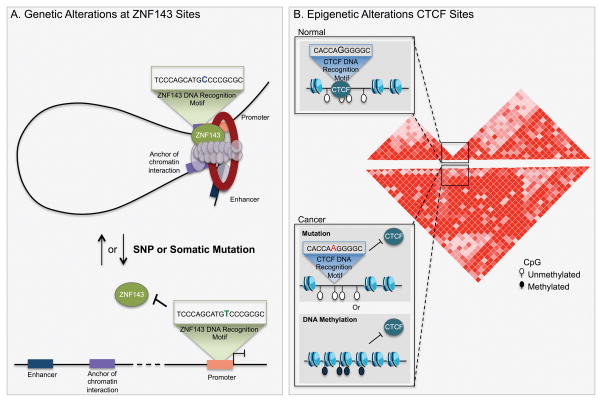
Figure 4. Genetic and epigenetic alterations targeting anchors of chromatin interactions
A) ZNF143 recognizes a DNA binding motif that is enriched at promoters. Genetic alteration in the consensus motif of ZNF143 can deter ZNF143 binding and result in the impaired chromatin interactions between promoters and enhancers and impact the expression of target genes. B) Anchors of chromatin interactions that define topologically associated domains (TADs) are bound by CTCF. Disruption of CTCF binding at these anchors can abrogate the formation of chromatin interactions to ultimately disrupt the three-dimensional organization of the genome in cancer. CTCF recognizes a 12 base-pair (bp) consensus motif mutated in various cancer types. The binding of CTCF to the DNA can also be compromised by DNA methylation, as reported in glioblastoma.

References

    1. Kellis M, Wold B, Snyder MP, Bernstein BE, Kundaje A, Marinov GK, et al. Defining functional DNA elements in the human genome. Proc Natl Acad Sci U S A. 2014;111:6131–8. - PMC - PubMed
    1. 1000 Genomes Project Consortium. Auton A, Brooks LD, Durbin RM, Garrison EP, Kang HM, et al. A global reference for human genetic variation. Nature. 2015;526:68–74. - PMC - PubMed
    1. Graur D, Zheng Y, Price N, Azevedo RBR, Zufall RA, Elhaik E. On the Immortality of Television Sets: “Function” in the Human Genome According to the Evolution-Free Gospel of ENCODE. Genome Biol Evol. 2013;5:578–90. - PMC - PubMed
    1. Treangen TJ, Salzberg SL. Repetitive DNA and next-generation sequencing: computational challenges and solutions. Nat Rev Genet. 2012;13:36–46. - PMC - PubMed
    1. Wittkopp PJ, Kalay G. Cis-regulatory elements: molecular mechanisms and evolutionary processes underlying divergence. Nat Rev Genet. 2012;13:59–69. - PubMed

Publication types

LinkOut - more resources