


Optimizing countershading camouflage
- PMID: 27807134
- PMCID: PMC5135326
- DOI: 10.1073/pnas.1611589113
Optimizing countershading camouflage
Abstract
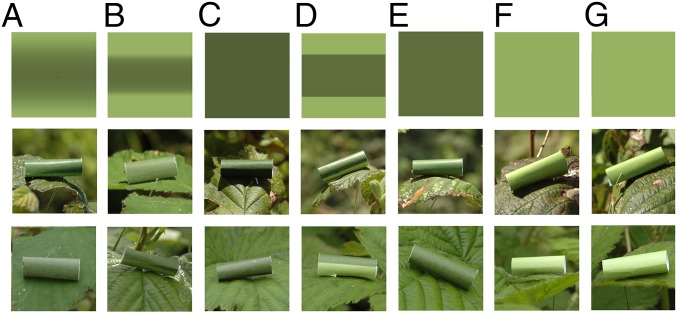
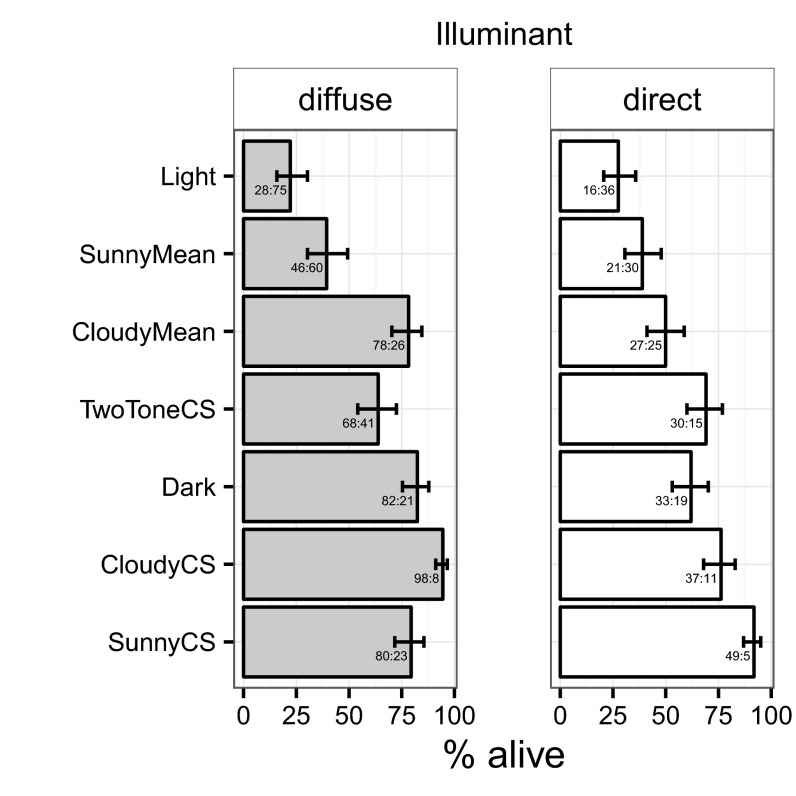
Countershading, the widespread tendency of animals to be darker on the side that receives strongest illumination, has classically been explained as an adaptation for camouflage: obliterating cues to 3D shape and enhancing background matching. However, there have only been two quantitative tests of whether the patterns observed in different species match the optimal shading to obliterate 3D cues, and no tests of whether optimal countershading actually improves concealment or survival. We use a mathematical model of the light field to predict the optimal countershading for concealment that is specific to the light environment and then test this prediction with correspondingly patterned model "caterpillars" exposed to avian predation in the field. We show that the optimal countershading is strongly illumination-dependent. A relatively sharp transition in surface patterning from dark to light is only optimal under direct solar illumination; if there is diffuse illumination from cloudy skies or shade, the pattern provides no advantage over homogeneous background-matching coloration. Conversely, a smoother gradation between dark and light is optimal under cloudy skies or shade. The demonstration of these illumination-dependent effects of different countershading patterns on predation risk strongly supports the comparative evidence showing that the type of countershading varies with light environment.
Keywords: animal coloration; camouflage; defensive coloration; shape perception; shape-from-shading.
Conflict of interest statement
The authors declare no conflict of interest.
Figures
References
-
- Allen WL, Baddeley R, Cuthill IC, Scott-Samuel NE. A quantitative test of the predicted relationship between countershading and lighting environment. Am Nat. 2012;180(6):762–776. - PubMed
-
- Caro T, Beeman K, Stankowich T, Whitehead H. The functional significance of colouration in cetaceans. Evol Ecol. 2011;25(6):1231–1245.
-
- Caro TM. The adaptive significance of coloration in mammals. Bioscience. 2005;55(2):125–136.
-
- Kamilar JM. Interspecific variation in primate countershading: Effects of activity pattern, body mass, and phylogeny. Int J Primatol. 2009;30(6):877–891.
Publication types
MeSH terms
Associated data
Grants and funding
LinkOut - more resources
Full Text Sources
Other Literature Sources
