


What explains gender inequalities in HIV/AIDS prevalence in sub-Saharan Africa? Evidence from the demographic and health surveys
- PMID: 27809824
- PMCID: PMC5095963
- DOI: 10.1186/s12889-016-3783-5
What explains gender inequalities in HIV/AIDS prevalence in sub-Saharan Africa? Evidence from the demographic and health surveys
Abstract
Background: Women are disproportionally affected by human immunodeficiency virus (HIV)/acquired immunodeficiency syndrome (AIDS) in sub-Saharan Africa (SSA). The determinants of gender inequality in HIV/AIDS may vary across countries and require country-specific interventions to address them. This study aimed to identify the socio-demographic and behavioral characteristics underlying gender inequalities in HIV/AIDS in 21 SSA countries.
Methods: We applied an extension of the Blinder-Oaxaca decomposition approach to data from Demographic and Health Surveys and AIDS Indicator Surveys to quantify the differences in HIV/AIDS prevalence between women and men attributable to socio-demographic factors, sexual behaviours, and awareness of HIV/AIDS. We decomposed gender inequalities into two components: the percentage attributable to different levels of the risk factors between women and men (the "composition effect") and the percentage attributable to risk factors having differential effects on HIV/AIDS prevalence in women and men (the "response effect").
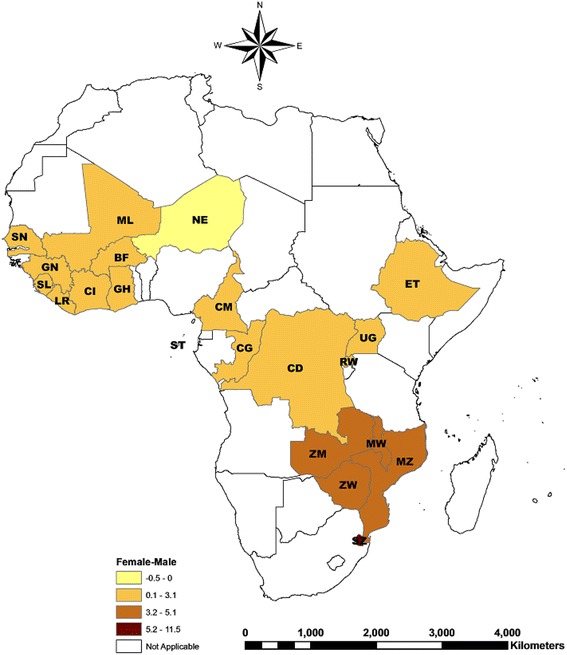
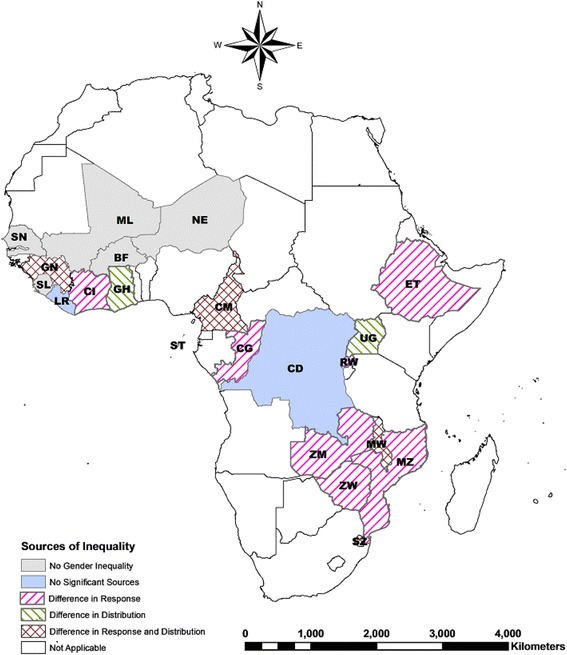
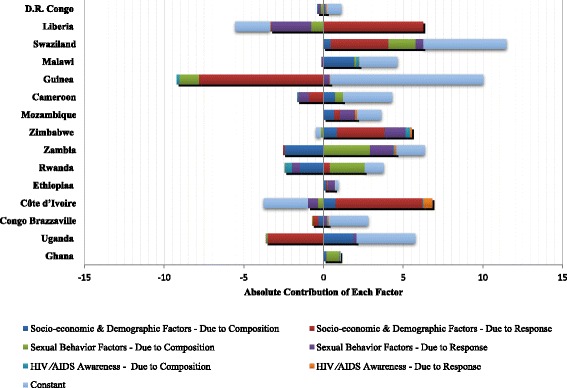
Results: Descriptive analyses showed that the difference between women and men in HIV/AIDS prevalence varied from a low of 0.68 % (P = 0.008) in Liberia to a high of 11.5 % (P < 0.001) in Swaziland. The decomposition analysis showed that 84 % (P < 0.001) and 92 % (P < 0.001) of the higher prevalence of HIV/AIDS among women in Uganda and Ghana, respectively, was explained by the different distributions of HIV/AIDS risk factors, particularly age at first sex between women and men. In the majority of countries, however, observed gender inequalities in HIV/AIDS were chiefly explained by differences in the responses to risk factors; the differential effects of age, marital status and occupation on prevalence of HIV/AIDS for women and men were among the significant contributors to this component. In Cameroon, Guinea, Malawi and Swaziland, a combination of the composition and response effects explained gender inequalities in HIV/AIDS prevalence.
Conclusions: The factors that explain gender inequality in HIV/AIDS in SSA vary by country, suggesting that country-specific interventions are needed. Unmeasured factors also contributed substantially to the difference in HIV/AIDS prevalence between women and men, highlighting the need for further study.
Keywords: Blinder-Oaxaca decomposition; Gender inequality; HIV/AIDS; Sub-Saharan Africa.
Figures
References
-
- ONUSIDA. Journée mondial SIDA. ONUSIDA; 2011. http://www.unaids.org/sites/default/files/media_asset/JC2216_WorldAIDSda.... [Accessed 20 Apr 2014].
-
- United Nations. The Millennium Development Goals Report 2011. New York: United Nation; 2011. http://www.un.org/millenniumgoals/pdf/(2011_E)%20MDG%20Report%202011_Boo....
-
- Pettifor AE, Rees HV, Kleinschmidt I, Steffenson AE, MacPhail C, Hlongwa-Madikizela L, Vermaak K, Padian NS. Young people's sexual health in South Africa: HIV prevalence and sexual behaviors from a nationally representative household survey. AIDS. 2005;19(14):1525–1534. doi: 10.1097/01.aids.0000183129.16830.06. - DOI - PubMed
-
- Carael M, Marais H, Polsky J, Mendoza A. Is there a gender Gap in the HIV response? Evaluating national HIV responses from the United Nations General Assembly special session on HIV/AIDS country reports. J Acquir Immune Defic Syndr. 2009;52(Supplement 2):S111–S118. doi: 10.1097/QAI.0b013e3181baeec2. - DOI - PubMed
MeSH terms
Grants and funding
LinkOut - more resources
Full Text Sources
Other Literature Sources
Medical
Research Materials
