Review
. 2016 Nov 4;48(11):e269.
doi: 10.1038/emm.2016.119.

ROS homeostasis and metabolism: a critical liaison for cancer therapy

Affiliations
Review

ROS homeostasis and metabolism: a critical liaison for cancer therapy

Jongdoo Kim et al. Exp Mol Med. .

Abstract

Evidence indicates that hypoxia and oxidative stress can control metabolic reprogramming of cancer cells and other cells in tumor microenvironments and that the reprogrammed metabolic pathways in cancer tissue can also alter the redox balance. Thus, important steps toward developing novel cancer therapy approaches would be to identify and modulate critical biochemical nodes that are deregulated in cancer metabolism and determine if the therapeutic efficiency can be influenced by changes in redox homeostasis in cancer tissues. In this review, we will explore the molecular mechanisms responsible for the metabolic reprogramming of tumor microenvironments, the functional modulation of which may disrupt the effects of or may be disrupted by redox homeostasis modulating cancer therapy.


Figures
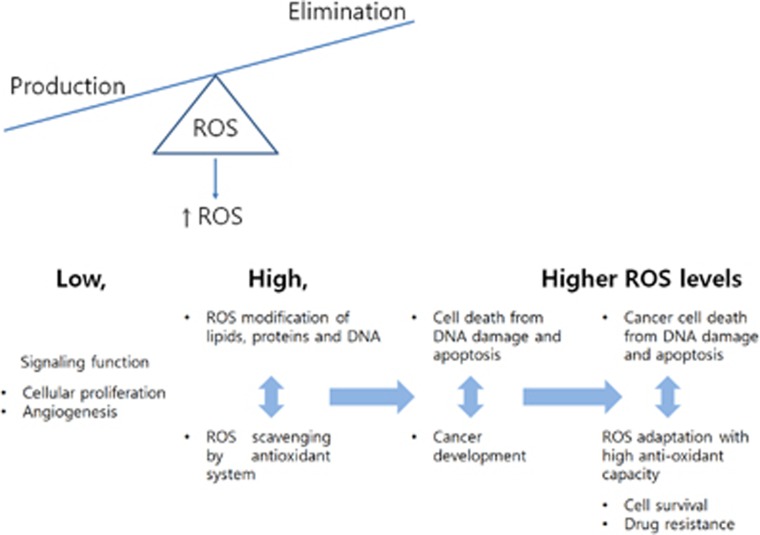
Figure 1
Figure 1
REDOX adaptation in cancer. Low levels of ROS can activate various signaling pathways to stimulate cell proliferation and survival. Adaptation to persistent and high levels of ROS can promote cancer development, survival of cancer cells and resistance to chemotherapeutics.
Figure 2
Figure 2
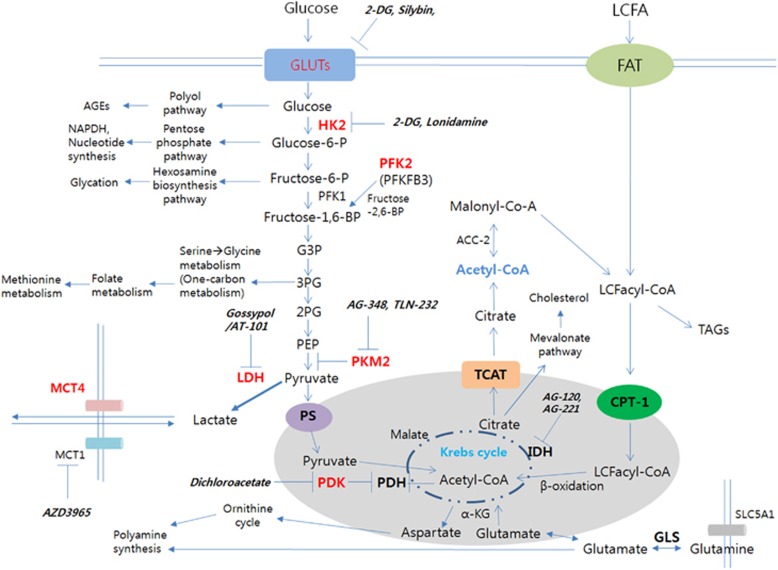
Metabolic targets at a glance. GLUTs, HK2, PFK2, PKM2, LDH, PDK and MCT4 shown in red can be upregulated from stabilization of HIF-1α. Representative inhibitors of metabolic nodes entering clinical trials are shown in bold. ACC, acetyl-CoA carboxylase; AGE, advanced glycation end product; CPT-1, carnitine palmitoyltransferase 1; FAT, fatty acid translocase; G3P, glyceraldehyde 3-phosphate; GLS, glutaminase; GLUT, glucose transporter; HK2, hexokinase 2; LCFA, long chain fatty acid; LCFacyl-CoAs, long chain fatty acyl-CoAs; MCT, monocarboxylate transporter; PEP, phosphoenolpyruvate; PDH, pyruvate dehydrogenase; PDK, pyruvate dehydrogenase kinase; PFK, phosphofructokinase; PS, pyruvate symporter; SLC5A1, sodium glucose co-transporter; TAG, triacylglyceride; TCAT, tricarboxylic acid transporter; 2-DG, 2-deoxyglucose; 2PG, 2-phosphoglycerate; 3PG, 3-phosphoglycerate.
Figure 3
Figure 3
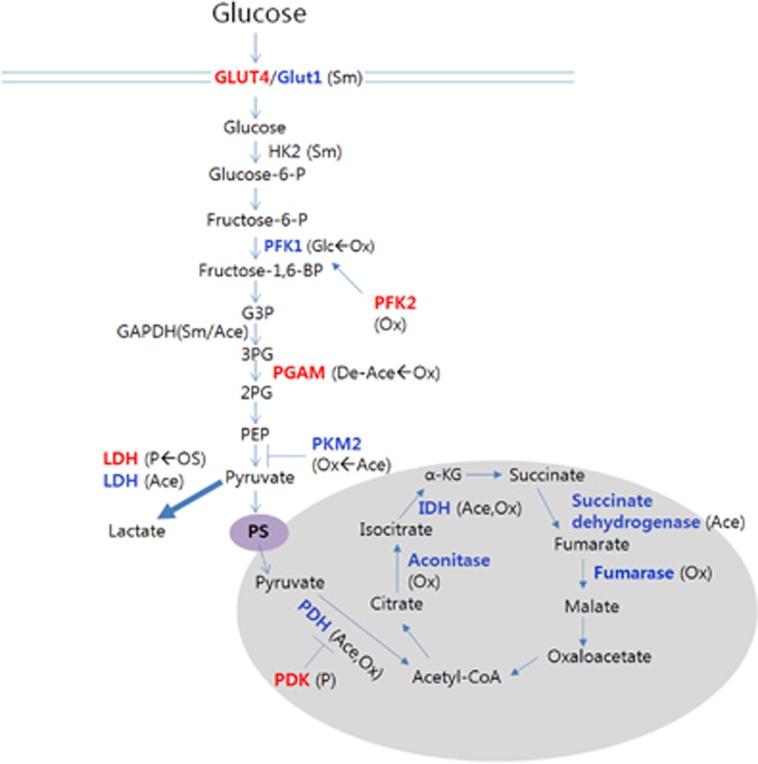
PTMs affecting enzymatic activities in glucose metabolism. Enzyme activities that are increased or decreased upon specific PTMs are shown in red and blue, respectively. We use arrows to indicate if any specific inducer is known for a PTM (inducer→resultant PTM). Whether sumoylation increases enzyme activities of HK2 and GAPDH is not clear; however, induced sumoylation promotes glycolysis, and the two enzymes are found to be SUMOylated(167). Ace, acetylation; De-Ace, deacetylation; Glc, glycosylation; OS, oxidative stress; Ox, oxidation; P, phosphorylation; PGAM, phosphoglycerate mutase; Sm, SUMOylation.

References

    1. Warburg O, Wind F, Negelein E. The metabolism of tumors in the body. J Gen Physiol 1927; 8: 519–530. - PMC - PubMed
    1. Lu J, Tan M, Cai Q. The Warburg effect in tumor progression: mitochondrial oxidative metabolism as an anti-metastasis mechanism. Cancer Lett 2015; 356: 156–164. - PMC - PubMed
    1. Coller HA. Is cancer a metabolic disease? Am J Pathol 2014; 184: 4–17. - PMC - PubMed
    1. Schnabel J. Targeting tumour metabolism. Nat Rev Drug Discov 2010; 9: 503–504. - PubMed
    1. Galluzzi L, Kepp O, Vander Heiden MG, Kroemer G. Metabolic targets for cancer therapy. Nat Rev Drug Discov 2013; 12: 829–846. - PubMed

Publication types

MeSH terms