Review
. 2017 Apr;74(8):1367-1378.
doi: 10.1007/s00018-016-2404-x. Epub 2016 Nov 3.

Cardiomyocyte proliferation in zebrafish and mammals: lessons for human disease

Affiliations
Review

Cardiomyocyte proliferation in zebrafish and mammals: lessons for human disease

Gianfranco Matrone et al. Cell Mol Life Sci. 2017 Apr.

Abstract

Cardiomyocytes proliferate profusely during early development and for a brief period after birth in mammals. Within a month after birth, this proliferative capability is dramatically reduced in mammals unlike lower vertebrates where it persists into adult life. The zebrafish, for example, retains the ability to regenerate the apex of the heart following resection by a mechanism predominantly driven by cardiomyocyte proliferation. Differences in proliferative capacity of cardiomyocytes in adulthood between mammals and lower vertebrates are closely liked to ontogenetic or phylogenetic factors. Elucidation of these factors has the potential to provide enormous benefits if they lead to the development of therapeutic strategies that facilitate cardiomyocyte proliferation. In this review, we highlight the differences between Mammalian and Zebrafish cardiomyocytes, which could explain at least in part the different proliferative capacities in these two species. We discuss the advantages of the zebrafish as a model of cardiomyocyte proliferation, particularly at the embryonic stage. We also identify a number of key molecular pathways with potential to reveal key steps in switching cardiomyocytes from a quiescent to a proliferative phenotype.

Keywords: Heart; Mammals; Proliferation; Regeneration; Zebrafish.


Conflict of interest statement

Authors declare to have no conflicts of interests.

Figures
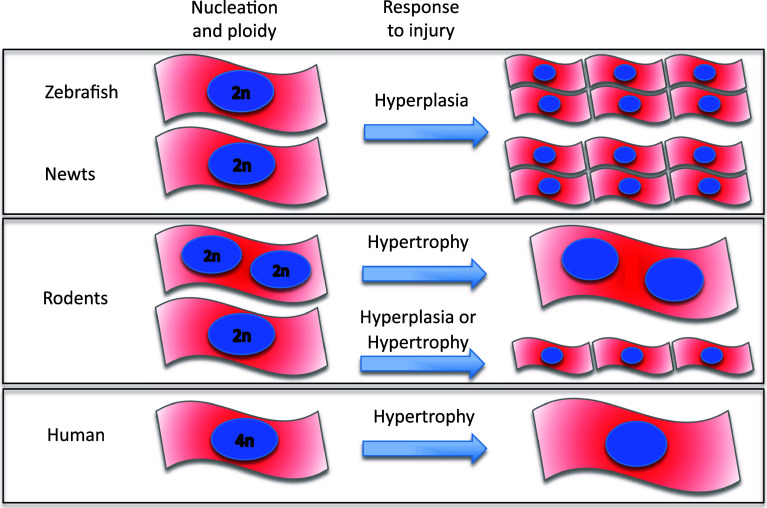
Fig. 1
Fig. 1
Cardiomyocyte cellular structure across species. Zebrafish and newt are mostly mononucleated and diploid [59, 154]; an organization that seems to favour a higher proliferative response to injury. Rodents show either mono- or bi-nucleated diploid cardiomyocytes [38]. Following stress or injury, mostly, these cardiomyocytes respond with hypertrophy; however, only those mononucleated cells appear to initiate proliferation. Human cardiomyocytes are mostly mononucleated and tetraploids. Limited data in young humans up to 20 years old, suggest that cardiomyocytes have some proliferative capacity [51, 52]. However, in later life, hypertrophy is the predominant response to injury in human
Fig. 2
Fig. 2
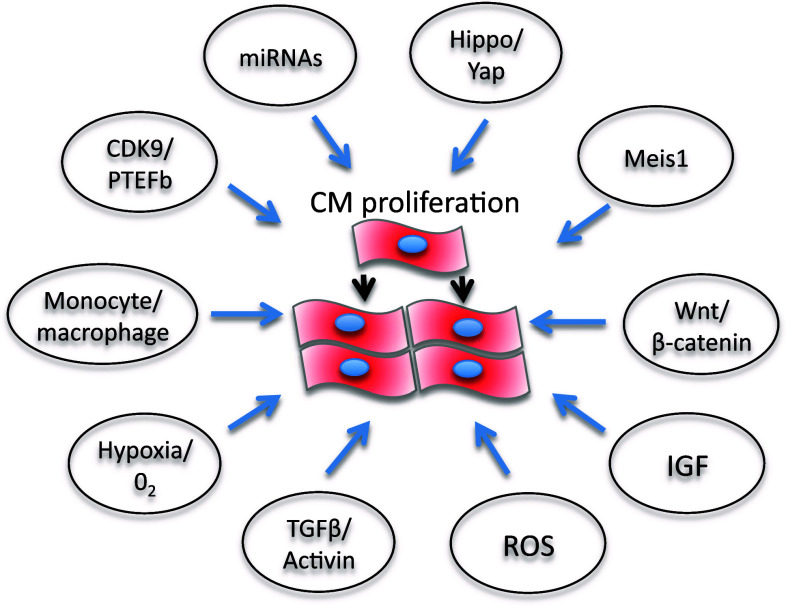
Schematic representation of possible molecular pathways that could be targeted therapeutically to promote cardiomyocyte proliferation in mammals (see text)

References

    1. Go AS, Mozaffarian D, Roger VL, Benjamin EJ, et al. Heart disease and stroke statistics–2013 update: a report from the American Heart Association. Circulation. 2013;127(1):e6–e245. doi: 10.1161/CIR.0b013e31828124ad. - DOI - PMC - PubMed
    1. Berenji K, Drazner MH, Rothermel BA, Hill JA. Does load-induced ventricular hypertrophy progress to systolic heart failure? Am J Physiol Heart Circ Physiol. 2005;289(1):H8–H16. doi: 10.1152/ajpheart.01303.2004. - DOI - PubMed
    1. Haider AW, Larson MG, Benjamin EJ, Levy D. Increased left ventricular mass and hypertrophy are associated with increased risk for sudden death. J Am Coll Cardiol. 1998;32(5):1454–1459. doi: 10.1016/S0735-1097(98)00407-0. - DOI - PubMed
    1. Lips DJ, deWindt LJ, van Kraaij DJ, Doevendans PA. Molecular determinants of myocardial hypertrophy and failure: alternative pathways for beneficial and maladaptive hypertrophy. Eur Heart J. 2003;24(10):883–896. doi: 10.1016/S0195-668X(02)00829-1. - DOI - PubMed
    1. Heineke J, Molkentin JD. Regulation of cardiac hypertrophy by intracellular signalling pathways. Nat Rev Mol Cell Biol. 2006;7(8):589–600. doi: 10.1038/nrm1983. - DOI - PubMed

Publication types

MeSH terms

LinkOut - more resources