doi: 10.1007/978-1-4939-3743-1_3.
Primer on the Gene Ontology
Affiliations
- PMID: 27812933
- PMCID: PMC6377150
- DOI: 10.1007/978-1-4939-3743-1_3
Item in Clipboard
Primer on the Gene Ontology
Methods Mol Biol.
2017.
Abstract
The Gene Ontology (GO) project is the largest resource for cataloguing gene function. The combination of solid conceptual underpinnings and a practical set of features have made the GO a widely adopted resource in the research community and an essential resource for data analysis. In this chapter, we provide a concise primer for all users of the GO. We briefly introduce the structure of the ontology and explain how to interpret annotations associated with the GO.
Keywords: Annotation evidence; Annotations; Evidence codes; Function; GO files; Gene Ontology structure; Gene association file (GAF); Vocabulary.
Figures
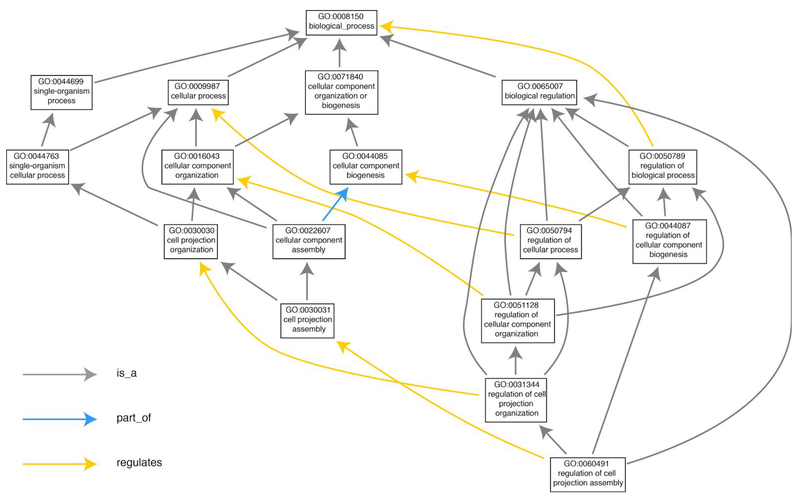
The structure of the Gene Ontology (GO) is illustrated on a subset of the paths of the term “regulation of cell projection assembly,” GO:0060491, to its root term. The GO is a directed graph with terms as nodes and relationships as edges; these relationships are either is_a, part_of, has_part, or regulates. In its basic representation, there should be no cycles in this graph, and we can therefore establish parent (more general) and child (more specific) terms (see Chap. XX for more details on the different representations; cross-reference to Moni’s chapter). Note that it is possible for a term to have multiple parents. This figure is based on the visualization available from the AmiGO browser, generated on November 6, 2015. (3).
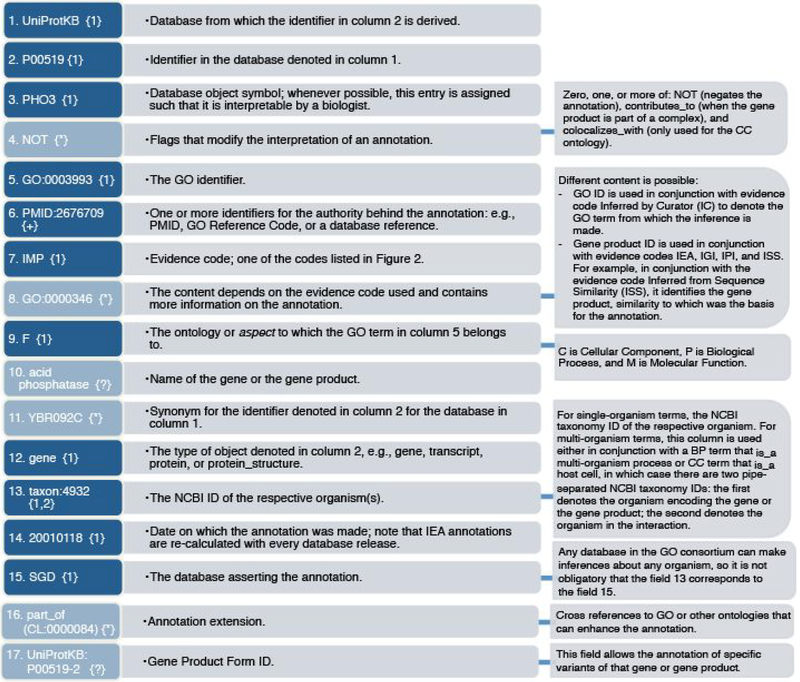
In the GAF file, each row represents an annotation, consisting of up to 17 tab-delimited fields (or columns). This figure describes these fields in the order in which they are found in the GAF file. Light blue colour denotes non-mandatory fields, and these are allowed to be empty in the GAF file. The cardinality—the number of elements in the field — is denoted with the symbol(s) in curly brackets: {?} indicates cardinality of zero or one; {*} indicates that any cardinality is allowed; {+} indicates cardinality of one or more; {1} indicates that cardinality is exactly one; {1,2} indicates that cardinality is either one or two. When cardinality is greater than 1, elements in the field are separated with a pipe character or with a comma; the former indicates ‘OR’ and the latter indicates ‘AND’. The GO term assigned in column 5 is always the most specific GO term possible.
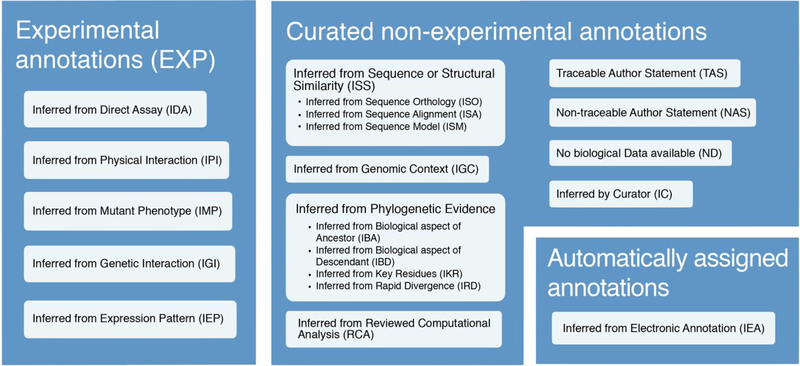
The type of information supporting annotations is recorded with Evidence Codes, which can be grouped into three main categories: experimental evidence codes, curated non-experimental annotations, and automatically assigned annotations. The obsolete evidence code NR (Not Recorded) is not included in the figure. Documentation about the different types of automatically assigned annotations can be found at http://www.geneontology.org/doc/GO.references .
References
Publication types
MeSH terms
Substances
Grants and funding
LinkOut - more resources
Full Text Sources
Other Literature Sources