. 2017:1446:245-259.
doi: 10.1007/978-1-4939-3743-1_18.

The Evidence and Conclusion Ontology (ECO): Supporting GO Annotations

Affiliations

The Evidence and Conclusion Ontology (ECO): Supporting GO Annotations

Marcus C Chibucos et al. Methods Mol Biol. 2017.

Abstract

The Evidence and Conclusion Ontology (ECO) is a community resource for describing the various types of evidence that are generated during the course of a scientific study and which are typically used to support assertions made by researchers. ECO describes multiple evidence types, including evidence resulting from experimental (i.e., wet lab) techniques, evidence arising from computational methods, statements made by authors (whether or not supported by evidence), and inferences drawn by researchers curating the literature. In addition to summarizing the evidence that supports a particular assertion, ECO also offers a means to document whether a computer or a human performed the process of making the annotation. Incorporating ECO into an annotation system makes it possible to leverage the structure of the ontology such that associated data can be grouped hierarchically, users can select data associated with particular evidence types, and quality control pipelines can be optimized. Today, over 30 resources, including the Gene Ontology, use the Evidence and Conclusion Ontology to represent both evidence and how annotations are made.

Keywords: Annotation; Biocuration; Conclusion; Confidence; ECO; Evidence; Experiment; Inference; Literature curation; Quality control.


Figures
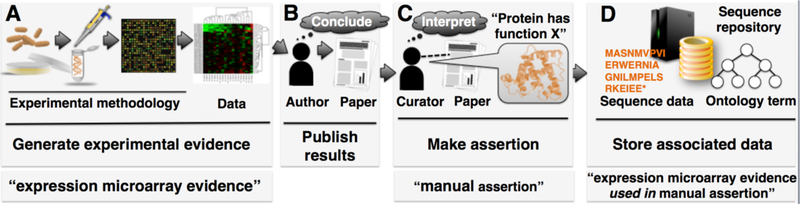
Figure 1.
Figure 1.. Representing experimental methods and conclusions in a biological database.
(A) An experiment is performed that generates data. (B) A researcher interprets methods & data, and draws conclusions that are published in a scientific journal. (C) A biological curator reads that paper, interprets the results presented therein, and makes an assertion. (D) The assertion is represented by an ontology term and stored along with the protein sequence and other data at a biological database. (General evidence and assertion summaries are depicted at the bottom.)
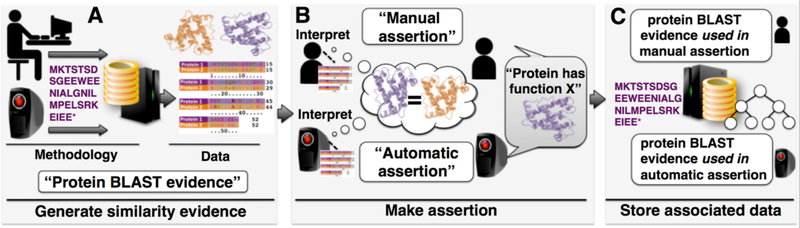
Figure 2.
Figure 2.. Computational evidence and assertion.
(A) A human or computer performs an analysis, for example comparing the sequence of a protein of unknown function to sequences at a database. A protein of known function is returned as a hit. (B) The alignment is analyzed and the protein sequences share enough similarity to be considered homologs (related through common evolutionary descent). The query protein is assigned the same function as the database protein. (C) This information is stored at a sequence repository along with other data and metadata. (Text in white boxes depicts evidence and assertion methods used in this process.)
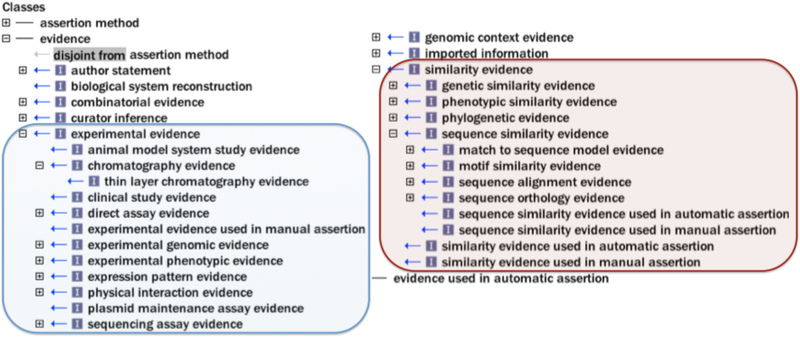
Figure 3.
Figure 3.. High-level Evidence Ontology (ECO) classes.
ECO comprises two root nodes, “evidence” and “assertion method”. “Experimental evidence” and selected subclasses are highlighted in blue. “Similarity evidence” and selected subclasses are highlighted in red.

References

    1. Gaudet P, Arighi C, Bastian F, et al. (2012) Recent advances in biocuration: meeting report from the Fifth International Biocuration Conference. Database (Oxford), 2012, bas036. - PMC - PubMed
    1. Burge S, Attwood TK, Bateman A, et al. (2012) Biocurators and biocuration: surveying the 21st century challenges. Database (Oxford), 2012, bar059. - PMC - PubMed
    1. Balakrishnan R, Harris MA, Huntley R, Van Auken K, Cherry JM (2013) A guide to best practices for Gene Ontology (GO) manual annotation. Database (Oxford), 2013, bat054. - PMC - PubMed
    1. Arighi CN, Carterette B, Cohen KB, et al. (2013) An overview of the BioCreative 2012 Workshop Track III: interactive text mining task. Database (Oxford), 2013, bas056. - PMC - PubMed
    1. Altman RB, Bergman CM, Blake J, et al. (2008) Text mining for biology--the way forward: opinions from leading scientists. Genome Biol, 9 Suppl 2, S7. - PMC - PubMed

Publication types

LinkOut - more resources