


Modelling the spatial and seasonal distribution of suitable habitats of schistosomiasis intermediate host snails using Maxent in Ndumo area, KwaZulu-Natal Province, South Africa
- PMID: 27814746
- PMCID: PMC5096326
- DOI: 10.1186/s13071-016-1834-5
Modelling the spatial and seasonal distribution of suitable habitats of schistosomiasis intermediate host snails using Maxent in Ndumo area, KwaZulu-Natal Province, South Africa
Abstract
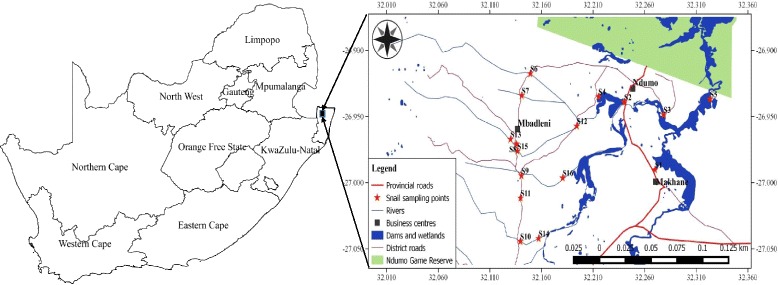
Background: Schistosomiasis is a snail-borne disease endemic in sub-Saharan Africa transmitted by freshwater snails. The distribution of schistosomiasis coincides with that of the intermediate hosts as determined by climatic and environmental factors. The aim of this paper was to model the spatial and seasonal distribution of suitable habitats for Bulinus globosus and Biomphalaria pfeifferi snail species (intermediate hosts for Schistosoma haematobium and Schistosoma mansoni, respectively) in the Ndumo area of uMkhanyakude district, South Africa.
Methods: Maximum Entropy (Maxent) modelling technique was used to predict the distribution of suitable habitats for B. globosus and B. pfeifferi using presence-only datasets with ≥ 5 and ≤ 12 sampling points in different seasons. Precipitation, maximum and minimum temperatures, Normalised Difference Vegetation Index (NDVI), Normalised Difference Water Index (NDWI), pH, slope and Enhanced Vegetation Index (EVI) were the background variables in the Maxent models. The models were validated using the area under the curve (AUC) and omission rate.
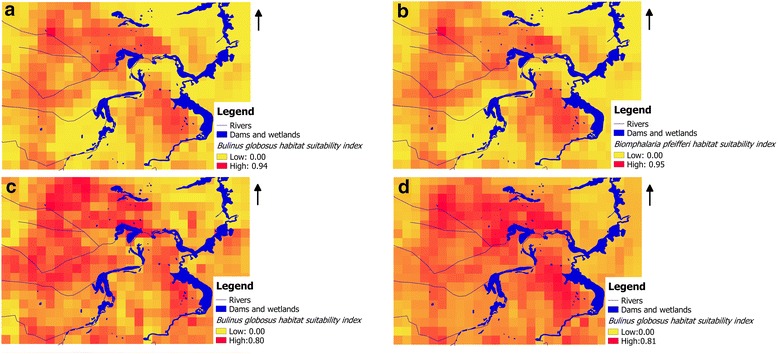
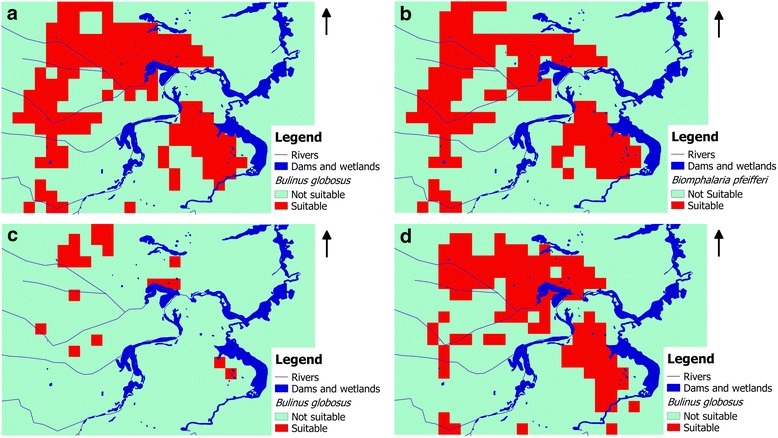
Results: The predicted suitable habitats for intermediate snail hosts varied with seasons. The AUC for models in all seasons ranged from 0.71 to 1 and the prediction rates were between 0.8 and 0.9. Although B. globosus was found at more localities in the Ndumo area, there was also evidence of cohabiting with B. pfiefferi at some of the locations. NDWI had significant contribution to the models in all seasons.
Conclusion: The Maxent model is robust in snail habitat suitability modelling even with small dataset of presence-only sampling sites. Application of the methods and design used in this study may be useful in developing a control and management programme for schistosomiasis in the Ndumo area.
Keywords: Maxent; Predictive modelling; Schistosomiasis; Snail-borne disease modelling.
Figures

References
-
- Moser W, Greter H, Schindler C, Allan F, Ngandolo BNR, Moto DD, et al. The spatial and seasonal distribution of Bulinus truncatus, Bulinus forskalii and Biomphalaria pfeifferi, the intermediate host snails of schistosomiasis, in N’Djamena, Chad. Geospat Health. 2014;9(1):109–118. doi: 10.4081/gh.2014.9. - DOI - PubMed
-
- Kazibwe F, Makanga B, Rubaire-Akiiki C, Ouma J, Kariuki C, Kabatereine NB, et al. Ecology of Biomphalaria (Gastropoda: Planorbidae) in Lake Albert, Western Uganda: snail distributions, infection with schistosomes and temporal associations with environmental dynamics. Hydrobiologia. 2006;568(1):433–444. doi: 10.1007/s10750-006-0224-y. - DOI
-
- World Health Organisation. WHO schistosomiasis fact sheet;2014; 2015.
Publication types
MeSH terms
LinkOut - more resources
Full Text Sources
Other Literature Sources
Research Materials
