


Aedes albopictus and Aedes japonicus - two invasive mosquito species with different temperature niches in Europe
- PMID: 27814747
- PMCID: PMC5097377
- DOI: 10.1186/s13071-016-1853-2
Aedes albopictus and Aedes japonicus - two invasive mosquito species with different temperature niches in Europe
Erratum in
-
Erratum to: Aedes albopictus and Aedes japonicus - two invasive mosquito species with different temperature niches in Europe.Parasit Vectors. 2016 Dec 6;9(1):629. doi: 10.1186/s13071-016-1893-7. Parasit Vectors. 2016. PMID: 27919276 Free PMC article. No abstract available.
Abstract
Background: Aedes albopictus and Ae. japonicus are two of the most widespread invasive mosquito species that have recently become established in western Europe. Both species are associated with the transmission of a number of serious diseases and are projected to continue their spread in Europe.
Methods: In the present study, we modelled the habitat suitability for both species under current and future climatic conditions by means of an Ensemble forecasting approach. We additionally compared the modelled MAXENT niches of Ae. albopictus and Ae. japonicus regarding temperature and precipitation requirements.
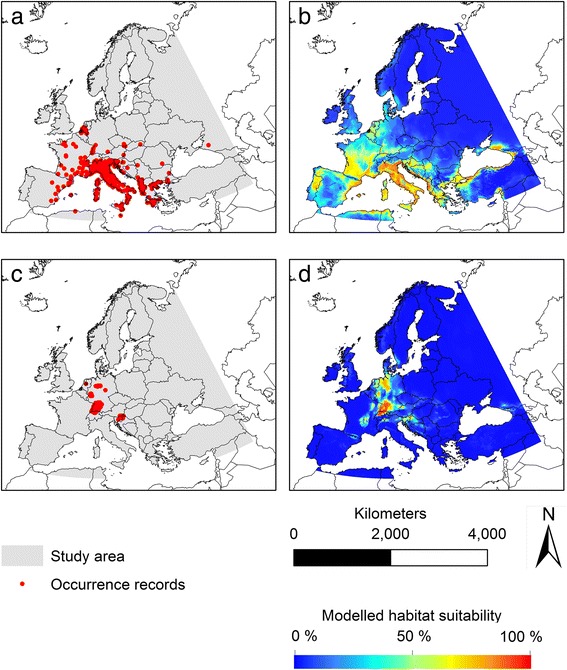
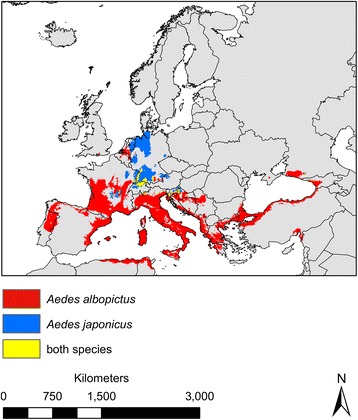
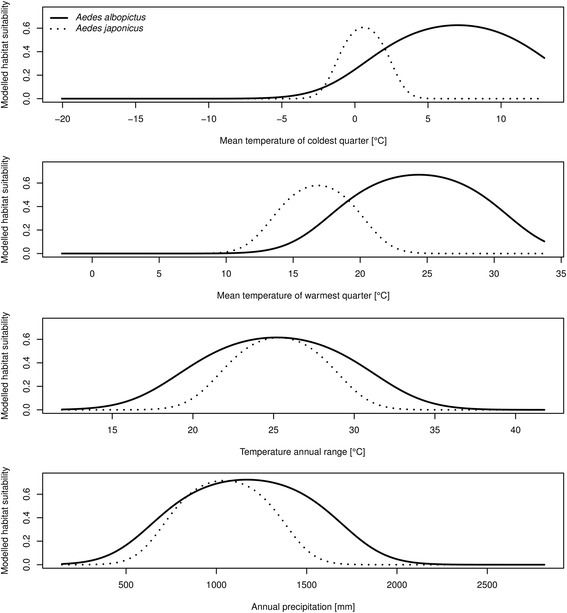
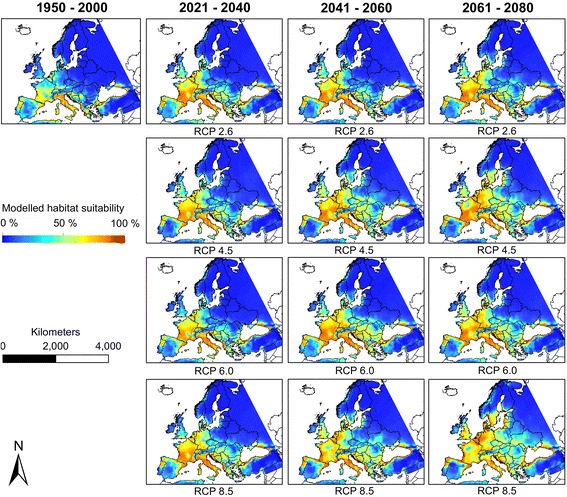
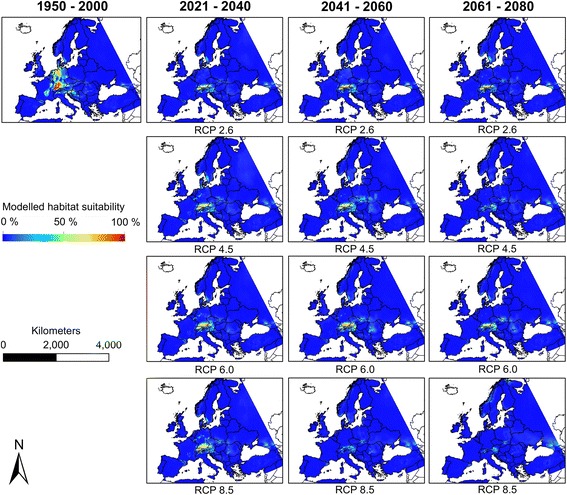
Results: Both species were modelled to find suitable habitat conditions in distinct areas within Europe: Ae. albopictus within the Mediterranean regions in southern Europe, Ae. japonicus within the more temperate regions of central Europe. Only in few regions, suitable habitat conditions were projected to overlap for both species. Whereas Ae. albopictus is projected to be generally promoted by climate change in Europe, the area modelled to be climatically suitable for Ae. japonicus is projected to decrease under climate change. This projection of range reduction under climate change relies on the assumption that Ae. japonicus is not able to adapt to warmer climatic conditions. The modelled MAXENT temperature niches of Ae. japonicus were found to be narrower with an optimum at lower temperatures compared to the niches of Ae. albopictus.
Conclusions: Species distribution models identifying areas with high habitat suitability can help improving monitoring programmes for invasive species currently in place. However, as mosquito species are known to be able to adapt to new environmental conditions within the invasion range quickly, niche evolution of invasive mosquito species should be closely followed upon in future studies.
Keywords: Asian bush mosquito; Asian tiger mosquito; Climate change; Invasive species; Species distribution modelling.
Figures
References
-
- Guisan A, Zimmermann NE. Predictive habitat distribution models in ecology. Ecol Model. 2009;135(2):147–86.
-
- Paupy C, Delatte H, Bagny L, Corbel V, Fontenille D. Aedes albopictus, an arbovirus vector: from the darkness to the light. Microbes Infect. 2009;11(14–15):1177–85. - PubMed
Publication types
MeSH terms
LinkOut - more resources
Full Text Sources
Other Literature Sources
