Review
. 2016 Nov;13(6):711-721.
doi: 10.1038/cmi.2016.58. Epub 2016 Oct 31.

Cellular and molecular regulation of innate inflammatory responses

Affiliations
Review

Cellular and molecular regulation of innate inflammatory responses

Juan Liu et al. Cell Mol Immunol. 2016 Nov.

Abstract

Innate sensing of pathogens by pattern-recognition receptors (PRRs) plays essential roles in the innate discrimination between self and non-self components, leading to the generation of innate immune defense and inflammatory responses. The initiation, activation and resolution of innate inflammatory response are mediated by a complex network of interactions among the numerous cellular and molecular components of immune and non-immune system. While a controlled and beneficial innate inflammatory response is critical for the elimination of pathogens and maintenance of tissue homeostasis, dysregulated or sustained inflammation leads to pathological conditions such as chronic infection, inflammatory autoimmune diseases. In this review, we discuss some of the recent advances in our understanding of the cellular and molecular mechanisms for the establishment and regulation of innate immunity and inflammatory responses.


Figures
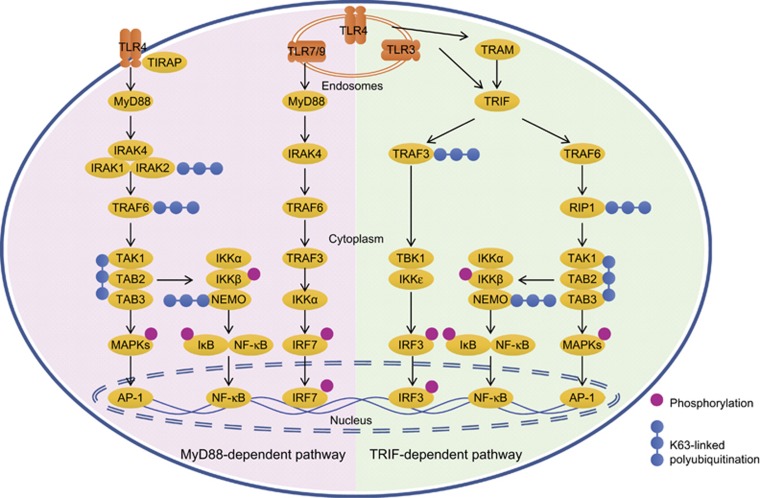
Figure 1
Figure 1
Schematic of signaling pathways of TLRs. Most TLRs with the exception of TLR3 initiate a MyD88-dependent pathway as shown in the left part. With the cooperation of Mal/TIRAP, TLR4 induces the MyD88–IRAK4 complex to recruit IRAK1 and IRAK2, which then interact with and induces K63-linked polyubiquitination of TRAF6 and TAK1/TAB2/TAB3 complexes. Activated TAK1 subsequently induce phosphorylation and activation of MAPKs and the IKK complex consisting of IKKα, IKKβ and K63-polyubiquitinated NEMO, finally promoting activation of AP-1 and NF-κB, and production of proinflammatory cytokines. TLR7 and TLR9 induces MyD88 activation to recruit signaling complex formed by IRAK4, TRAF6 and TRAF3, which induces phosphorylation and activation of IRF7 and production of type I IFN. Meanwhile, TLR3 and internalized TLR4 activate TRIF-dependent signaling as shown in the right part. TRAM is needed for the interaction between TLR4 and TRIF. TRIF recruits TRAF6 and RIP1, which induces downstream activation MAP kinases and NF-κB, similar to the MyD88-dependent pathway. TRIF also activates that TRAF3/TBK1/IKKɛ axis to promote IRF3-dependent expression of type I IFN.
Figure 2
Figure 2
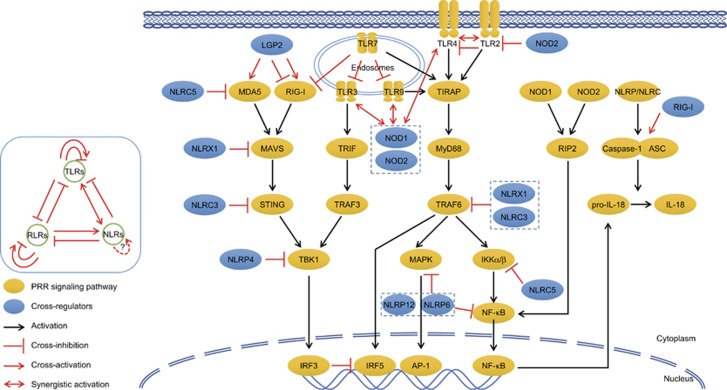
Interplay across TLR, RLR and NLR signaling pathways. TLR, RLR and NLR-triggered signaling pathways display complex interplay with each other. ① Crosstalk inside PRR family: LGP2 both positively and negatively regulate MDA5 and RIG-I signaling, so do TLR2 for TLR4. ② TLR-mediated cross-regulation: TLR7 agonists inhibit TLR3, TLR9 and RIG-I signaling; TLR3/4/9 synergize with NOD1/2 for amplified innate immune responses. ③ RLR-mediated cross-regulation: RIG-I signaling inhibits TLR signaling via competitive occupancy at Il12 promoter by IRF5 over IRF3, but promotes NLRP3 inflammasome activation via interacting with ASC. ④ NLR-mediated cross-regulation: NOD2 tolerates TLR2 signaling for prevention of colitis. NLRX1, NLRC3/5, NLRP4/6/12 suppress TLR and RLR signaling via targeting distinct molecules.

References

    1. Kotas ME, Medzhitov R. Homeostasis, inflammation, and disease susceptibility. Cell 2015; 160: 816–827. - PMC - PubMed
    1. Takeuchi O, Akira S. Pattern recognition receptors and inflammation. Cell 2010; 140: 805–820. - PubMed
    1. Hunter CA, Jones SA. IL-6 as a keystone cytokine in health and disease. Nat Immunol 2015; 16: 448–457. - PubMed
    1. Wack A, Terczyńska-Dyla E, Hartmann R. Guarding the frontiers: the biology of type III interferons. Nat Immunol 2015; 16: 802–809. - PMC - PubMed
    1. Iwasaki A, Medzhitov R. Control of adaptive immunity by the innate immune system. Nat Immunol 2015; 16: 343–353. - PMC - PubMed

Publication types

LinkOut - more resources