


doi: 10.1038/nmeth.4067.
Epub 2016 Nov 7.
CHARMM36m: an improved force field for folded and intrinsically disordered proteins
Affiliations
- PMID: 27819658
- PMCID: PMC5199616
- DOI: 10.1038/nmeth.4067
Item in Clipboard
CHARMM36m: an improved force field for folded and intrinsically disordered proteins
Nat Methods.
2017 Jan.
Abstract
The all-atom additive CHARMM36 protein force field is widely used in molecular modeling and simulations. We present its refinement, CHARMM36m (http://mackerell.umaryland.edu/charmm_ff.shtml), with improved accuracy in generating polypeptide backbone conformational ensembles for intrinsically disordered peptides and proteins.
Figures
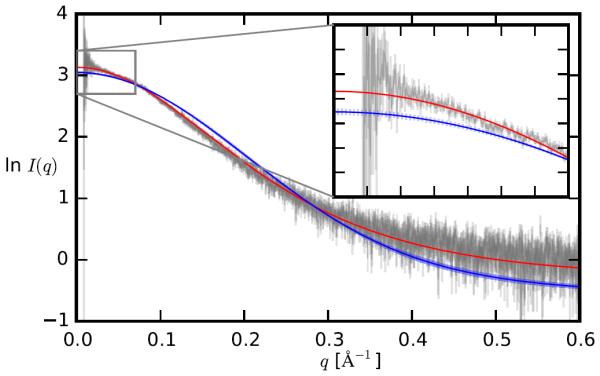
SAXS profiles of the RS peptide. Ensemble-averaged scattering curves from the C36 simulation (blue) and the C36m simulation (red) are plotted, with the experimental curve shown with error in gray. The nonweighted error function χ2 as defined in Ref. was 0.63 using C36, and 0.12 using C36m. The error bars represent the standard deviation computed by dividing the conformational ensembles in two, and computing the average SAXS profile for each half separately. For the C36m ensemble, the error bars are smaller than the line width.
References
-
- Brucale M, Schuler B, Samorì B. Single-Molecule Studies of Intrinsically Disordered Proteins. Chemical Reviews. 2014;114:3281–3317. - PubMed
-
- Mackerell AD. Empirical force fields for biological macromolecules: Overview and issues. Journal of Computational Chemistry. 2004;25:1584–1604. - PubMed
-
- Rauscher S, et al. Structural Ensembles of Intrinsically Disordered Proteins Depend Strongly on Force Field: A Comparison to Experiment. Journal of Chemical Theory and Computation. 2015;11:5513–5524. - PubMed
Methods-only References
-
- Vorobyov IV, Anisimov VM, MacKerell AD. Polarizable Empirical Force Field for Alkanes Based on the Classical Drude Oscillator Model. The Journal of Physical Chemistry B. 2005;109:18988–18999. - PubMed
-
- Lovell SC, et al. Structure validation by Cα geometry: φ,ψ and Cβ deviation. Proteins: Structure, Function, and Bioinformatics. 2003;50:437–450. - PubMed
-
- Fitzkee NC, Fleming PJ, Rose GD. The Protein Coil Library: A structural database of nonhelix, nonstrand fragments derived from the PDB. Proteins: Structure, Function, and Bioinformatics. 2005;58:852–854. - PubMed
-
- Mukrasch MD, et al. Highly Populated Turn Conformations in Natively Unfolded Tau Protein Identified from Residual Dipolar Couplings and Molecular Simulation. Journal of the American Chemical Society. 2007;129:5235–5243. - PubMed
Publication types
MeSH terms
Substances
Grants and funding
LinkOut - more resources
Full Text Sources
Other Literature Sources
